Water damage restoration in a mid-century Tempe, AZ home with vintage plumbing
RestoPros

Water Damage Restoration in Tempe, AZ — Local, and On Call 24/7

We're based in Tempe, which means when a galvanized line finally gives out in Maple-Ash or a tenant near ASU reports a ceiling stain that's been growing for a week, you're calling the closest certified crew in the Valley — not a franchise dispatcher three cities away. Emergency arrivals here typically run under an hour. Free inspection, verified drying, direct insurance billing, and reporting that works for owners, landlords, and HOA boards.

Google
starstarstarstarstar
5.0 Google Rating
verified

Licensed & Certified

IICRC Certified Technicians

shield

Fully Insured

Bonded for Your Protection

location_on

Local East Valley Pros

Mesa, Chandler, Gilbert, Tempe & Queen Creek

Tempe has the oldest housing stock in the East Valley, and age is the thread running through nearly every water loss we restore here. Homes in Maple-Ash, Holdeman, and University Park were built when galvanized steel supply lines and cast-iron drains were standard. Galvanized pipe corrodes internally until it either restricts to a trickle or splits; cast-iron drains crack and separate at the joints. Neither fails politely, and both are now well past the service life anyone designed for.

The second Tempe factor is who lives in the house. This is a rental-dense city — thousands of homes, condos, and apartments around ASU are tenant-occupied, often with out-of-state owners. Water damage in a rental gets reported later than water damage in an owner-occupied home, sometimes by days, and 'later' is the single most expensive variable in this business. Multi-unit buildings add their own problem: a failure in an upstairs unit becomes three owners' and one HOA's problem simultaneously.

Third: flat and low-slope roofs. Mid-century Tempe is full of them, and they pond monsoon rain until it finds a seam. We restore all of it — extraction, moisture mapping, verified structural drying, mold prevention, and reconstruction — with documentation built for whoever needs it: homeowner, landlord, property manager, adjuster, or condo board.

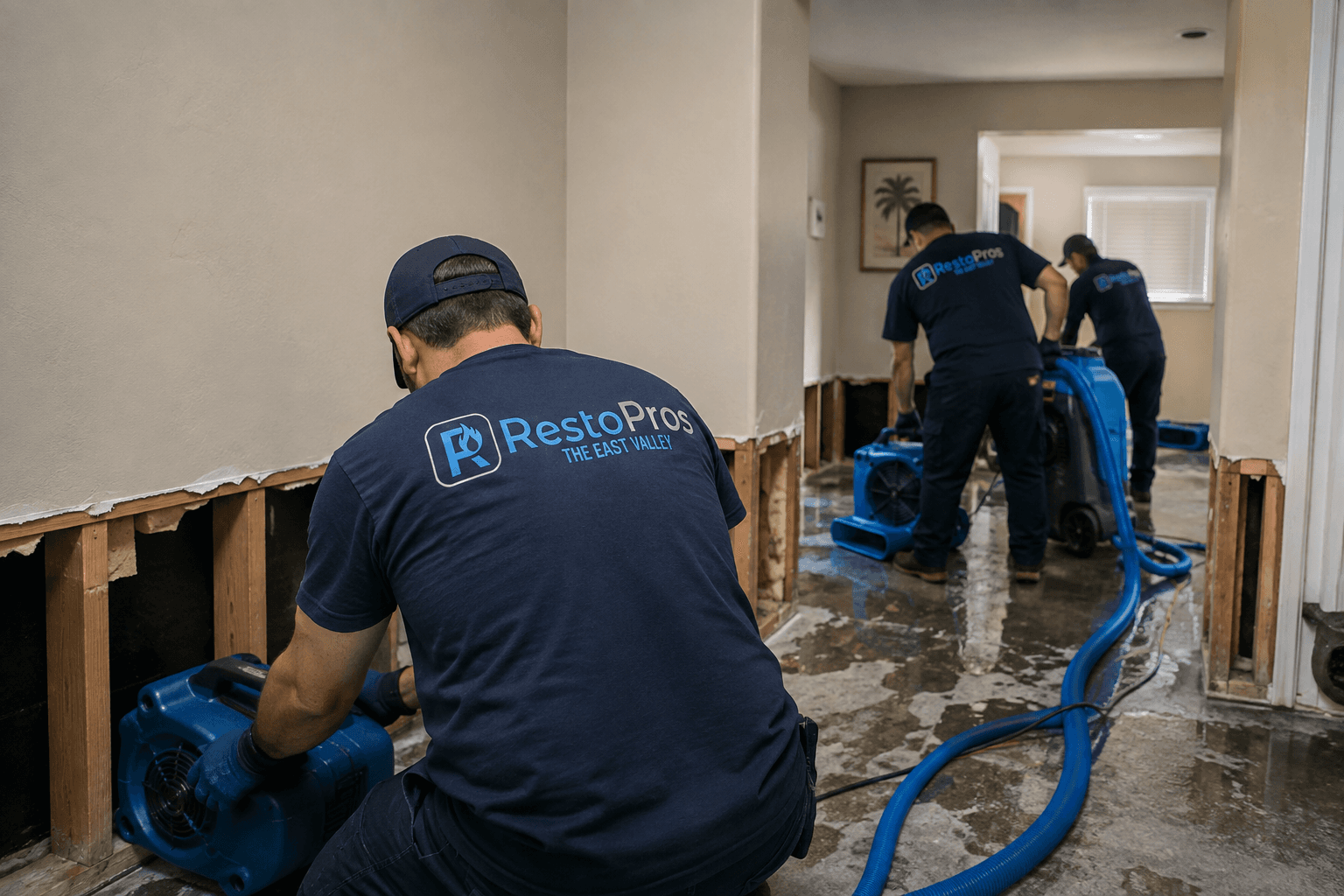
Why Tempe Properties Flood

Older systems, dense rentals, and mid-century roof design — Tempe's water damage causes look different from the newer suburbs around it.

Galvanized supply lines at end of life

Pre-1980 Tempe homes commonly still have galvanized steel supply piping. It corrodes from the inside out, and by the time it's this old the failure mode is a split or a pinhole under full pressure. Low water pressure and rusty-colored water are the warnings that usually precede it.

Cast-iron drain failures

Original cast-iron waste lines crack and separate at joints, and because it's drain water rather than supply water, the resulting damage is Category 2 or 3 — meaning contaminated, and meaning porous materials it touched come out rather than getting dried in place.

Delayed reporting in rental properties

The most costly pattern in Tempe. A slow leak behind a shower wall in a student rental runs for a week or more before anyone mentions it. What would have been a two-day dry-out becomes wall cavity mold, saturated framing, and a much larger claim.

Flat and low-slope roofs ponding monsoon rain

A mid-century Tempe signature. Water sits rather than sheds, finds a seam or a failed penetration seal, and enters the roof assembly — where it can travel a long way before it stains a ceiling.

Multi-unit cascades in condos and apartments

An upstairs unit's supply line, water heater, or overflowing tub sends water down through floor assemblies into the units below. These losses involve multiple policies and often an HOA master policy, so precise documentation of origin and damage path is essential.

Sewer backups from root intrusion

Tempe's mature, tree-lined neighborhoods sit over aging laterals that roots find. Slow drains and gurgling are the early warning; a Category 3 backup through the lowest drain in the house is the finish.

Water Damage Response Across Tempe

Being based here means short drive times to every part of the city — and knowing what each area's housing tends to do.

  • location_onMaple-Ash & Mitchell ParkHistoric and mid-century homes with galvanized supply lines, cast-iron drains, and plaster assemblies that dry differently than modern drywall.
  • location_onUniversity Park & the ASU areaDense rental housing where delayed reporting drives cost. We coordinate tenant access and report directly to out-of-state owners and property managers.
  • location_onHoldeman & south-central TempeOlder single-family stock with aging plumbing and low-slope roof sections vulnerable to monsoon ponding.
  • location_onWarner Ranch & south TempeNewer family homes where the failures skew toward supply fittings, water heaters, and AC condensate rather than vintage plumbing.
  • location_onThe LakesWaterfront-adjacent homes with distinct drainage and moisture conditions that we verify rather than assume during drying.
  • location_onTempe Town Lake condos & Mill AvenueMulti-unit residential and hospitality properties where cascading losses cross unit lines and require documentation for multiple insurers and the HOA.
timelineOur Process

How We Restore Water-Damaged Tempe Properties

Fast because we're local, and documented for whoever needs the paperwork — owner, tenant, manager, adjuster, or board.

01

Call & Dispatch

Call (520) 482-3900 any hour. Tempe is our home base, so emergency crews typically arrive in under an hour anywhere in the city.

02

Source, Scope & Report

We stop the source and map the moisture footprint with meters and thermal imaging, then issue a written scope you can forward to an owner, property manager, adjuster, or HOA without translation.

03

Extraction

Standing water out first — on every affected level in multi-unit losses — before it wicks further into vintage plaster, drywall, and flooring.

04

Age-Aware Structural Drying

Older Tempe assemblies dry differently: plaster, lath, and original framing hold moisture in ways modern drywall doesn't. We place equipment for the actual materials and verify with daily readings.

05

Sanitize, Treat & Test for Asbestos Where Needed

Antimicrobial treatment throughout. In pre-1990 homes we test suspect materials before disturbing them, since asbestos in drywall compound and flooring is common in Tempe's housing era.

06

Repair & Rebuild

Reconstruction including texture matching on vintage finishes, with a final walkthrough and a complete closing file for insurance.

Tempe Water Damage: Cost, Coverage, and Who Pays in a Condo

Two Tempe-specific factors move cost more than anything else. The first is dwell time — a rental leak reported a week late involves materials that a same-day call would have saved. The second is building age: vintage assemblies sometimes require careful, slower drying, and pre-1990 construction may require asbestos testing before any material is disturbed, which is a real line item but a non-negotiable one.

For condos and apartments, the coverage question has a standard shape: your policy generally covers your unit's interior, the upstairs owner's covers theirs, and the HOA master policy covers common elements — but the exact split lives in your CC&Rs. What determines whether those insurers resolve it quickly is documentation of origin and damage path, which we produce as a matter of course. We restore your unit while they sort responsibility.

For landlords, we coordinate access with tenants, send photo-documented updates you can act on from anywhere, bill your carrier directly on covered claims, and provide the itemized scope your policy requires. You don't need to be in Arizona for the restoration to move.

  • check_circleFree inspection with written scope, shareable with owners, managers, adjusters, and HOA boards.
  • check_circleTenant coordination handled respectfully — access scheduled, occupants kept informed.
  • check_circleAsbestos testing coordinated before disturbing suspect materials in pre-1990 homes.
  • check_circleDirect insurance billing and multi-party documentation on condo and multi-unit losses.

Water Damage in Tempe? We're the Closest Certified Crew

Homeowner, landlord, tenant, or HOA board — call RestoPros of the East Valley at (520) 482-3900 for 24/7 water damage restoration in Tempe. Free inspection, written scope, direct insurance billing, and updates you can forward to anyone who needs them.

Get in Touch

Need a free inspection in Tempe? Fill out the form and our local team will get back to you quickly.

schedule

Open 24/7 for Emergencies

helpFAQ

Water Damage Restoration in Tempe — FAQs

Faster than anywhere else we serve — Tempe is our home base. Emergency crews typically arrive within an hour, 24/7, from north Tempe and the ASU area down through Warner Ranch and south Tempe. Call (520) 482-3900 and we'll dispatch immediately.

Yes, this is routine for us. We coordinate access with your tenants, document the loss with photos and written scopes at every stage, communicate with your adjuster, and bill your carrier directly. You approve decisions by phone or email and get updates you can act on from anywhere.

Typically your policy covers your unit's interior, the upstairs owner's covers theirs, and the HOA master policy covers common elements — but the split depends on your CC&Rs. We document the origin and damage path precisely, which is exactly what the insurers involved need, and we restore your unit while they resolve responsibility.

It changes the approach. Plaster and lath hold and release moisture differently than drywall, so drying plans and verification differ. Pre-1990 construction can also contain asbestos in drywall compound and flooring, so we test suspect materials before disturbing them. And we'll flag failing galvanized or cast-iron plumbing so you're not calling us again in six months.

Sudden and accidental losses — a burst galvanized line, a ruptured water heater, an appliance failure, storm-driven rain through the roof — are covered under most policies. Long-running leaks and wear are typically excluded, which is precisely why delayed reporting in rentals is so costly. Rising floodwater requires separate flood coverage.

Absolutely — that's the classic delayed-report signature, and a musty smell means active growth somewhere moisture is present. Our inspection is free and includes moisture meter and thermal imaging checks, so you find out what's behind the wall before it becomes a remediation and rebuild project.

call

Emergency Help 24/7

CALL 520-482-3900

arrow_forward