Fire and smoke damage restoration in a Tempe, AZ multi-unit property
RestoPros

Fire & Smoke Damage Restoration in Tempe, AZ — Homes, Rentals & Businesses

A cooking fire in a student rental. A kitchen hood fire on Mill Avenue. An electrical fire inside a 1960s wall in Maple-Ash. Tempe's fires look different from the suburbs around it, and so does the restoration. We're based here, respond 24/7 in under an hour, and handle the whole recovery — board-up, soot and odor removal, contents, suppression-water drying, and rebuild — with documentation for owners, tenants, managers, HOA boards, and adjusters.

Google
starstarstarstarstar
5.0 Google Rating
verified

Licensed & Certified

IICRC Certified Technicians

shield

Fully Insured

Bonded for Your Protection

location_on

Local East Valley Pros

Mesa, Chandler, Gilbert, Tempe & Queen Creek

Two things define fire restoration in Tempe: the age of the buildings and the density of the occupancy. The city's older housing stock — Maple-Ash, Holdeman, University Park — carries aging electrical systems, original panels, and decades of accumulated circuit modifications. Fires that start inside those walls fill cavities and insulation with smoke before flames are ever visible, which means the odor problem extends well beyond anything you can see.

The occupancy side is just as consequential. Tempe is dense with rentals, condos, and apartments, and multi-unit fires create multi-party problems: smoke travels through shared wall and ceiling assemblies, through common attics, and through shared HVAC into units the fire never touched. A single kitchen fire can leave three neighboring units with real smoke damage and no visible fire damage at all — and sorting out whose policy covers what depends entirely on how precisely the damage path is documented.

Then there's hospitality. Mill Avenue and the ASU corridor run on restaurants and bars, where kitchen and hood fires produce heavy protein and grease residue, health-department requirements govern the reopening, and every closed day is measurable lost revenue. We work after hours where it keeps you operating and produce the documentation commercial policies and inspectors expect.

Tempe's Fire and Smoke Profile

Older construction, dense rentals, and a hospitality corridor — the causes and consequences here differ from newer suburbs.

Cooking fires in rental housing

The most common Tempe residential fire. Protein residue from a grease or food fire is nearly invisible but carries an intense, rancid odor that spreads through the unit and into the HVAC — which is why 'we cleaned the kitchen and it still smells' is the standard follow-up call.

Electrical fires in pre-1980 homes

Aging panels, original branch wiring, and decades of added circuits in Tempe's older neighborhoods. These fires frequently start inside wall or ceiling cavities, seeding smoke into insulation and framing before anyone sees flame.

Multi-unit smoke migration

In condos and apartments, smoke moves through shared assemblies, common attics, and shared HVAC. Units adjacent to and above a fire routinely need professional deodorization despite zero fire damage — and each one is potentially a separate claim.

Restaurant and hood fires

Mill Avenue and ASU-corridor kitchens generate heavy grease and protein residue that demands enzyme and degreasing chemistry, plus documentation that satisfies health department requirements before reopening.

Suppression water in older assemblies

Firefighting water in plaster-and-lath construction behaves differently than in modern drywall — it holds longer and dries slower, so drying plans have to account for the actual materials rather than a standard curve.

Asbestos in pre-1990 materials

Much of central Tempe predates 1990, when asbestos was common in drywall compound, flooring, and insulation. Fire damage disturbs those materials, so testing before demolition isn't optional — it's the responsible sequence.

Fire & Smoke Response Across Tempe

Being based here means the shortest response times in the city — and knowing the building stock we're walking into.

  • location_onMaple-Ash & Mitchell ParkHistoric and mid-century homes with aging electrical and plaster assemblies that hold smoke odor deeply. Asbestos testing before demolition is standard here.
  • location_onUniversity Park & the ASU areaDense rental housing where cooking fires dominate and where we coordinate tenant access while reporting to out-of-state owners and property managers.
  • location_onHoldeman & south-central TempeOlder single-family stock with the same vintage electrical risks and materials considerations.
  • location_onWarner Ranch & south TempeNewer family homes with tighter envelopes — less structural fire risk, but smoke that gets in doesn't ventilate out passively, so deodorization is critical.
  • location_onTempe Town Lake condosMulti-unit residential where smoke crosses unit lines and losses involve multiple owner policies plus the HOA master policy.
  • location_onMill Avenue & the hospitality corridorRestaurants, bars, and hotels where hood fires, grease residue, health-department requirements, and reopening speed all converge.
timelineOur Process

Our Tempe Fire Restoration Process

Fast because we're local, sequenced to beat the 72-hour corrosion window, and documented for every party who needs it.

01

Emergency Board-Up & Securing

Board up openings and tarp the roof to secure the property. Tempe is our home base, so we typically arrive in under an hour, 24/7, at (520) 482-3900.

02

Assessment, Residue Testing & Multi-Party Reporting

Residue type identified surface by surface, damage path mapped — including into adjacent units — and a written scope issued that owners, tenants, managers, adjusters, and HOA boards can all work from.

03

Pre-Clean At-Risk Surfaces

Glass, metal, stone, and appliances treated immediately, before acidic residue permanently etches them. This happens in the first 72 hours regardless of where the broader scope stands.

04

Extract & Dry Suppression Water

Firefighting water removed and the structure dried with daily moisture verification — with drying plans adjusted for plaster, lath, and other vintage assemblies that hold water longer.

05

Soot Removal, Contents & HVAC

HEPA vacuuming and dry-sponge work before any wet cleaning, residue-matched chemistry (enzyme and degreasing for protein and grease fires), item-by-item contents processing, and duct decontamination.

06

Deodorize & Rebuild

Thermal fogging, ozone, or hydroxyl treatment after source removal, sealing primers on cleaned surfaces, then reconstruction including texture matching on vintage finishes.

Tempe Fire Restoration: Cost, Multi-Party Claims, and Commercial Downtime

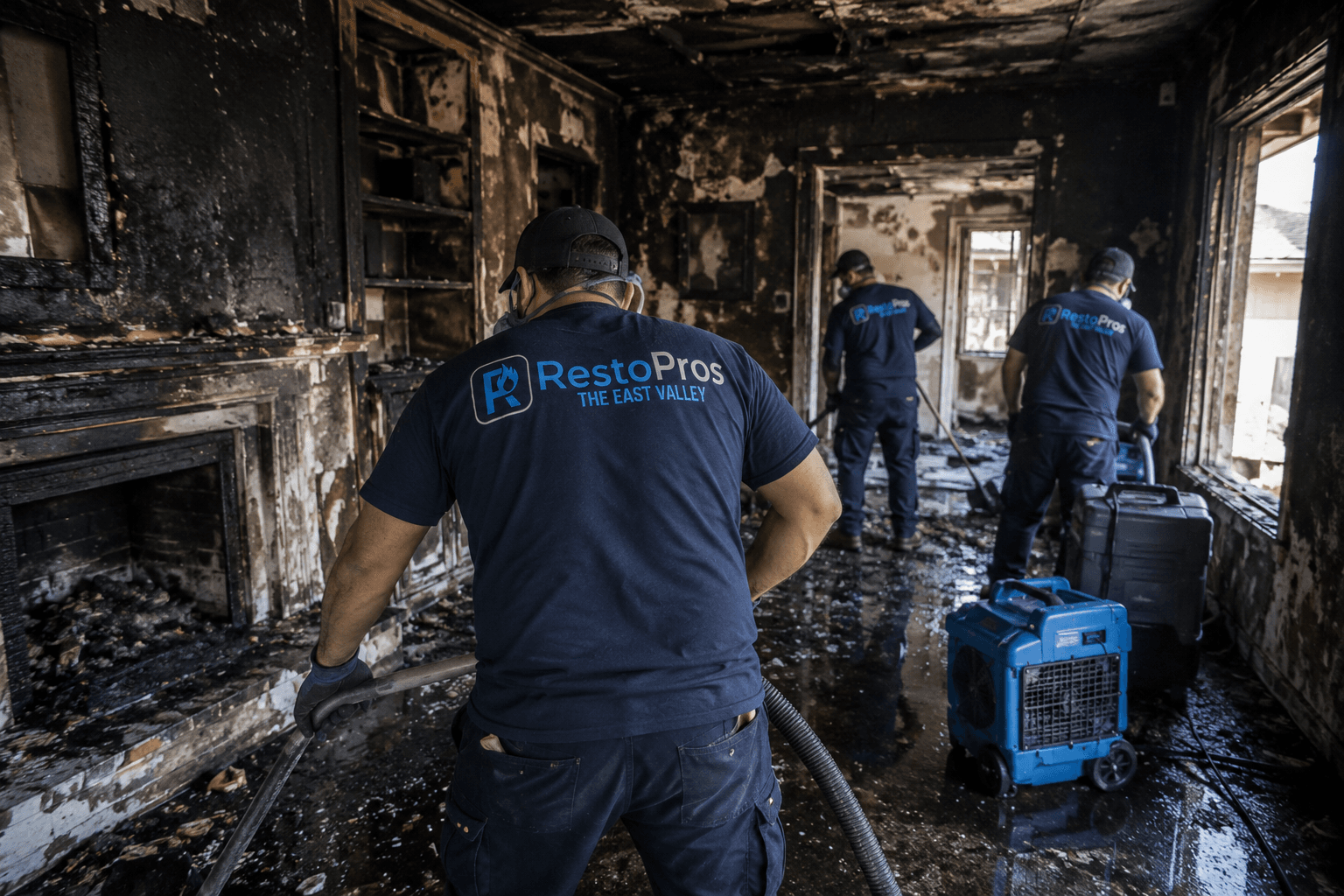
Fire costs scale with burn area, smoke travel, residue type, suppression water volume, HVAC involvement, and rebuild scope. Two Tempe-specific factors add to that: building age, since pre-1990 construction may require asbestos testing and abatement before demolition, and occupancy type, since multi-unit losses require documenting damage separately per unit for separate claims.

In condos and apartments the coverage split follows the same general shape as water losses — your policy covers your unit's interior, the neighbor's covers theirs, the HOA master policy covers common elements — with the details in your CC&Rs. Smoke-only damage in an adjacent unit is a legitimate, claimable loss, and it's frequently overlooked because there's nothing visibly burned. We document each affected unit separately so those claims can actually be filed.

For Mill Avenue and corridor businesses, the real cost is closure. We prioritize reopening, work overnight where it helps, address health-department-relevant cleaning for food service, and document business interruption alongside the physical loss for your commercial policy. Free assessment, written line-item scope, direct insurance billing on all of it.

  • check_circleUnder-an-hour typical emergency response — we're based in Tempe.
  • check_circlePer-unit documentation on multi-unit losses so every affected owner can claim.
  • check_circleAsbestos testing coordinated before disturbing pre-1990 materials.
  • check_circleAfter-hours commercial work to minimize closure on Mill Avenue and the ASU corridor.

Fire or Smoke Damage in Tempe? We're Minutes Away

Homeowner, landlord, tenant, restaurant, or HOA board — call RestoPros of the East Valley at (520) 482-3900. 24/7 emergency board-up, smoke and soot removal, deodorization, and rebuild, with documentation for every party and direct insurance billing.

Get in Touch

Need a free inspection in Tempe? Fill out the form and our local team will get back to you quickly.

schedule

Open 24/7 for Emergencies

helpFAQ

Fire & Smoke Damage Restoration in Tempe — FAQs

Very likely yes. Smoke migrates through shared walls, ceilings, common attics, and shared HVAC, and smoke-only damage is a legitimate covered loss under most policies. It's routinely overlooked because nothing looks burned. We document affected units separately so each owner can file properly.

Yes — this is routine for us. We coordinate access, secure the property, document everything with photos and written scopes, communicate with your adjuster and tenants, and bill your carrier directly. You approve decisions from wherever you are.

It depends on the scope, but speed is the whole point of how we sequence commercial work: immediate securing, grease and protein residue removal with the right enzyme and degreasing chemistry, deodorization, and cleaning documented to support health-department requirements. We work overnight where that keeps you serving.

It changes the sequence. Pre-1990 materials may contain asbestos in drywall compound and flooring, so suspect materials get tested before demolition. Plaster and lath also hold suppression water longer than drywall, so drying is planned and verified for those materials specifically. Doing it right is faster than doing it twice.

With proper source removal followed by thermal fogging, ozone, or hydroxyl treatment plus HVAC decontamination, most properties are odor-free within days to a couple of weeks. Odor that returns on warm afternoons after a 'finished' job means residue was left in ducts, insulation, or cavities — that's a redo, not a fragrance problem.

Faster than anywhere else we serve, because we're based here — typically under an hour, 24/7, from north Tempe and the ASU area through Warner Ranch and south Tempe. Call (520) 482-3900.

call

Emergency Help 24/7

CALL 520-482-3900

arrow_forward