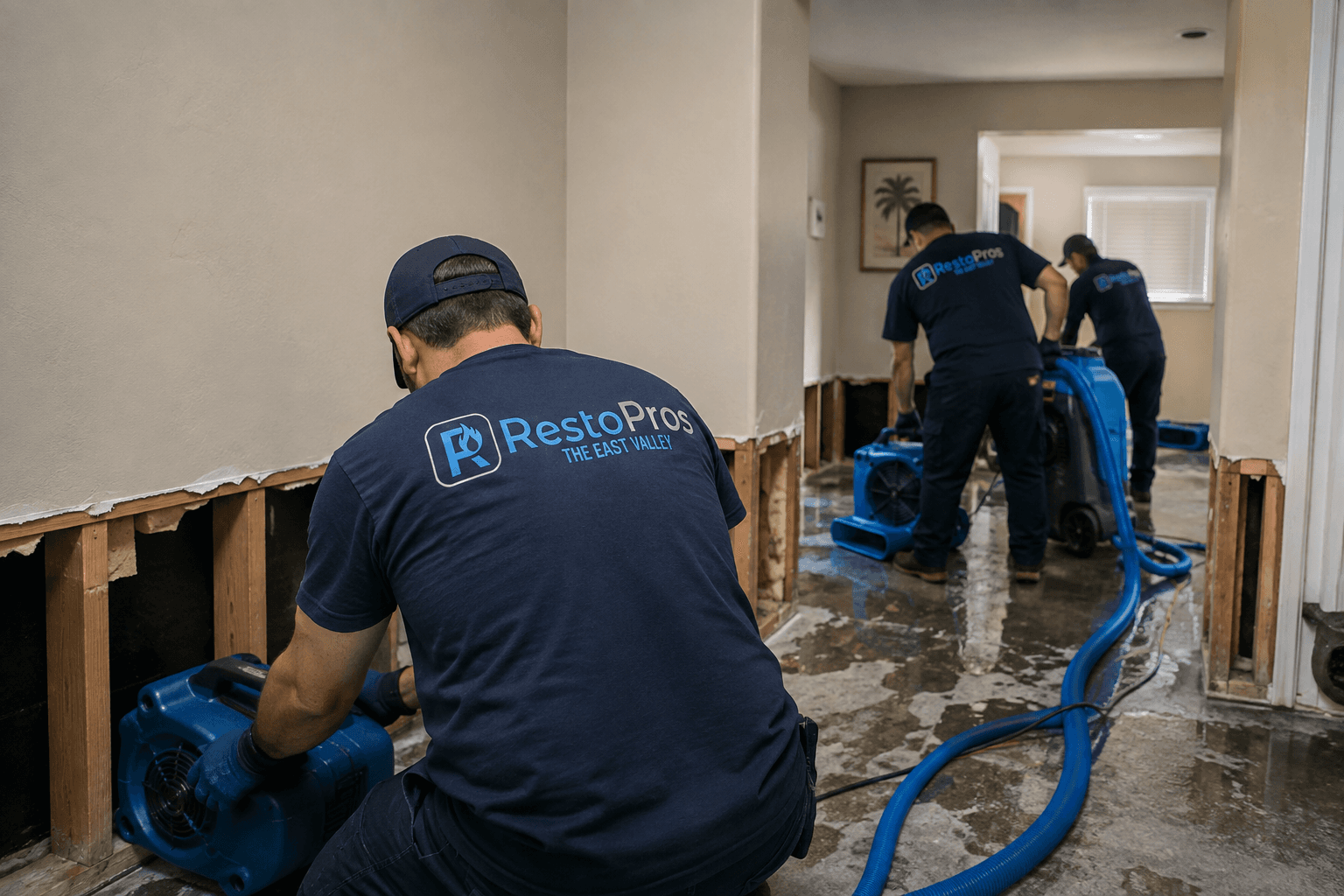
Moisture mapping and water extraction in a Chandler, AZ home after a slab leak
RestoPros

Water Damage Restoration in Chandler, AZ — 24/7 Emergency Response

From a slab leak surfacing through Ocotillo tile to a burst line in a 1980s Andersen Springs home, Chandler's water damage has a distinct signature — and we've spent years learning it. RestoPros of the East Valley responds 24/7, typically within 60–90 minutes, with electronic moisture detection, commercial drying equipment, and IICRC-certified crews. Free inspection, verified drying, direct insurance billing.

Google
starstarstarstarstar
5.0 Google Rating
verified

Licensed & Certified

IICRC Certified Technicians

shield

Fully Insured

Bonded for Your Protection

location_on

Local East Valley Pros

Mesa, Chandler, Gilbert, Tempe & Queen Creek

Chandler's water damage story is really two stories separated by about fifteen years of construction. North Chandler and the neighborhoods around Andersen Springs and Downtown were built largely between the late 1970s and mid-1990s — the exact window when polybutylene supply pipe was standard, and when copper lines were routinely cast under the concrete slab. Both of those materials are now decades into a slow chemical fight with Arizona's mineral-heavy municipal water, and both lose eventually.

South Chandler tells a different story. Ocotillo, Fulton Ranch, and Sun Groves are newer, larger, and often built on lakefront or lake-adjacent lots. Here the failures skew toward slab leaks driven by hard-water corrosion, water heater ruptures, AC condensate backups during the long cooling season, and the drainage and irrigation realities of waterfront grading.

The through-line is that Chandler's most expensive water damage is usually the water you never see. A slab leak can run for months under flooring, feeding mold in wall bases and beneath tile while the visible surfaces look perfectly normal. That's why our Chandler jobs start with detection and moisture mapping rather than assumption — and why we handle the whole recovery, from extraction and verified structural drying through mold prevention and the rebuild.

Why Chandler Homes Flood

These are the causes we're dispatched for most often across Chandler, and each one behaves differently once it's inside the structure.

Slab leaks from hard-water corrosion

Chandler's water is mineral-dense, and copper supply lines running beneath a concrete slab pit from the inside until they weep. Warm spots on the floor, an unexplained water bill increase, darkening grout, or the sound of running water with everything off are the tells. Because the leak is under concrete, damage accumulates for weeks or months before it's visible.

Polybutylene pipe failures in 1978–1995 homes

Large parts of north Chandler were plumbed with gray polybutylene, which degrades internally from chlorine in treated water and fails as a sudden burst rather than a slow drip. Full line pressure with nobody home is how a single fitting puts hundreds of gallons into a house.

Water heater ruptures

Hard-water sediment shortens tank life to roughly 6–10 years here. Chandler heaters typically sit in the garage or an interior closet, so a rupture either soaks stored belongings and adjoining bedroom walls or discharges into the middle of the house.

AC condensate backups

Chandler's cooling season runs long, and the air handler condenses water continuously through it. A clogged drain line backs that water up into the pan and through the ceiling below — one of the most common calls we take in July and August.

Lakefront lot grading and irrigation

In Ocotillo and Fulton Ranch, waterfront lots come with drainage directed toward the lake, heavy landscape irrigation, and elevated ambient moisture at the lot line — all of which affect how quickly a structure dries and how thoroughly it must be verified.

Monsoon roof and wall intrusion

July and August microbursts lift tile and drive rain into attics and wall assemblies. The ceiling stain that shows up days later is usually the tail end of a much wetter story above it.

Water Damage Response Across Chandler

Where you are in Chandler tells us a lot about what we're likely to find before we arrive.

  • location_onOcotilloNewer lakefront and lake-adjacent homes where slab leaks and AC condensate issues dominate, with drying plans adjusted for waterfront moisture conditions.
  • location_onFulton RanchLarger 2000s homes, often two-story, where upstairs failures cascade and open plans let ground-floor water travel quickly.
  • location_onAndersen Springs & north ChandlerLate-1970s through mid-1990s construction — prime polybutylene and aging-copper territory, plus original water heaters well past expected service life.
  • location_onDowntown Chandler & historic coreOlder housing stock with genuinely aged plumbing and building assemblies that dry differently than modern drywall construction.
  • location_onSun Groves & south Chandler1990s–2000s subdivisions where supply fittings, angle stops, and water heaters are reaching end of life together.
  • location_onPrice Corridor & commercial ChandlerOffices, tech suites, restaurants, and retail where downtime is the real cost — we work after hours where possible and prioritize getting you operational.
timelineOur Process

How We Restore Water-Damaged Chandler Properties

Detection first, then extraction, then verified drying — with documentation your adjuster can act on at every stage.

01

Call & Dispatch

Call (520) 482-3900 any hour, day or night. We gather the essentials and send a crew to your Chandler address, typically arriving within 60 to 90 minutes.

02

Detection & Moisture Mapping

For hidden losses like slab leaks, we locate the source and map the moisture footprint with meters and thermal imaging before anything is opened — no exploratory demolition, and a written scope before work starts.

03

Extraction

Standing water is removed with truck-mounted and portable equipment, stopping continued saturation of drywall, baseboards, cabinetry, and flooring.

04

Structural Drying

Air movers and dehumidifiers run until daily moisture readings confirm dry standard — including under-slab-adjacent flooring assemblies, which dry slowly and must be verified rather than assumed.

05

Sanitize & Prevent Mold

Surfaces are cleaned, sanitized, and treated with antimicrobial. Slab-leak losses get particular attention here, because prolonged hidden moisture is the highest-risk mold scenario we handle.

06

Repair & Rebuild

Flooring, drywall, baseboards, paint, and cabinetry restored to pre-loss condition, coordinated alongside your plumber's pipe repair so the whole event closes as one project.

Chandler Water Damage: Cost and Coverage

Cost tracks scope, and scope tracks time. A supply-line break caught within the hour on tile is a modest dry-out. A slab leak discovered after months under wood flooring — with mold established in the wall bases — is a different project entirely, involving flooring removal, containment, remediation, and reconstruction. This is why the early warning signs are worth knowing, and why we run detection before quoting anything.

On the insurance side, slab leaks get a specific three-part treatment in Arizona: the resulting water damage to flooring, drywall, and structure is usually covered; the access work to open and repour the concrete is often covered under tear-out provisions; and the pipe repair itself typically is not, since it's considered maintenance. Sudden failures — a burst polybutylene line, a ruptured water heater, an appliance discharge — are covered as sudden and accidental discharge. Coverage weakens the longer a leak demonstrably ran, which is another reason speed protects both your home and your claim.

Every Chandler job starts with a free inspection and a written, line-item estimate. We document cause and moisture readings to insurance standards, communicate with your adjuster, and bill your carrier directly for covered mitigation.

  • check_circleFree inspection with electronic moisture detection — including suspected slab leaks.
  • check_circleNon-invasive location first: we find it before anyone opens concrete or flooring.
  • check_circleDirect insurance billing and adjuster coordination on covered claims.
  • check_circleCoordinated with your plumber so pipe repair and restoration close out together.

Water Damage in Chandler? Let's Find It and Dry It

Whether it's visible flooding or a slab leak you only suspect, the fix starts with knowing exactly where the water is. Call RestoPros of the East Valley at (520) 482-3900 for a free Chandler inspection — 24/7 emergency response and direct insurance billing.

Get in Touch

Need a free inspection in Chandler? Fill out the form and our local team will get back to you quickly.

schedule

Open 24/7 for Emergencies

helpFAQ

Water Damage Restoration in Chandler — FAQs

Chandler is core territory for us, with crews on call 24/7. Emergency arrivals typically run 60 to 90 minutes anywhere in the city — Ocotillo, Fulton Ranch, Andersen Springs, Downtown, Sun Groves, or out toward Sun Lakes. Call (520) 482-3900 the moment you find water or suspect a hidden leak.

Run the meter test: shut off every fixture and water-using appliance, then watch the low-flow indicator on your water meter. If it's moving, water is escaping. Pair that with warm floor spots, a climbing water bill, or damp flooring and a slab leak becomes the leading suspect. Call us for a free moisture inspection — we locate it electronically, without opening concrete to search.

Generally in three parts: the resulting damage to flooring, drywall, and structure is usually covered; the concrete access work is often covered under tear-out language; and the pipe repair itself typically isn't, as it's treated as maintenance. Policies vary, and how long the leak ran matters — we document cause and moisture to support the claim.

It's worth ten minutes to check. Homes built between 1978 and 1995 were often plumbed with gray polybutylene, which fails as a sudden burst rather than a warning drip. Look at the water heater connections and under-sink stub-outs for dull gray flexible pipe, sometimes marked PB2110. If you find it, plan a repipe on your schedule rather than the pipe's.

Typically 3 to 5 days for structural drying, longer for slab-adjacent flooring assemblies. You'll know because we take moisture readings daily and log them — equipment doesn't come out until materials read at dry standard. Pulling equipment early because a surface looks dry is the most common way a water job becomes a mold job.

Yes — offices, tech suites, restaurants, and retail across Chandler. For commercial losses we prioritize reopening, work after hours where it keeps you operating, and produce the itemized documentation commercial policies require.

call

Emergency Help 24/7

CALL 520-482-3900

arrow_forward