
Between 1978 and 1995, millions of American homes — including a large share of the East Valley's construction boom in north Chandler, west Mesa, Dobson Ranch, and early Gilbert — were plumbed with polybutylene, a gray plastic pipe that was cheaper and faster to install than copper. It was marketed as the pipe of the future. It became the subject of one of the largest class-action settlements in U.S. history instead, because of one characteristic that matters enormously to homeowners: polybutylene doesn't leak politely before it fails. It bursts.
Key Takeaways
- Polybutylene (often stamped 'PB2110') is gray, flexible plastic pipe installed roughly 1978–1995 — squarely in the East Valley's biggest construction era.
- Chlorine and disinfectants in municipal water degrade it from the inside, so pipe that looks fine can be structurally brittle — and failures are sudden bursts, not slow drips.
- You can usually identify it yourself in ten minutes at the water heater, under sinks, and at the main shutoff.
- Some insurers surcharge, exclude, or decline homes with poly-b — a fact that surfaces at the worst times: claims and home sales.
How to Tell If Your Home Has It (10 Minutes)
- Check the build year first: East Valley homes built 1978–1995 are candidates; peak usage here was the mid-80s. Homes outside that window are almost certainly fine.
- Look at the water heater connections: poly-b is dull gray, flexible, usually half-inch to one-inch, and often marked 'PB2110' along the pipe.
- Open under-sink cabinets: gray pipe stubbing out of walls (sometimes with plastic or copper crimp-band fittings) is the classic sighting. Note: gray plastic angle-stop supply tubes are not the same thing — it's the pipe in the wall that matters.
- Check the main shutoff and hose bibs: poly-b was also used for the underground service line from the meter — blue, gray, or black plastic entering the house.
- Can't tell? A plumber or home inspector can confirm in one visit — worth it before your insurer or a buyer's inspector does it for you.
Why It Fails — and Why Arizona Water Makes It Worse
Polybutylene's flaw is chemical: chlorine and chloramine disinfectants in treated municipal water oxidize the pipe's inner wall, creating microfractures that spread through the material over years. The pipe becomes brittle from the inside out — which is why visual inspections of the outside mean little, and why failures arrive as sudden ruptures under normal pressure rather than warning drips. Valley water works against it twice: our municipal systems maintain robust disinfectant residuals (a good thing for drinking water, hard on poly-b), and our extreme heat accelerates the chemistry, particularly for lines running through 140° attics. A material with a known failure mechanism has now had forty-plus Arizona summers to work on it. The surviving poly-b in East Valley walls isn't the good batch — it's the not-yet batch.
What a Poly-B Failure Looks Like in Practice
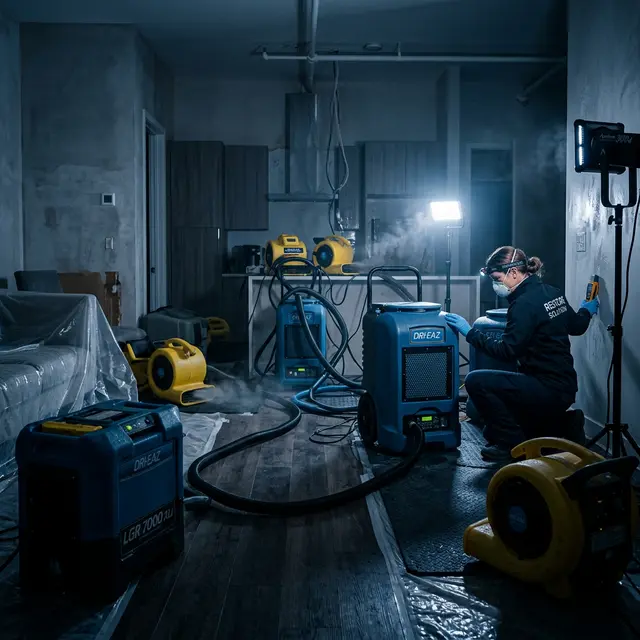
The calls follow a pattern: a bang or hiss inside a wall, water appearing at a baseboard two rooms away, and — because bursts release full line pressure — hundreds of gallons in the first hour if nobody's home to hit the shutoff. Ceiling failures from attic runs are the dramatic version. The damage profile is exactly the sudden, spreading kind we cover in our water damage restoration cost guide: category-clean water, but broad, fast, and into everything porous. If your home has poly-b, knowing the location of your main shutoff — and making sure everyone in the house knows it — is not optional.
The Insurance Wrinkle Nobody Mentions Until It Matters
Insurers know the actuarial story on polybutylene, and it shows up three ways in Arizona: some carriers surcharge or require inspection before writing homes with poly-b; some exclude water damage from poly-b failures specifically or decline coverage renewal until it's replaced; and at sale time, buyers' inspectors flag it, lenders' insurers price it, and negotiations reopen. A first failure claim usually gets paid — but often arrives with a letter requiring repipe as a condition of continued coverage. The strategic point: replacing poly-b on your schedule is a plumbing project; replacing it on your insurer's schedule after a loss is a plumbing project plus a water damage claim plus a deadline.
Replacement: What a Repipe Actually Involves
A whole-home repipe replaces the distribution system with PEX (the modern flexible standard) or copper, typically over two to four days for a single-story East Valley home. Crews run new lines through the attic and walls, cut access openings at fixtures, and patch drywall afterward — most Valley repipes are quoted with texture-matched patching included. Cost scales with fixture count, stories, and finishes; in the Phoenix market, typical single-family repipes land in the mid-four figures to low five figures. Get the drywall/patching scope in writing, and if your service line from the meter is also poly, price that separately — it's a different job. It's real money; it's also the cheapest this problem will ever be, because every alternative includes the repipe plus a flood.
If a Poly-B Line Just Burst: The Order of Operations
- Main shutoff first — every minute is gallons.
- Kill power to affected rooms if water reached outlets.
- Photograph everything before cleanup begins.
- Get drying started the same day — burst-pipe water in wall cavities is on the 24–48 hour mold clock like any other.
- Before repairs close the walls, decide about the rest of the system. Patching one section of a failed poly-b run and closing the drywall over the remainder is the decision homeowners regret most reliably.
Frequently Asked Questions
Is polybutylene banned?
It was never formally banned, but U.S. production ended in the mid-1990s after the failures and the Cox v. Shell class-action settlement. Building codes no longer recognize it for new work — which is also why 'repair it in kind' isn't an option; failed sections get replaced with PEX or copper.
My poly-b has been fine for 35 years. Isn't it past the danger?
Unfortunately the logic runs the other way: the degradation is cumulative, so surviving pipe is further along the failure curve, not proven immune. Age without failure means it hasn't happened yet, not that it won't.
Which East Valley neighborhoods have polybutylene?
Anywhere built 1978–1995: large parts of west and central Mesa, Dobson Ranch, north Chandler, early Gilbert subdivisions, and 80s Tempe infill. It's the build year, not the zip code — check your pipes, not the map.
A poly-b line burst and soaked two rooms — what do you handle versus the plumber?
The plumber replaces pipe; we handle everything the water touched — extraction, moisture mapping, structural drying with daily readings, mold prevention, and rebuilding drywall and flooring — coordinated as one project with your insurance documentation done properly. Call (520) 482-3900, 24/7.
1980s East Valley Home? Check Your Pipes This Weekend
And if gray pipe has already let go, RestoPros of the East Valley provides 24/7 water damage restoration across Chandler, Mesa, and Gilbert — the heart of poly-b country — with 60–90 minute response and direct insurance billing. While you're assessing your home's plumbing era, our slab leak detection guide covers the other pipe problem hiding in homes of the same vintage.