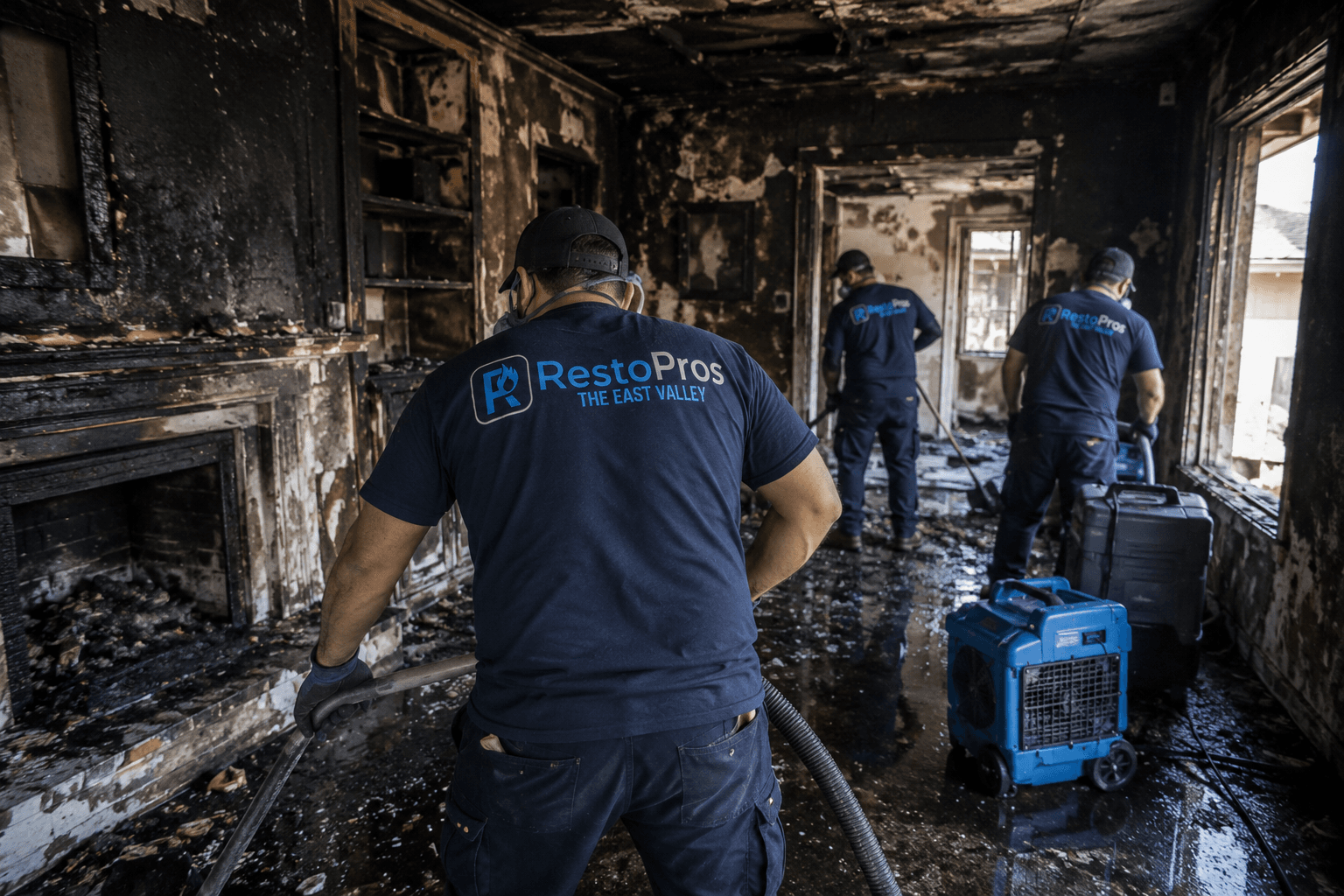
RestoPros crew performing fire and smoke damage restoration in a Chandler, AZ home
RestoPros

Fire & Smoke Damage Restoration in Chandler, AZ — 24/7 Board-Up to Rebuild

Chandler's newer homes are built tight — great for your power bill, and the reason smoke from a contained kitchen fire ends up in bedrooms at the other end of the house. RestoPros of the East Valley responds 24/7 across Chandler with emergency board-up, residue-matched soot removal, molecular deodorization, contents cleaning, and full reconstruction, billed directly to your insurer.

Google
starstarstarstarstar
5.0 Google Rating
verified

Licensed & Certified

IICRC Certified Technicians

shield

Fully Insured

Bonded for Your Protection

location_on

Local East Valley Pros

Mesa, Chandler, Gilbert, Tempe & Queen Creek

There's a counterintuitive thing about fire damage in a modern Chandler home: the newer and better-built the house, the worse the smoke problem tends to be. Homes in Ocotillo, Fulton Ranch, and Sun Groves were built to modern envelope standards that deliberately limit air exchange. When smoke fills that envelope, it has nowhere to go and nothing to dilute it — so residue settles across a far wider area than the fire itself ever reached, and it stays until someone removes it.

Chandler's larger floor plans compound it. Bigger homes mean longer duct runs and larger air handlers, and if the HVAC was running when the fire started — which in an Arizona summer it almost certainly was — the system inhaled the smoke and distributed it methodically to every room it serves. We routinely scope Chandler jobs where the visible fire damage is confined to one kitchen wall and the odor problem spans three thousand square feet.

The city's older side has a different profile. North Chandler and the neighborhoods around Andersen Springs date to the late 1970s through mid-1990s, and carry aging electrical panels, decades of added circuits, and original wiring. Fires that start inside those walls fill cavities and insulation with smoke before flames are visible — and in homes of that vintage, materials disturbed during demolition may need asbestos testing first.

Chandler's Fire and Smoke Profile

What starts fires here, and more importantly what the smoke does afterward in this city's housing stock.

Kitchen and cooking fires

The most common residential fire by a wide margin. Grease and food fires produce protein residue — a faint amber film that's nearly invisible but carries an intense rancid odor. Homeowners clean the visible stove area, find nothing else, and can't understand why the house still smells. The film is on every cabinet face, wall, and ceiling for a wide radius.

Tight envelopes that trap smoke

Chandler's newer construction limits air exchange by design. Smoke that enters doesn't passively ventilate out over the following days the way it would in an older, leakier house — it settles and stays, which makes professional deodorization essential rather than optional.

HVAC distribution across large floor plans

Long duct runs in larger Ocotillo and Fulton Ranch homes carry residue to rooms the fire never approached. Duct and equipment decontamination is frequently required even where visible damage is minimal.

Electrical fires in 1978–1995 north Chandler homes

Aging panels, original branch wiring, and decades of accumulated circuit additions. These fires often ignite inside wall or ceiling cavities, seeding smoke into insulation and framing before anyone sees flame.

Garage fires reaching shared attic space

Attached garages storing fuel, solvents, batteries, and equipment at 130°+ in summer. Because garage and house attics often connect, smoke from a garage fire migrates into the main structure through the shared space above.

Suppression water on top of everything

Firefighting introduces hundreds or thousands of gallons that soak drywall, insulation, and framing — starting the 24-to-48-hour mold clock in Arizona heat. Structural drying is part of every fire job we run, not an afterthought.

Fire & Smoke Response Across Chandler

Housing era changes both the fire risk and how the restoration has to be sequenced.

  • location_onOcotillo & Fulton RanchLarger, newer, tightly built homes where smoke saturates the envelope and travels via extensive HVAC. High contents value makes item-by-item cleaning especially worthwhile here.
  • location_onAndersen Springs & north ChandlerLate-1970s through mid-1990s construction with aging electrical. In-wall fire origins are common, and pre-1990 materials may require asbestos testing before demolition.
  • location_onDowntown Chandler & historic coreOlder assemblies that hold smoke odor differently than modern drywall, and where texture and finish matching on the rebuild takes more care.
  • location_onSun Groves & south Chandler1990s–2000s subdivisions with open plans that let smoke spread laterally across the main floor with little to slow it.
  • location_onPrice Corridor & tech officesOffice and tech suites where smoke damage to electronics and equipment is the dominant loss, and where every closed day is measurable.
  • location_onChandler Fashion Center & retail corridorRestaurants and retail where hood fires, grease residue, health-department requirements, and reopening speed all converge.
timelineOur Process

Our Chandler Fire Restoration Process

Sequenced to beat the 72-hour corrosion window — because acidic residue permanently etches glass, metal, and stone within days.

01

Emergency Board-Up & Securing

Openings boarded, roof tarped, property secured against weather and entry. Call (520) 482-3900 any hour — we typically reach Chandler addresses within 60 to 90 minutes.

02

Residue Testing & Written Scope

Residue identified surface by surface — dry, wet, protein, or fuel — because each needs different cleaning chemistry and the wrong one sets stains permanently. Full documentation for your insurer.

03

Pre-Clean At-Risk Surfaces

Glass, metal, stone, and appliances treated in the first 24 to 72 hours, before acidic residue etches and pits them beyond recovery. This happens before broader scoping is complete.

04

Extract & Dry Suppression Water

Firefighting water removed and the structure dried with commercial equipment and daily moisture verification, preventing the mold problem that otherwise follows every fire.

05

Soot Removal, Contents & HVAC

HEPA vacuuming and dry-sponge work first — never wet-wiping dry soot, which smears it permanently — then residue-matched cleaning, item-by-item contents processing, and duct decontamination.

06

Deodorize & Rebuild

Thermal fogging, ozone, or hydroxyl treatment after source removal, sealing primers on cleaned surfaces, then reconstruction to pre-loss condition.

Chandler Fire Restoration: Cost, Contents, and Coverage

Fire losses vary more than any other restoration category. The drivers: burn area, how far smoke and residue traveled, residue type — protein and wet smoke cost meaningfully more to clean than dry smoke — how much suppression water entered, whether HVAC needs decontamination, and the reconstruction scope, which on larger losses is the majority of the total. In Chandler specifically, the tight-envelope effect means smoke scope is often larger relative to fire scope than homeowners expect.

Fire and smoke damage is covered by essentially every homeowner's policy, including smoke damage in areas the flames never reached, and adjusters expect professional cleaning, deodorization, and contents processing as standard line items. Two things protect your claim: document everything before cleanup starts, because photos of residue are evidence that disappears as work proceeds, and insist on item-by-item contents assessment rather than accepting a blanket total-loss assumption.

That contents point matters more in Chandler than most places, simply because the homes are larger and hold more. Good contents cleaning — including ultrasonic processing for hard items — routinely saves things families had written off, and a claim should reflect real salvage rather than wholesale replacement. If you're displaced, we also help document additional living expenses, which most policies cover.

  • check_circle24/7 emergency board-up and tarping to secure the property immediately.
  • check_circleResidue testing before any cleaning — wrong chemistry makes damage permanent.
  • check_circleItem-by-item contents assessment and cleaning, not blanket write-offs.
  • check_circleAsbestos testing coordinated before demolition in pre-1990 north Chandler homes.

Fire or Smoke Damage in Chandler? Call Before the Soot Sets

Acidic residue starts permanently etching glass, metal, and finishes within 72 hours. Call RestoPros of the East Valley at (520) 482-3900 for 24/7 emergency board-up, soot and odor removal, contents cleaning, and rebuild across Chandler.

Get in Touch

Need a free inspection in Chandler? Fill out the form and our local team will get back to you quickly.

schedule

Open 24/7 for Emergencies

helpFAQ

Fire & Smoke Damage Restoration in Chandler — FAQs

Because Chandler's newer homes are built tight. Smoke that enters a modern envelope can't passively ventilate out, and if the AC was running it distributed residue through the ductwork to every room the system serves. The smell isn't lingering air — it's residue on surfaces throughout the house, and it stays until it's removed.

Crews are on call 24/7 and typically arrive within 60 to 90 minutes anywhere in the city — Ocotillo, Fulton Ranch, Andersen Springs, Downtown, Sun Groves, or the Price Corridor. Call (520) 482-3900 the moment the scene is safe.

Wet-wiping dry soot drives carbon into paint and drywall texture and turns removable powder into permanent staining — the single most damage-multiplying thing homeowners do. Different residue types need different chemistry. Ventilate, stay off the residue, and let the assessment come first.

Considerably more than most people assume, provided the right chemistry reaches them before acid damage sets. We assess item by item — hard contents, many textiles, and a surprising share of household goods are recoverable — and document salvage for your claim rather than defaulting to write-offs.

It changes the sequence. Pre-1990 materials may contain asbestos in drywall compound, texture, or flooring, so suspect materials get tested before demolition. Older assemblies also hold suppression water and smoke odor differently, so drying and deodorization are planned for those specific materials.

It's a full water damage loss stacked on top of the fire, on the same 24-to-48 hour mold clock in Arizona heat. Extraction and verified structural drying are standard parts of every fire job we run — skipping that step is how a restored home develops mold two months later.

call

Emergency Help 24/7

CALL 520-482-3900

arrow_forward