
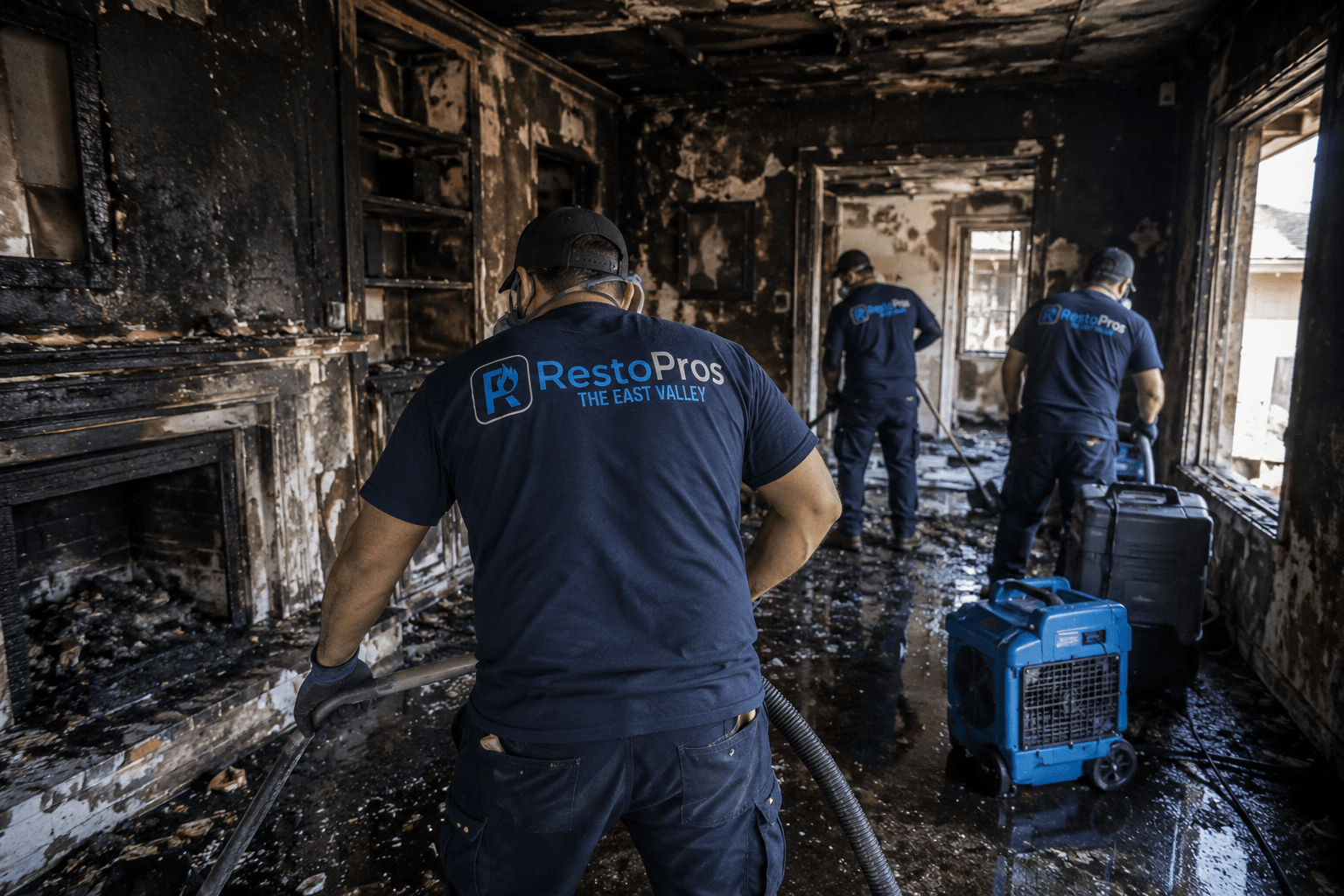
Whether it's last night's kitchen fire, a previous owner's twenty-year cigarette habit, or a summer of wildfire smoke riding into the Valley on monsoon winds, smoke odor has one defining property: it outlasts your patience. That's because the smell isn't in the air — it's in microscopic particles bonded to every surface the smoke touched, re-releasing odor every time temperature and humidity shift. Getting rid of it means removing or neutralizing the residue, not perfuming the air above it.
Here's the honest hierarchy: what works for light odor, what never works, and where the line sits between a DIY weekend and a professional deodorization job.
Key Takeaways
- Smoke odor comes from residue on surfaces and inside materials — treatments that only address the air (sprays, candles) fail by design.
- Light odor responds to aggressive ventilation, washing every washable surface and fabric, and full HVAC filter replacement.
- Odor that survives cleaning lives in places DIY can't reach: ductwork, attic insulation, wall cavities, and unsealed wood.
- Professional-grade fixes — source removal, HEPA air scrubbing, thermal fogging, ozone or hydroxyl treatment — work because they chemically neutralize residue, not mask it.
First, Identify Your Smoke Problem
The source changes the strategy. A protein fire (burnt food, especially meat) leaves a nearly invisible film with an outsized, greasy odor concentrated in the kitchen and HVAC. A structure fire leaves visible soot plus deep-penetrated odor — and everything below applies double. Cigarette smoke is a whole-house film built over years, strongest on ceilings, walls, and inside ducts. Wildfire and outdoor smoke is usually the lightest case: particles that drifted in and settled without a hot, driving fire behind them.
The DIY Steps That Actually Work
1. Flush the house with outside air
Not a cracked window — a deliberate cross-breeze with box fans exhausting outward from one side of the house while opposite windows feed intake. Run it for hours, repeatedly. In East Valley summers, do it at dawn and pay the cooling penalty afterward; it's the cheapest real progress you can make.
2. Wash everything washable
Fabrics are odor reservoirs: curtains, bedding, slipcovers, clothes in open closets. Launder with an added cup of white vinegar or a laundry booster. Send what can't be laundered to dry cleaning and mention smoke — cleaners have specific processes for it.
3. Clean hard surfaces top-down
Ceilings, walls, cabinet faces, window glass, blinds, light fixtures. Warm water with a degreasing dish soap or trisodium phosphate substitute lifts the film cigarette and cooking smoke deposits. You'll see the residue on the sponge — that's the odor leaving. Change rinse water constantly or you're just relocating it.
4. Attack the HVAC
Your AC ran during or after the smoke event, which means the system inhaled it. Replace filters immediately (and again in a week), vacuum accessible registers and return grilles, and wipe the blower compartment if you can reach it safely. If odor blasts out every time the system starts, the ducts themselves are holding residue — flag that for the professional section below.
5. Deploy real absorbers, patiently
Open containers of activated charcoal (far stronger than baking soda, which helps mostly in small enclosed spaces like fridges and cars) placed around affected rooms genuinely adsorb odor molecules over days to weeks. This is a finishing move for light residual odor — not a primary treatment.
What Doesn't Work
- Candles, plug-ins, and 'odor eliminator' sprays — perfume layered on top of an intact residue layer. The smoke wins in a week.
- Painting over un-cleaned, un-sealed walls — odor bleeds through standard paint. (Sealing primers exist and work, but only after cleaning, as a system.)
- Consumer 'ozone generators' run while you live in the house — ozone at effective concentrations is a lung irritant that requires vacating and venting; the plug-in units are too weak to matter and still not great to breathe.
- Waiting for it to fade. Smoke residue is chemically stable. Twenty-year-old cigarette houses smell like cigarettes for a reason.
When DIY Loses: The Places You Can't Reach
If you've ventilated, washed, and scrubbed and the smell keeps returning — especially on hot afternoons or when the AC cycles — the residue is in the spaces cleaning can't touch: duct interiors, attic insulation (a giant smoke filter sitting over your ceiling), wall and ceiling cavities that breathed smoke through outlets and can lights, and raw wood in framing and cabinetry interiors that absorbed odor into open grain. No amount of surface work fixes a reservoir problem.
What Professional Smoke Deodorization Actually Does
- Source removal first: HEPA vacuuming and chemical-sponge cleaning of soot-bearing surfaces, disposal of unsalvageable insulation and materials — because neutralizing works only after the bulk residue is gone.
- HEPA air scrubbing: commercial negative-air machines cycling the home's air through true HEPA + carbon filtration for days, capturing suspended particles.
- Thermal fogging: a heated deodorizing fog with the same penetration behavior as smoke — it follows the smoke's own paths into cavities and grain and neutralizes odor where it lives.
- Ozone or hydroxyl treatment: oxidizers that chemically break odor molecules apart. Ozone is fast and requires an unoccupied, sealed house; hydroxyl is gentler and can run in occupied spaces.
- Duct cleaning and, where needed, sealing: clearing the system that redistributes odor every cycle.
- Sealing primers on cleaned structural surfaces as the final lock before repainting.
This is the same equipment stack we deploy on our fire and smoke damage restoration jobs across the East Valley — the difference between a house that smells 'better' and a house where a visitor would never know.
Frequently Asked Questions
How long does smoke smell last in a house?
Untreated, indefinitely — residue is chemically stable and re-releases odor with heat and humidity for years. Treated properly (source removal plus neutralization), a typical home is odor-free in days to a couple of weeks.
Does vinegar or baking soda remove smoke smell?
They help at the margins: vinegar in laundry and on washable surfaces, baking soda in small enclosed volumes. Neither touches residue in walls, ducts, or insulation, which is where persistent odor lives.
Is ozone treatment safe?
In professional hands, yes — the house is vacated, sealed, treated, and thoroughly vented before re-occupancy. Running consumer ozone units in an occupied home is neither safe nor effective, which is the worst combination.
We just had a kitchen fire — what order should things happen?
Don't scrub soot with water (it smears and sets). Ventilate, stay off the residue, and get an assessment quickly — soot is acidic and starts permanently etching metal, glass, and finishes within days. RestoPros handles the full sequence from cleanup through deodorization: (520) 482-3900.
Smoke Odor That Won't Quit? That's Our Specialty
RestoPros of the East Valley provides professional smoke and odor removal across Tempe, Mesa, and the whole East Valley — from single-room kitchen fires to whole-home deodorization. If a fire started this, begin with our house fire recovery plan, then call (520) 482-3900 for a free assessment.