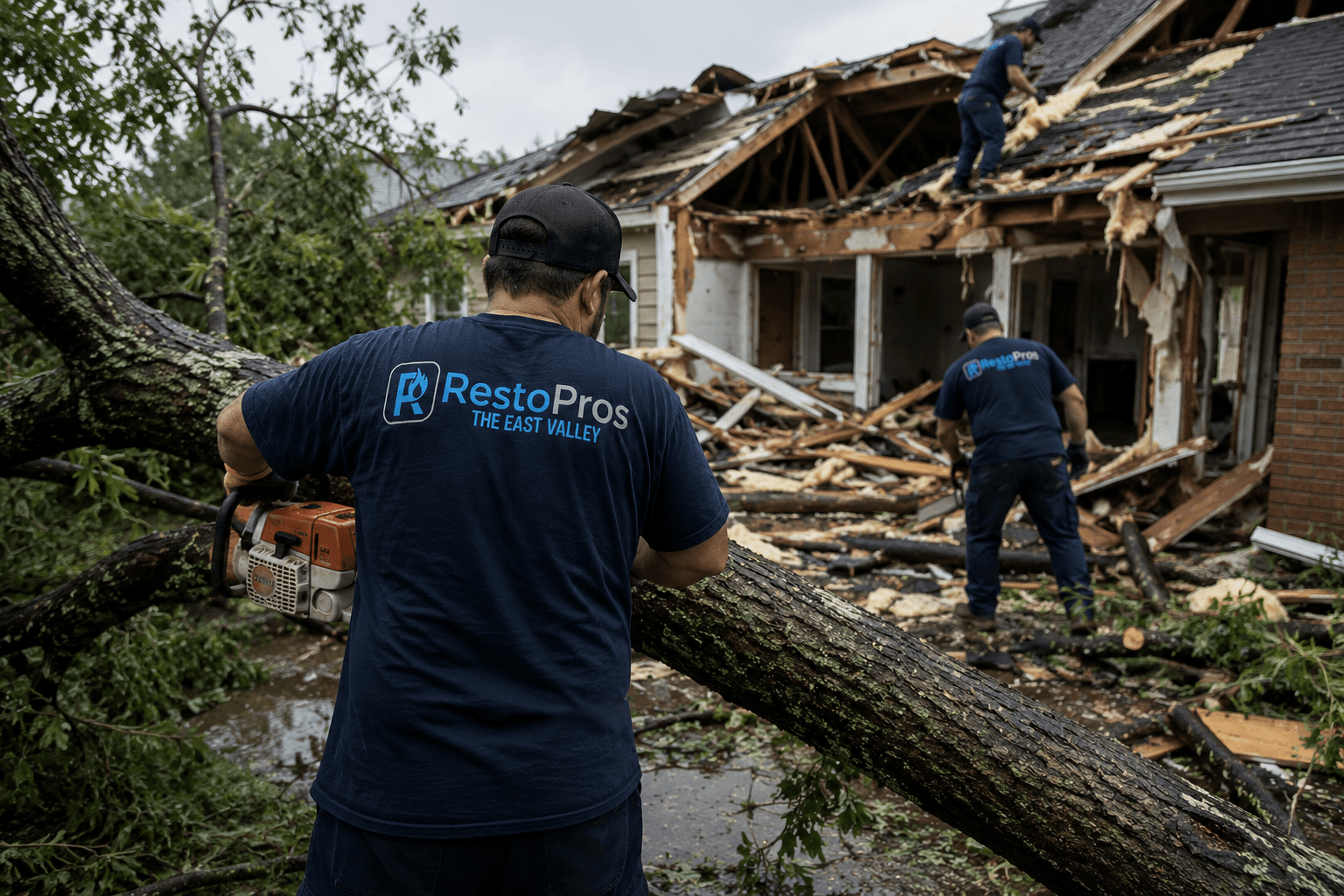
RestoPros crew tarping monsoon storm damage on a Chandler, AZ home
RestoPros

Storm & Flood Damage Restoration in Chandler, AZ — 24/7 Emergency Tarping

A monsoon cell can strip tile off a Chandler roof in under two minutes, and the rain behind it arrives before you've finished looking at the mess in the yard. RestoPros of the East Valley answers 24/7 and typically reaches Chandler addresses within 60–90 minutes with tarping, board-up, water extraction, structural drying, and the rebuild — documented so your insurance claim holds together.

Google
starstarstarstarstar
5.0 Google Rating
verified

Licensed & Certified

IICRC Certified Technicians

shield

Fully Insured

Bonded for Your Protection

location_on

Local East Valley Pros

Mesa, Chandler, Gilbert, Tempe & Queen Creek

Most storm damage in Chandler is not dramatic. A few tiles slide, a solar mount loosens, a bit of flashing lifts — and from the driveway the roof looks completely normal. The damage that actually costs money happens over the following weeks, as each subsequent storm pushes water through the opening the first one made, into attic insulation and down through ceiling assemblies. By the time a brown ring appears on a bedroom ceiling in September, the wet material above it has been sitting through three or four storms.

What makes Chandler different from the rest of the East Valley is what sits on top of its roofs and who has to approve touching them. This is a city of newer master-planned neighborhoods with rooftop solar and active homeowners associations, which means a storm repair here often involves three parties who do not talk to each other: your insurer, your roofer, and either your solar provider or your HOA's architectural committee. That coordination problem delays more Chandler repairs than the actual construction work does.

We handle the whole sequence — emergency tarping the day you call, moisture mapping, extraction and verified drying, then reconstruction — and we document the damage by cause so wind and flood portions of the claim route to the right policies. Free inspection, written line-item scope, and direct billing to your carrier on covered work.

What Storms Actually Do to Chandler Homes

Six patterns account for most of the storm calls we run in Chandler, and several of them are specific to how this city was built.

Solar array mounts as roof penetrations

Rooftop solar is common across Chandler's newer neighborhoods, and every panel is anchored by mounts that pass through the roof surface. Those penetrations are sealed, and sealant degrades in Arizona sun. High wind puts leverage on the array and transfers it into the mounts, so a storm can loosen a flashing seal without moving a single panel. The array still looks perfect from the street while water enters at the anchor points. If you have solar and you had wind, the mounts need looking at specifically — a general roof glance will miss them.

HOA architectural approval delaying tile repairs

In Ocotillo, Fulton Ranch, Sun Groves and most of Chandler's master-planned communities, replacing roof tile means matching color and profile to the community standard, and that often requires architectural committee sign-off. Discontinued tile profiles make this worse. The practical effect is that the roof repair — the thing that stops water entering — can stall behind an approval process while monsoon season continues. This is why we tarp properly rather than temporarily: the tarp may need to hold for weeks, not days.

Wind-driven rain past flashing and roof penetrations

Outflow winds ahead of a monsoon cell drive rain horizontally, which defeats flashing designed for water falling downward. Vents, skylights, swamp cooler curbs, and solar conduit penetrations all become entry points under those conditions. Water enters the attic, saturates insulation, and travels along framing before it appears anywhere visible.

Part-year residents discovering damage late

Chandler and neighboring Sun Lakes have a significant number of residents who leave for the summer — precisely the months when monsoon storms hit. A roof opened in July has until October to let water in, and what would have been a tarp and a repair becomes saturated insulation, ceiling replacement, and often mold. If you're away, having someone check the property after major storms is worth far more than it costs.

Flat and low-slope commercial roofs on the Price Corridor

Chandler's office, tech and light-industrial buildings along the Price Corridor use membrane roofing that ponds water rather than shedding it. Storm debris blocks drains and scuppers, ponding follows, and seams fail under standing water. For these properties the loss is rarely the roof itself — it's the interruption, the equipment underneath, and every day the space can't be used.

Block walls, RV gates, and yard structures

Block-wall fencing catches wind like a sail, and long unsupported runs topple in gusts. Add patio covers, shade sails, ramadas, and RV gates in Chandler's newer subdivisions and you get debris moving at speed toward the house — which is how windows and stucco get damaged by a storm that never touched the roof.

Storm Response Across Chandler

What we expect to find shifts by area, and knowing the neighborhood shapes how we inspect.

  • location_onOcotilloNewer homes with high rates of rooftop solar and strict community architectural standards. Mount-penetration leaks and tile-match approval delays are the two recurring themes here.
  • location_onFulton RanchLarger two-story homes with more exposed roof area and longer interior water paths — storm water entering the attic can surface a room or two away from where it came in.
  • location_onAndersen Springs & north ChandlerLate-1970s through mid-1990s construction with roofs and underlayment at or past service life, plus mature trees capable of dropping substantial limbs.
  • location_onSun Groves & south Chandler1990s–2000s subdivisions on open ground with limited windbreak, where wind loading on roofs and block-wall fencing is highest.
  • location_onDowntown Chandler & the historic coreOlder buildings with low-slope roof sections that pond rather than shed, and assemblies that hold water longer than modern construction.
  • location_onPrice Corridor & commercial ChandlerMembrane roofing, drainage-dependent systems, and businesses where reopening speed matters more than anything else on the estimate.
timelineOur Process

Our Chandler Storm Damage Process

Stop the water first, prove what happened second, rebuild third — in that order, every time.

01

Call & Rapid Dispatch

Reach us any hour at (520) 482-3900, including during a storm. Crews typically arrive at Chandler addresses within 60 to 90 minutes.

02

Tarp & Secure

Roof tarping and board-up happen on arrival, before scoping is finished. Because HOA approvals and tile availability can delay a permanent repair here, we install tarps to hold for the medium term rather than overnight.

03

Inspect the Whole Roof — Including the Solar

Moisture mapping with meters and thermal imaging, attic inspection for wet insulation, and a specific look at solar mounts, flashing, and penetrations. We photograph everything for the claim while it's still visible.

04

Document by Cause

Wind and roof-path water get scoped separately from any ground-path water. They fall under different policies, and combining them into one estimate is a common route to partial denial.

05

Extract, Remove & Dry

Standing water out, saturated insulation removed — it holds water and won't dry reliably in place — then commercial drying with daily logged moisture readings until materials hit dry standard, plus antimicrobial treatment to stop post-monsoon mold.

06

Repair & Rebuild

Drywall, texture matching, paint, insulation and flooring, coordinated with your roofer and, where needed, your HOA's approval process and your solar provider. One point of contact through to the final walkthrough.

Chandler Storm Damage: Cost, Coverage, and the Solar Question

The cost of a Chandler storm loss is set less by the storm than by how long the opening stayed open. A tile displaced on Saturday and tarped on Saturday usually means damp insulation and a short dry-out. The same opening left through two more August cells means saturated insulation across a wide span, ceiling replacement, and often mold remediation on top. Everything else — roof scope, interior finishes, whether flooring is affected — follows from that first decision.

On coverage, the distinction that decides most monsoon claims is direction of travel. Wind damage, and rain that entered through an opening the wind created, are generally covered by standard Arizona homeowner's policies. Water that rose from the ground — street flooding, runoff backing up, water under a door — is generally a flood loss, excluded from homeowner's and requiring separate flood insurance. A single Chandler afternoon can produce both, which is exactly why we scope them as two causes from the first visit.

Solar adds a third party. If wind damaged the array itself, that may fall under your homeowner's policy, your solar lease or PPA agreement, or the installer's workmanship warranty depending on how the system was financed and how old it is. If the damage is a leak at the mounts rather than to the panels, it's usually a roof claim. We document the penetration condition specifically so the right party is looking at the right problem — and so you aren't caught between a roofer and a solar company each pointing at the other.

  • check_circle24/7 emergency tarping and board-up, built to hold while approvals and materials catch up.
  • check_circleSolar mounts, flashing and penetrations inspected specifically — not just a general roof look.
  • check_circleDamage documented separately by cause so wind and flood claims each route correctly.
  • check_circleFree inspection with a written line-item scope; direct insurance billing on covered work.

Storm Damage in Chandler? Get Tarped Before the Next Cell

Monsoon storms arrive in waves, and an open roof invites every one of them. Call RestoPros of the East Valley at (520) 482-3900 for 24/7 emergency tarping, board-up, water extraction and full storm damage restoration across Chandler.

Get in Touch

Need a free inspection in Chandler? Fill out the form and our local team will get back to you quickly.

schedule

Open 24/7 for Emergencies

helpFAQ

Storm & Flood Damage Restoration in Chandler — FAQs

We run 24/7 through monsoon season and typically reach Chandler addresses within 60 to 90 minutes. On heavy storm nights volume can stretch that, so call early rather than waiting for morning — the next cell is usually only hours behind the first.

Yes. We tarp around and beneath arrays without walking on panels or disturbing wiring, and we inspect the mounts and flashing specifically, since that's where storm leaks usually start on a solar roof. If the array itself looks damaged we'll document it and tell you to bring your solar provider in — we won't touch the electrical side.

It's the most expensive assumption in monsoon season. A displaced tile has broken the roof's water seal, and the damage arrives with the next rain — into insulation and ceiling assemblies, where mold can start within 24 to 48 hours in August heat. A same-week inspection costs nothing and is far cheaper than a September ceiling rebuild.

This is common in Chandler's master-planned communities, especially when a tile profile has been discontinued and a match has to be sourced or approved. We install tarping designed to hold for the medium term, keep the interior dry with equipment while you wait, and provide documentation the committee and your adjuster can both work from.

Wind damage, and rain that came in through a wind-created opening, are generally covered. Water that rose from the ground — street flooding or runoff under a door — is generally a flood claim needing separate flood insurance. Many Chandler storm losses involve both at once, which is why we document them separately by cause.

Arrange for someone to walk the property after major storms and photograph the roofline from the ground — a neighbor, a property watcher, or a service. Damage found in July is a tarp; the same damage found in October is usually insulation, ceiling and mold. If something is found while you're away, we can secure the property and send photo documentation and a written scope before you travel back.

call

Emergency Help 24/7

CALL 520-482-3900

arrow_forward