
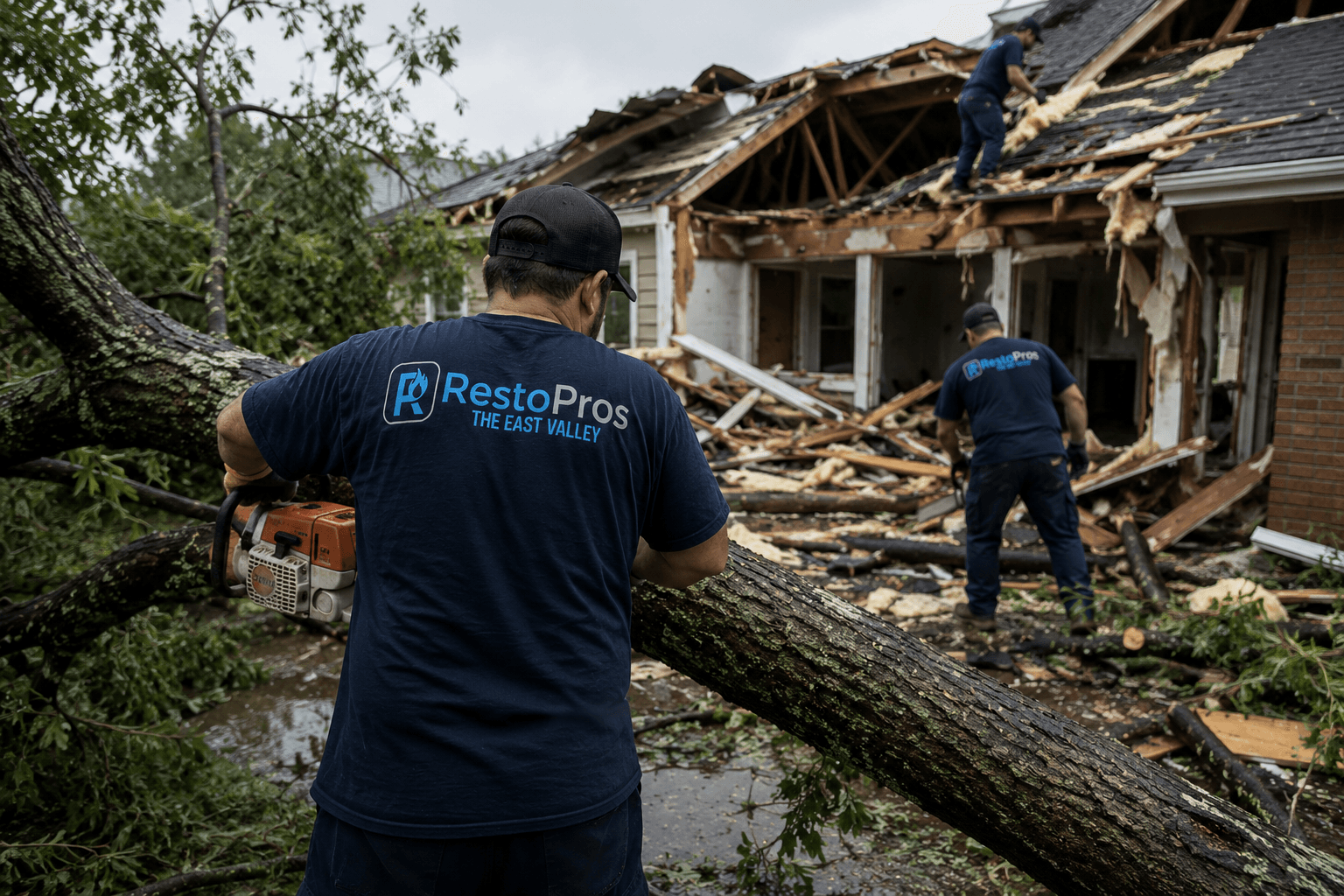
If you've lived in the East Valley through even one monsoon season, you know the sight: a wall of brown dust a mile high rolling across the horizon from the southeast, swallowing Queen Creek, then Gilbert, then Mesa in a matter of minutes. That's a haboob — and while the photos are dramatic, what matters to homeowners is what those storms leave behind: stripped roof tiles, sandblasted AC units, and the wind-driven rain damage that follows close behind.
This guide covers what a haboob actually is, when they hit Arizona, the specific damage they cause to East Valley homes, and exactly what to inspect once the dust settles.
Key Takeaways
- A haboob is a monsoon-driven dust wall with wind gusts commonly reaching 40–60+ mph — strong enough to lift roof tiles and throw debris.
- The most expensive haboob damage usually isn't the dust — it's the rain that often follows, entering through wind-opened roofs.
- Wind damage is generally covered by homeowner's insurance; flooding from the same storm usually is not.
- After every haboob, check your roof line, attic, AC unit, and pool equipment before the next storm cell arrives.
What Is a Haboob?
A haboob is an intense dust storm created when a collapsing thunderstorm pushes a burst of cold air downward. That outflow hits the desert floor and shovels loose dust into a rolling wall that can stand several thousand feet tall and stretch dozens of miles wide. The National Weather Service's monsoon safety guidance puts the Phoenix metro — including the entire East Valley — in one of the most haboob-prone corridors in North America, because storms collapsing over the deserts southeast of the Valley send their outflow straight up the Highway 60 and I-10 corridors.
Visibility can drop from miles to near zero in under a minute. But for your house, the dust is mostly a mess. The wind is the weapon.
When Is Haboob Season in Arizona?
Haboobs are a monsoon phenomenon, so the season mirrors it: mid-June through the end of September, peaking in July and August when storm activity over the deserts is strongest. The East Valley typically sees several significant dust storms per summer, usually arriving in the late afternoon or evening — often as the opening act of a thunderstorm that brings rain twenty or thirty minutes later. That sequence matters, and we'll come back to it.
What Haboob Winds Do to East Valley Homes
Roofs take the first hit
Outflow gusts work exactly like prying fingers on roofing. Concrete and clay tiles lift and slide; asphalt shingles crease and tear at the tabs; foam and flat roofs lose gravel and membrane edges. The damage is often invisible from the ground — a slipped tile or a creased shingle looks fine from the driveway but has broken the roof's water seal.
Debris becomes ammunition
Patio umbrellas, trampolines, ramada covers, and unsecured gates go airborne in 50 mph gusts. Mature trees — especially shallow-rooted mesquites and palo verdes that Valley landscapers love — drop limbs onto roofs, walls, and vehicles. Block-wall fences catch wind like sails and can topple sections outright.
Your AC pays a quiet price
Rooftop and side-yard condenser units ingest a storm's worth of fine dust into their coils. One haboob won't kill a unit, but a summer of them chokes airflow, raises head pressure, and shortens compressor life — and a struggling AC in August has a way of creating condensate leaks that show up as ceiling stains weeks later.
Dust finds every gap your house has
Fine dust infiltrating around door sweeps, window seals, and attic vents is annoying — but it's also information. Anywhere dust got in, wind-driven rain can get in too. A visible dust line in the attic or garage after a haboob is a map of your home's air leaks, drawn for free.
The Real Danger: The Rain That Follows
Here's the pattern that produces most of the storm damage calls we run every summer: the haboob arrives first and opens the roof — a slipped tile here, a lifted shingle edge there. Then the parent thunderstorm arrives with an inch of rain in thirty minutes, and that rain goes straight through the openings the wind just made. The homeowner sees a ceiling stain two days later and assumes a small leak. What's actually up there is soaked insulation, wet framing, and — in Arizona's August heat — a mold colony on a 24-to-48-hour head start.
This is why we treat 'minor' post-haboob roof damage as urgent. If a storm has already hit your home, our storm and flood damage restoration team tarps and dries first, then repairs — because stopping the next storm's water matters more than cosmetics.
After-the-Haboob Checklist
- Walk the roofline from the ground with binoculars: look for slipped or cracked tiles, lifted shingle edges, and debris sitting on the roof.
- Check the attic with a flashlight: fresh dust lines show air (and water) pathways; damp insulation or a musty smell means water already got in.
- Inspect ceilings and the tops of walls over the next several days — monsoon leaks often stain slowly.
- Look at your AC condenser: bent fins, packed dust, or debris against the coil deserve a service visit before the next 115° week.
- Photograph everything before you clean up. Wind damage claims settle on documentation.
- Check pool pumps and skimmers — a haboob can dump pounds of dust into a pool and clog equipment.
Does Insurance Cover Haboob Damage?
Generally, yes — wind is a covered peril on standard Arizona homeowner's policies, which means tile damage, fence sections, tree strikes, and rain that entered through wind-created openings are usually claimable. The critical distinction: water that rises from the ground (flash flooding after the same storm) falls under separate flood insurance, not your homeowner's policy. Many monsoon losses involve both, which is why we document damage by cause — wind-driven rain through the roof versus rising water — so each claim is routed correctly the first time.
Frequently Asked Questions
How strong are haboob winds in Arizona?
Outflow gusts in a typical haboob run 40–60 mph, and stronger storms can exceed that. It's the same wind mechanism as a severe thunderstorm gust front — more than enough to lift roof tiles, snap tree limbs, and push over block-wall fencing.
Should I run my AC during a dust storm?
Your AC's condenser will pull dusty air either way, but it's smart to check and replace your indoor return filter after major dust storms, and have coils cleaned if units have been through several. If the system starts leaking water at the air handler afterward, shut it down and get it checked — clogged condensate lines after dust season are a common source of ceiling damage.
Do haboobs damage roofs even without rain?
Yes. The wind alone lifts and slides tiles and creases shingles. The damage often doesn't show up until the next rain finds the opening — which is exactly why a post-storm roof check matters even when the storm was 'just dust.'
What should I do if a haboob damaged my home in Mesa, Chandler, or Gilbert?
Photograph the damage, don't climb the roof yourself, and get it tarped before the next storm cell. RestoPros of the East Valley provides 24/7 emergency tarping, board-up, water extraction, and storm damage repair across the East Valley — and we bill your insurance directly.
Storm Damage After a Haboob? We're Local and We're Fast
When the dust settles and something's wrong — a slipped tile, a stained ceiling, a fence in the neighbor's yard — call RestoPros of the East Valley at (520) 482-3900. We respond 24/7 across Mesa, Chandler, Gilbert, and the rest of the East Valley with tarping, drying, and full storm damage restoration. And if you want to get ahead of the next one, start with our monsoon season prep guide for East Valley homeowners.