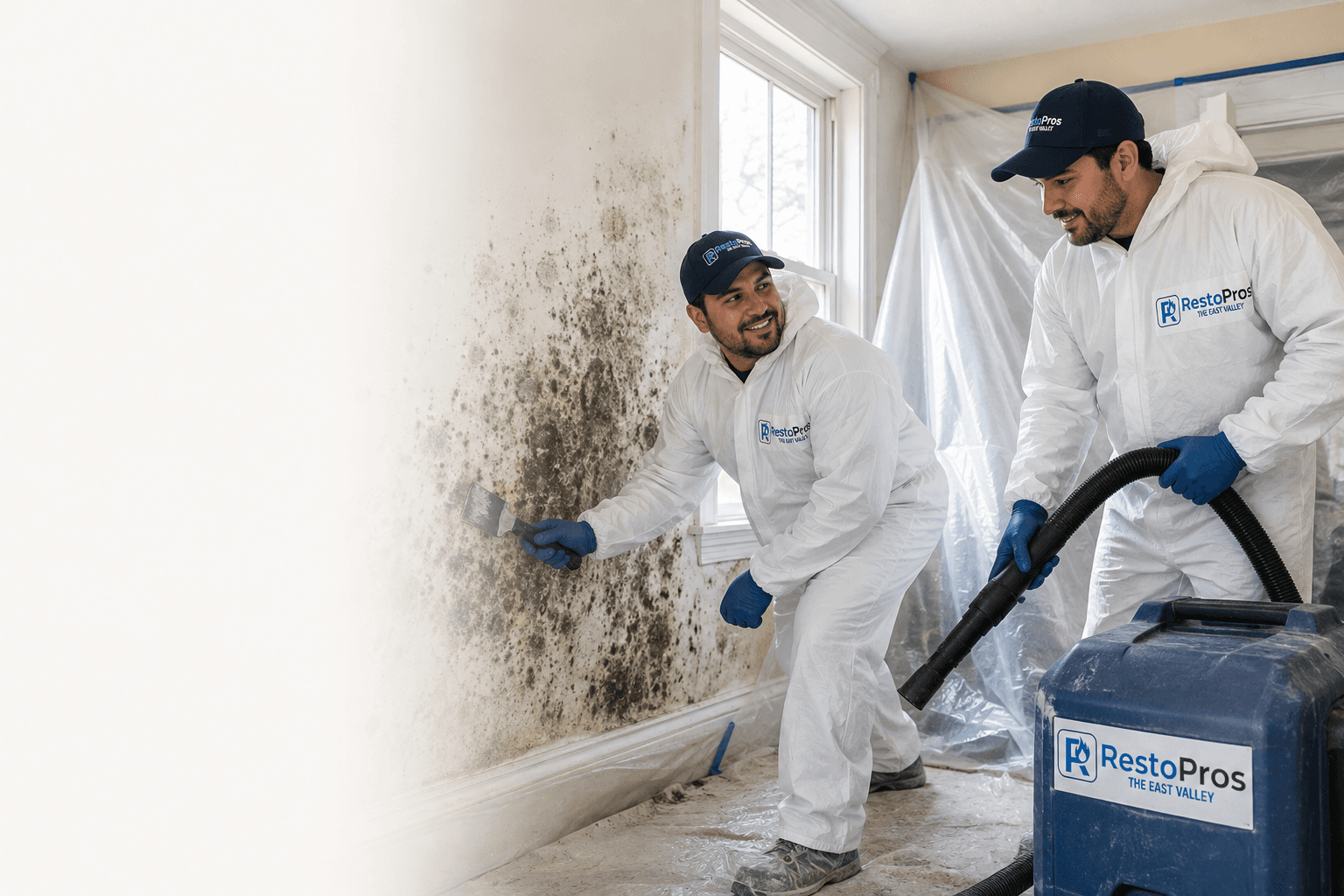
Apache Junction's housing stock is unlike anything else in the East Valley, and that difference shapes nearly every mold job we do here. A significant portion of the city's homes are manufactured or mobile units — HUD-code structures where the floor assembly is a wood-framed deck sitting above a belly wrap of insulation, not a concrete slab or a conventional crawl space. When a water line weeps or a toilet seal fails inside one of these homes, the moisture doesn't just wet the visible floor covering. It saturates the OSB or particleboard decking beneath it and wicks into the fiberglass batt wrapped in the belly — and that environment, dark, insulated, and completely sealed from airflow, produces mold growth that no amount of surface cleaning will reach. Many restoration companies decline this work because opening a manufactured-home undercarriage is genuinely different from pulling drywall. We do it routinely.
The second factor in Apache Junction is seasonality. A large share of homes here belong to winter visitors, and a home that sits locked from May through October is a home where a slow leak, a cooler overflow, or a roof penetration can run for four to five months before anyone smells it. By October, that's not early-stage growth on the surface. It's mature, established colony growth that has moved into framing and structural members. The scope is larger, the insurance conversation is different — vacancy clauses in most homeowner policies exclude losses that occurred or worsened during a vacancy period — and the remediation decisions are often being made by someone still in Minnesota or Wisconsin, over the phone, for a property they haven't seen. We handle that situation regularly.
Third, Apache Junction still has a substantial number of older homes and manufactured units running evaporative coolers — swamp coolers — rather than refrigerated AC. These units add humidity to the indoor air by design, which raises baseline indoor moisture levels higher than anywhere refrigerated air conditioning is the standard. More importantly, swamp coolers penetrate the roof, and those roof penetrations are a persistent leak point. A cooler that's been leaking at its curb for a season doesn't drip inside dramatically — it saturates the roof decking and the attic insulation slowly, and growth spreads outward from the penetration under insulation that looks dry on the surface. That failure pattern is distinct from AC condensate issues and distinct from monsoon intrusion, and it requires different inspection methods to find it.