
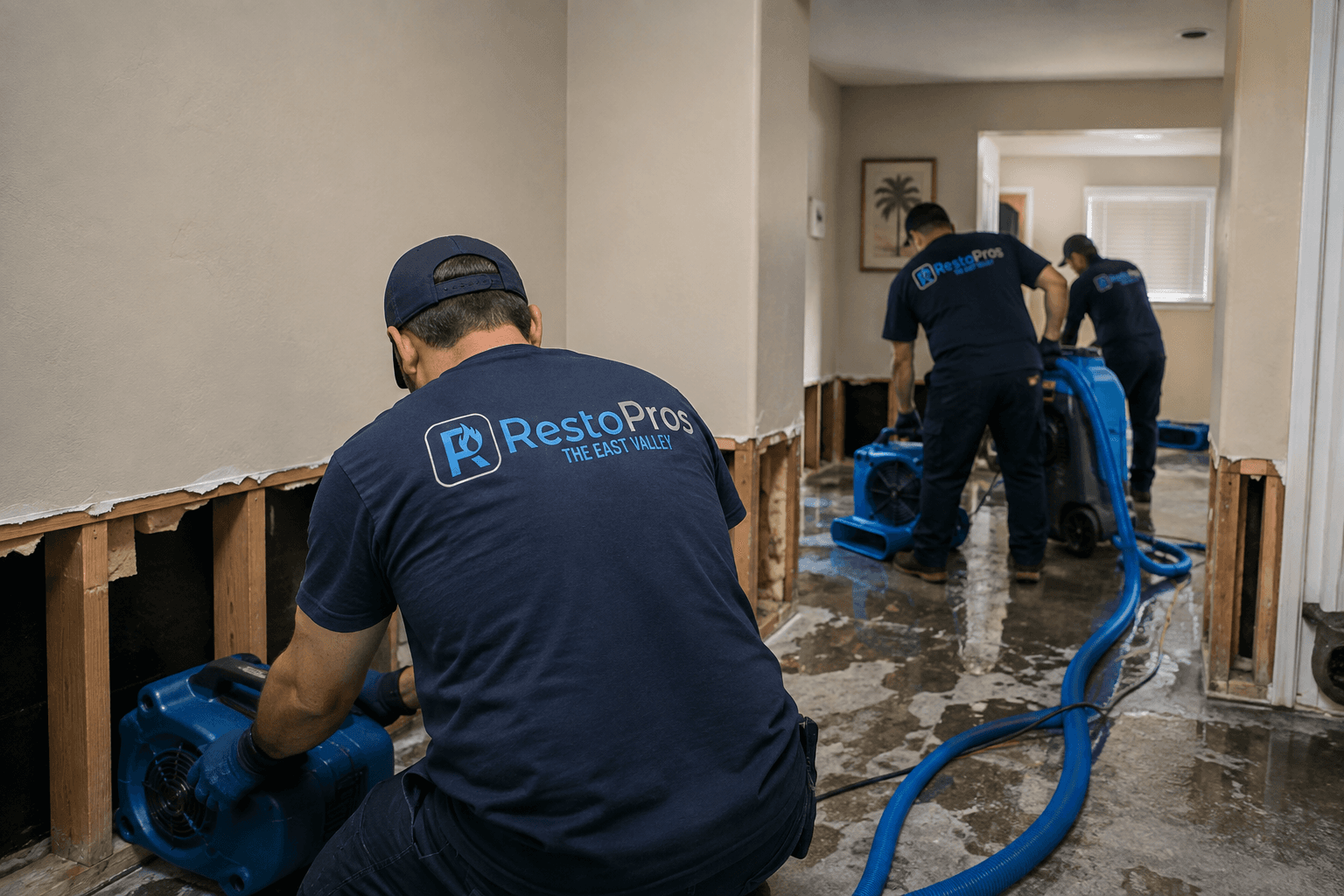
Every October, as winter residents return to Apache Junction and Gold Canyon, our phones start ringing with a particular kind of call: 'We just got back, and something smells wrong.' A supply line that failed in June has had four months to work. A monsoon-opened roof has taken three storms. What would have been a hundred-gallon cleanup in an occupied home became a soaked structure, a mature mold colony, and sometimes a gutted interior — because water damage is a function of time, and vacant homes give it all the time it wants.
The good news: vacant-home losses are the most preventable category in our industry. An hour of shutdown work before you leave eliminates most of the risk. Here's the complete playbook.
Key Takeaways
- Shutting off the main water supply before you leave prevents the majority of catastrophic vacant-home losses outright.
- Summer is the high-risk season for Arizona seasonal homes: supply fittings fail in the heat and monsoons test every roof, with nobody there to notice.
- Check your policy's vacancy clause — many policies restrict coverage after 30–60 days unoccupied unless you've made arrangements.
- A $50 leak sensor or a property watcher on a biweekly schedule turns a four-month disaster into a four-day repair.
Why Vacant Arizona Homes Flood in Summer
Three mechanisms account for nearly all of it. First, plumbing failures on a timer: supply lines, toilet connectors, and water heaters don't care that you're in Michigan — and summer attic and garage temperatures north of 130° accelerate the aging of every rubber washer and braided line in the house. Second, monsoon season runs June through September, precisely the vacancy window: a haboob lifts tiles in July, and every storm after that waters your attic. Third, the AC-off greenhouse effect: a sealed house at 95°+ interior with any moisture source becomes a humidity chamber where mold grows faster than almost anywhere in the country. The desert doesn't protect an empty house; the empty part is the whole problem.
The Before-You-Leave Shutdown (One Hour, In Order)
- Shut off the main water supply — the single highest-value action on this list. The house-side shutoff is typically near the front hose bib; if it's a gate valve older than the ban on pull-tab cans, have a plumber swap it for a quarter-turn ball valve first.
- Turn the water heater to vacation mode (or off, gas valve closed, if you've shut water off) — an empty-and-heating tank is both a hazard and a warranty killer.
- Open a faucet briefly after shutoff to relieve line pressure.
- Inspect and replace suspect supply lines: toilets, faucets, washing machine (braided stainless only), fridge ice maker. These fail more than pipes do.
- Leave the AC on, set warm but running — 85–88° with the system cycling controls humidity and protects wood, drywall, and cabinets. A dead-off house in monsoon season swings humid enough to feed mold on its own.
- Pre-monsoon roof check: tiles, flashing, and the condition of anything that penetrates the roof. June is the right month; October is the expensive one.
- Clear gutters, scuppers, and yard drainage so the first microburst doesn't pond water against the house.
- Photograph every room, the roof line, and your water meter reading on departure day — your insurance file will thank you.
The $50 Upgrade That Changes Everything
Wi-Fi leak sensors — small pucks placed at the water heater, under sinks, behind the washer, and near the AC air handler — text your phone the moment they get wet, from anywhere. A step up, smart shutoff valves close the main automatically when a sensor trips or flow runs abnormally. For a seasonal household, this is the best-value insurance money can buy that isn't actually insurance: the failure still happens, but it's a Tuesday text and a neighbor's five-minute visit instead of an October discovery.
The Vacancy Clause: Read It Before You Need It
Most homeowner's policies distinguish between an occupied home, an 'unoccupied' one (furnished, you intend to return), and a 'vacant' one — and many restrict or void certain coverages after 30 or 60 consecutive unoccupied days unless you've disclosed the pattern or added an endorsement. Seasonal residents should ask their agent three questions directly: How does my policy treat my summer absence? Is there a periodic-inspection requirement (some policies expect someone to check the home on a schedule)? Do I need a vacancy or seasonal-home endorsement? A property watcher visiting every two weeks — documented with photos — satisfies most requirements and shortens every timeline that matters.
The Return-Day Walkthrough
- Trust your nose first — musty or earthy smell on opening the door means moisture found a home. Don't air it out and forget it; find the source.
- Scan every ceiling and the tops of walls for stains, bubbling, or texture distortion — monsoon leaks stain in rings.
- Open every under-sink cabinet and check the water heater pan and floor.
- Look at wood floors and baseboards for cupping, gapping, or dark edges.
- Restore water at the main, then watch your meter's low-flow indicator with all fixtures off — movement means a leak beat you home.
- Check the attic if you can do so safely: water stains on decking, matted insulation, or that same musty smell.
If You Find Damage — Especially Old Damage
Resist the urge to demo it yourself or run fans on a months-old problem — long-dwell water almost always means mold, and disturbing it without containment spreads spores through the house you just got back to. Photograph everything untouched, note your departure-day photos and meter reading, and get a professional moisture and mold assessment before anything is opened. Insurers scrutinize vacant-home claims; documentation showing you shut down properly, arranged checks, and acted immediately on discovery is what keeps a months-old loss claimable.
Frequently Asked Questions
Should I really shut off the water for the whole summer?
Yes — it's the one action that converts nearly every plumbing failure from a catastrophe to a non-event. If something in the house needs water (some evaporative systems, irrigation on the same line), isolate what you can and sensor the rest.
Should I leave the AC running in a vacant Arizona house?
Yes — set warm (85–88°) but running. It's not about comfort; it's humidity control. A sealed, dead-off house in monsoon season cycles enough moisture to feed mold and warp wood, and the cooling cost at that setpoint is modest.
What if damage happened while we were away — is it still covered?
Often yes, if the cause is a covered peril and you can show reasonable care: proper shutdown, periodic checks per your policy, and immediate action on discovery. This is exactly where vacancy clauses and documentation decide outcomes — and where our photos, moisture mapping, and cause documentation help your claim.
Can you start work before we're back in Arizona?
Yes — this is routine for us in Apache Junction and Gold Canyon. Your property watcher or neighbor lets us in, we secure and mitigate immediately, and you get photo updates, the written scope, and adjuster coordination remotely. The house is stabilized before your flight lands. Call (520) 482-3900.
Seasonal Home in Apache Junction? We're Your Local Backstop
RestoPros of the East Valley handles water damage restoration across Apache Junction and Queen Creek — including manufactured homes, and including owners managing everything from two time zones away. Save our number with your house-sitter's: (520) 482-3900, answered 24/7.