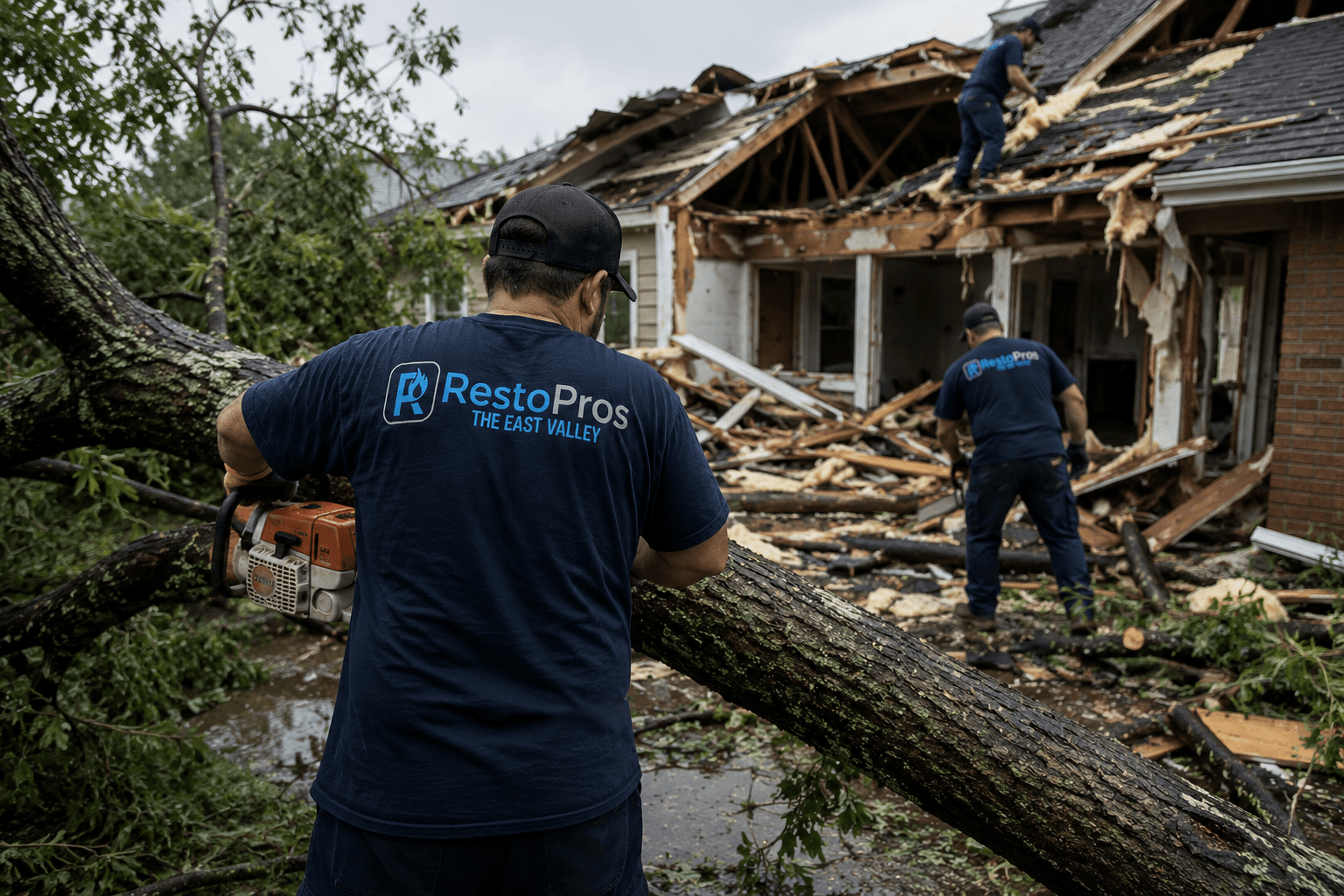
Mesa storm damage follows a rhythm most homeowners only learn the hard way. Between mid-June and the end of September, collapsing thunderstorms send outflow winds ahead of the rain — the haboob wall everyone photographs. Those gusts commonly hit 40 to 60 mph, which is more than enough to lift concrete tile, crease shingles, tear at fascia, and put a mesquite limb through a roof. Then the parent storm arrives with an inch of rain in half an hour, and it goes straight through whatever the wind just opened.
That sequence is why storm work is time-sensitive in a way that surprises people. The wind damage itself is often modest and cosmetic-looking. The expensive damage is what the next three storms do through the opening, into attic insulation, down through ceiling assemblies, and into wall cavities — where, in August heat, mold gets going within 24 to 48 hours. A tarp within hours of the first storm is frequently the difference between a roof repair and a whole-ceiling rebuild.
Mesa's size and variety complicate it further. Tall two-story rooflines in Las Sendas and northeast Mesa catch more wind. Mature trees in the older west Mesa and downtown neighborhoods drop limbs. Low-lying areas and properties near washes take flash-flood water at ground level, which is a contaminated-water job with a completely different scope. We handle all of it, from the first tarp to the final coat of paint.