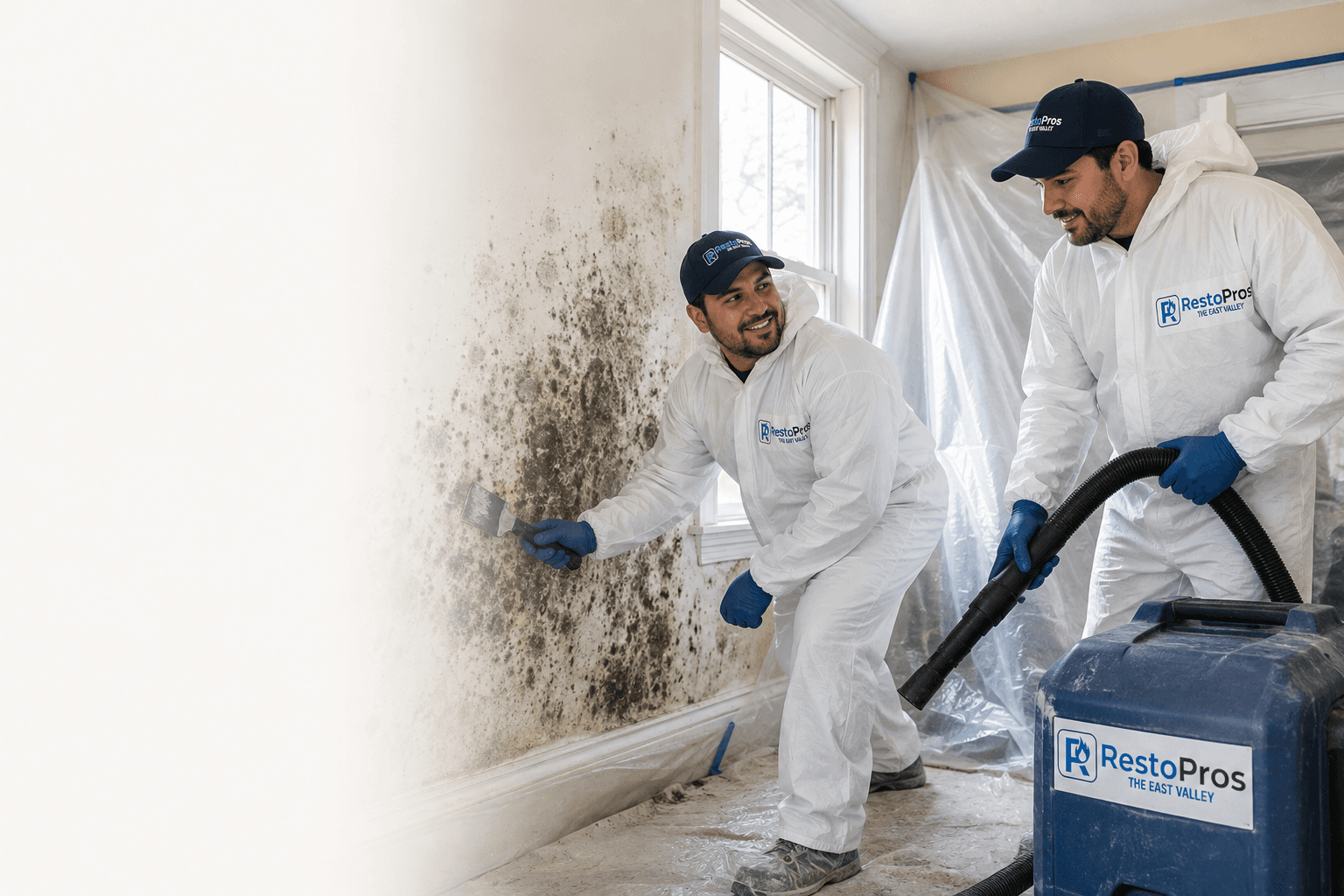
IICRC-certified technician conducting a documented mold inspection in a Tempe, AZ rental property
RestoPros

Mold Testing, Inspection & Remediation in Tempe, AZ — Documentation That Holds Up

In Tempe, mold is often less about the cleanup and more about the paper trail. Tenant complaints, buyer contingencies, landlord disputes, and HOA disagreements all land in the same place: someone needs documented results that stand up to scrutiny. RestoPros of the East Valley provides free moisture inspections and IICRC-standard remediation — plus third-party testing coordination when the situation genuinely calls for it. We give you the kind of written clearance that closes disputes, not just the kind that clears a room.

Google
starstarstarstarstar
5.0 Google Rating
verified

Licensed & Certified

IICRC Certified Technicians

shield

Fully Insured

Bonded for Your Protection

location_on

Local East Valley Pros

Mesa, Chandler, Gilbert, Tempe & Queen Creek

More people in Tempe go looking for mold testing than for mold removal, and that ordering tells you something real about this city: here, mold is frequently a dispute before it's a repair. A tenant says the unit made them sick. A buyer's inspector flags something during escrow. A condo owner is certain the source is in the unit above. A landlord wants proof that the move-out condition was the outgoing tenant's doing. In every one of those situations, what people actually need is documentation — who tested, what they found, and what was done about it.

The honest answer about testing is this: per EPA guidance, identifying the specific species of indoor mold growth almost never changes what you do about it. All significant indoor growth gets removed using the same containment and remediation protocol regardless of genus. Where third-party testing genuinely earns its cost is in transactions and disputes — when you need an independent industrial hygienist's written report to satisfy another party rather than for your own decision-making. We will tell you clearly when that's the situation you're in, and when a free moisture inspection answers the question just as well.

Tempe's housing adds a physical layer to this that other East Valley cities don't share. The oldest neighborhoods in the area — Maple-Ash, Holdeman, University Park — have plaster and lath walls that hold and release moisture differently than modern drywall. Growth hides in different places in these assemblies: in the air gap between plaster and framing, in the wood lath itself, along horizontal mortar joints in block construction. And because many of these homes predate 1990, asbestos testing may need to happen before mold remediation can begin — particularly if the moisture source requires opening walls. We coordinate both and sequence them so there are no delays.

Why Tempe Mold Jobs Look Different From the Rest of the Valley

Four factors make Tempe mold work distinct from what we see in newer East Valley cities — the building stock, the rental density, the dispute context, and the turnover cycle.

Plaster and lath assemblies hide growth differently

Homes in Maple-Ash, Holdeman, and University Park were built with plaster applied over wood lath — a multi-layer assembly with air gaps, wood, and lime or gypsum that holds moisture in pockets modern drywall doesn't have. When a pipe weeps inside one of these walls, the moisture disperses through lath channels before it shows on the surface. Growth is often found in the wood lath, behind the plaster face, or at the wall-floor junction long before anything is visible. Thermal imaging and moisture meters are the only way to map the real footprint in this construction type.

Rental density creates the move-out discovery pattern

A significant share of Tempe mold calls happen at turnover — when a unit is emptied between tenants, furniture that had been sitting against a wall for two years moves, and the growth behind it is discovered. This is the pattern that generates the most contentious disputes: the landlord wants to know if the tenant caused it; the outgoing tenant insists it was pre-existing. A documented inspection at the time of discovery, with moisture readings showing whether the source is still active, is the only thing that answers that question with evidence rather than argument.

Real estate transactions with inspection contingencies

Tempe's condo and older single-family inventory turns over frequently, and mold flags during buyer inspections are common given the housing era. When a mold clause is triggered in escrow, the parties often disagree about whether testing is needed, what the scope of remediation should be, and who pays. Third-party industrial hygienist testing plus written clearance after remediation is often required to close the deal — and the timeline is compressed. We've done this enough times in Tempe to know how to move fast and produce documentation that satisfies buyer, seller, and both agents.

Condo and multi-unit ownership disputes

In Tempe Town Lake condos and high-density buildings near Mill Avenue, an upstairs unit's leak becomes the downstairs owner's mold problem — but the upstairs owner may dispute that their unit is the source. Third-party testing and documented moisture mapping of the origin versus the affected area is what these disputes require. We produce the written scope and coordinate with the HOA so the party responsible for remediation and the party responsible for reconstruction are clearly separated.

Pre-1990 materials and the asbestos sequencing issue

Many Tempe homes from the 1960s through the 1980s contain asbestos in drywall joint compound, vinyl floor tile, and ceiling texture — materials that are common water damage surfaces. Before mold remediation can remove any suspect material in a home this age, asbestos testing determines whether abatement is required first. We coordinate sampling and sequencing so remediation doesn't have to pause mid-job. This is a routine part of working in Tempe's housing stock, not a surprise.

Delayed discovery from tenant non-reporting

Tempe's rental market means the person living in the space is often not the person paying for repairs — which creates a well-documented delay in reporting. A slow leak behind a shower wall in an ASU-area rental may go months without mention. By the time it's discovered, the growth is well established in the wall cavity, and what would have been a contained remediation becomes a rebuild. Growth that has had months to develop in a sealed plaster assembly spreads into framing and subfloor in ways that a week-old moisture event would not.

Mold Inspection & Remediation Across Tempe

Each part of Tempe has a characteristic housing type and a corresponding pattern of where moisture accumulates and where growth hides.

  • location_onMaple-Ash & Mitchell ParkThe historic core of Tempe. Plaster-over-lath construction with wood framing means moisture is concealed in layered assemblies, and growth found here is almost always more extensive than the visible patch suggests. Pre-1990 materials are the rule, not the exception, so asbestos testing before demolition is standard practice on any remediation that opens walls.
  • location_onHoldemanMid-century single-family and smaller rental properties with aging plumbing and low-slope roof sections. Growth in Holdeman typically originates from slow supply-line weeps inside enclosed cabinets or from flat-roof intrusion that saturates ceiling insulation above the plaster. The rental density here means move-out discoveries are common.
  • location_onUniversity Park & the ASU corridorHigh-density student rental housing where delayed reporting is the norm. Growth is often discovered by the landlord or property manager, not the occupant, and is commonly found behind furniture in bedrooms or in bathroom wall cavities that have been weeping for months. The dispute question — tenant-caused or pre-existing — comes up on nearly every job in this corridor.
  • location_onWarner RanchNewer construction on the south side of Tempe, where the mold sources shift from vintage plumbing to AC condensate, supply fitting failures, and water heater closets. Growth here tends to be more contained and discovered earlier, but the documentation needs are similar when a tenant complaint or pre-sale inspection is the trigger.
  • location_onThe LakesWaterfront-adjacent condos and single-family homes where exterior moisture conditions are more persistent than in inland Tempe. Ground-level units in particular can have slab moisture issues, and the water-adjacent setting means the baseline ambient humidity in crawl spaces and at foundation level is higher than most of the East Valley.
  • location_onTempe Town Lake condos & Mill Avenue corridorHigh-rise and mid-rise residential buildings where multi-unit moisture pathways are the dominant issue. A single pipe failure can affect four units across two floors, and the documentation requirements — origin unit, affected units, shared assemblies — are more complex than a single-family job. We produce the layered scope that HOAs and multiple insurers need.
timelineOur Process

How We Handle Tempe Mold Jobs — From First Call to Written Clearance

The process is the same IICRC-standard remediation we use everywhere. What's different in Tempe is the documentation we build at each stage, because this market requires it.

01

Free Moisture Inspection & Scope

We map the moisture footprint with calibrated meters and thermal imaging — not just the visible patch, but the actual affected area through the assembly. You get a written finding describing what we found, where the source is, and what the remediation scope is. This document is yours to share with a landlord, property manager, HOA, or adjuster without modification.

02

Honest Assessment of Testing

We explain where testing adds real value and where it doesn't. In a landlord-tenant dispute, a buyer-seller escrow situation, or a multi-unit origin dispute, third-party industrial hygienist testing provides independent documentation that settles the argument. For a homeowner who simply wants to know whether to act, a free moisture inspection with clear written findings is usually sufficient. We coordinate certified third-party testing when that's the right tool.

03

Asbestos Sequencing If Needed

For any pre-1990 Tempe property where remediation will require opening walls or disturbing suspect materials, we arrange asbestos sampling before remediation begins. We know which materials to test in homes of this era and how to sequence results so the remediation doesn't stall. Clearance comes back before demolition starts.

04

Containment Under Negative Air

The work area is sealed with plastic barriers held under negative pressure with HEPA filtration, so the remediation process doesn't spread spores to unaffected parts of the building. In multi-unit buildings this means containing to the affected unit — we don't rely on building HVAC shutdown alone.

05

Removal, Treatment & Verified Drying

Contaminated porous materials are removed and bagged for disposal. Remaining surfaces receive EPA-registered antimicrobial treatment. Structural drying follows with daily logged moisture readings until materials reach dry standard — not surface-dry, but verified dry through the assembly.

06

Written Clearance & Reconstruction

Visual clearance and final moisture verification at completion. Where the job requires it — transactions, disputes, documented health concerns — we coordinate post-remediation clearance testing through an independent industrial hygienist. Reconstruction follows: drywall, plaster texture matching on historic assemblies, flooring, paint. You get a finished space and a documented record.

Mold Remediation Costs in Tempe: What Drives the Number

The variables that move price most are scope (how much material is genuinely affected, not just what's visible), access difficulty, what's feeding the moisture, whether asbestos testing adds a pre-remediation step, and what documentation you need at the end. A single-bathroom wall remediation with straightforward access runs in the low thousands in this market. A job that involves plaster-and-lath assemblies with moisture that has migrated through framing, or a multi-unit building with documented origin and cascade, is a larger scope — not because of padding, but because the actual affected area and the work required are larger. We never guess; we measure and write it down.

Insurance coverage for mold follows the same Arizona-wide rule: mold that results from a sudden, covered water event is generally covered up to the policy's mold sublimit, which is commonly $5,000 to $10,000. Mold from long-term moisture, gradual leaks, or deferred maintenance is typically excluded. In Tempe's rental market, this distinction becomes legally significant — if a tenant's delayed reporting is what turned a covered water event into an excluded mold claim, that fact belongs in the documented record. For landlord policies, the documentation of timing and source matters for exactly this reason.

We don't charge for inspections, and we don't inflate scopes. If growth you're seeing is small, on a non-porous surface, and there's no hidden moisture source, we'll tell you what you can handle yourself and what to watch for. The free inspection is also where we determine whether third-party testing adds value in your specific situation or whether it's an added cost that won't change the outcome. Call (520) 482-3900 and we'll tell you what we find.

  • check_circleFree inspection with written findings — documented and shareable with landlords, managers, adjusters, and HOA boards.
  • check_circleThird-party industrial hygienist testing coordinated when transactions, disputes, or documented health concerns require independent results.
  • check_circleAsbestos sampling arranged and sequenced before remediation in pre-1990 properties — no mid-job delays.
  • check_circleWritten clearance documentation at completion, including post-remediation testing where required for close of escrow or dispute resolution.

Mold Found in a Tempe Rental, Condo, or Home? Start With a Free Inspection

Whether you need documentation for a dispute or just want to know what's behind the wall, the first step is the same: a free moisture inspection with written findings. Call RestoPros of the East Valley at (520) 482-3900 — IICRC-certified remediation, containment under negative air, and clearance documentation that holds up.

Get in Touch

Need a free inspection in Tempe? Fill out the form and our local team will get back to you quickly.

schedule

Open 24/7 for Emergencies

helpFAQ

Mold Remediation in Tempe — FAQs

Third-party mold testing means an independent industrial hygienist collects air or surface samples, sends them to an accredited lab, and issues a written report with species identification and spore counts. That report carries weight in real estate transactions, landlord-tenant disputes, and multi-unit origin disagreements — situations where one party needs documented independent findings to satisfy another. Per EPA guidance, species identification almost never changes what gets done: all significant indoor growth is removed using the same protocol regardless of genus. For a homeowner who simply wants to know whether to remediate, our free moisture inspection with written findings usually answers the question without the testing cost. We'll tell you honestly which situation you're in.

You need a written moisture inspection report establishing whether growth is present and whether the source is active, a documented remediation scope and clearance report, and ideally a dated record of when the complaint was received and when remediation began. Third-party testing by an independent industrial hygienist strengthens your position if the dispute moves forward. We produce written inspection findings and remediation documentation as a matter of course; we coordinate certified testing when the situation calls for it. Call us as soon as the complaint is received — timing matters for both remediation outcomes and documentation.

The sequence depends on what the mold clause in your purchase agreement requires, but the typical path is: independent testing to establish scope, a written remediation plan, remediation with containment, and post-remediation clearance testing that produces a written clearance report. We've worked through this process enough times in Tempe to know how to move within escrow timelines. We provide the written scope and clearance documentation; you provide it to the parties and the transaction moves forward.

Possibly — and the answer depends on what materials the remediation requires disturbing. Homes built before 1980 commonly contain asbestos in drywall joint compound, vinyl floor tile, ceiling texture, and pipe insulation. If mold remediation will require removing or cutting into any of these materials, Arizona and federal EPA rules require testing before the work begins. We arrange sampling, sequence it before the remediation start date, and adjust the scope once results are back. It adds a step, but it's non-negotiable and protects everyone involved.

That depends on the source and the timeline, which is exactly what a documented inspection determines. If the moisture source is an active slow leak from building plumbing, it predates tenancy and is typically an ownership responsibility. If the source is condensation from a covered AC unit or a fixture the tenant damaged, the situation is different. The moisture readings and source identification in our written inspection report are the evidence that answers this — not an opinion, but a measured finding. We document what we find at the time of discovery so the record is dated and objective.

Plaster over wood lath is a layered assembly with air channels between the plaster face and the framing behind it. Moisture that enters through a pipe leak or wall penetration disperses through those channels and can travel several feet from the entry point before saturating the lath. Growth takes hold in the wood lath, in the framing behind it, and at the wall-floor junction where moisture pools — none of which is visible from the room side. Thermal imaging and moisture meters at multiple depths are the only reliable way to map the real boundary. Removal in plaster assemblies also requires care around asbestos-containing additives that were common in pre-1980 plaster formulations, which is another reason testing precedes the work.

call

Emergency Help 24/7

CALL 520-482-3900

arrow_forward