
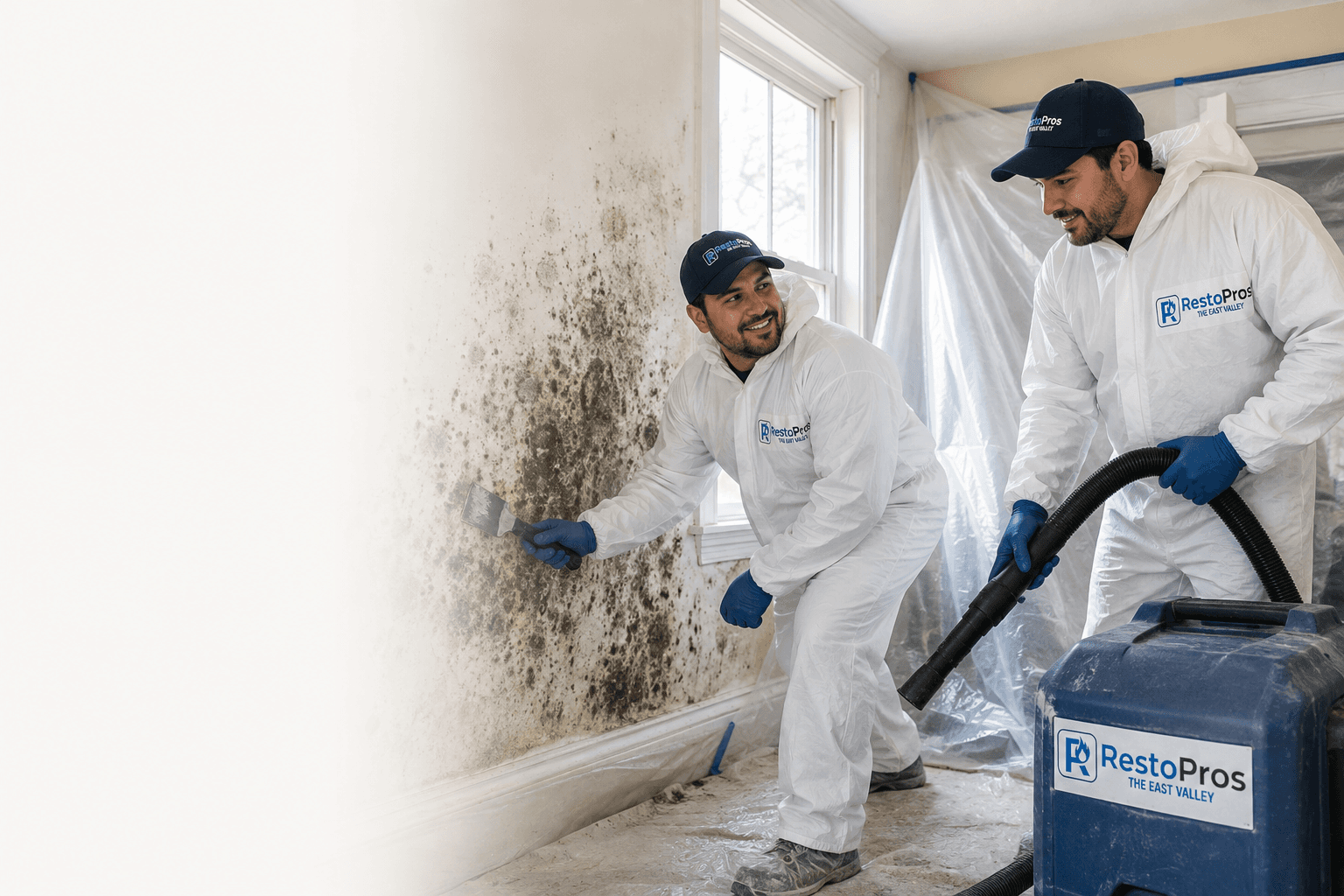
A musty smell is one of the most useful warnings a house can give you — and one of the most commonly ignored. That damp, earthy, wet-cardboard odor is made of microbial volatile organic compounds (MVOCs): gases released by mold and mildew as they actively grow and digest whatever they're living on. Which means the smell isn't a leftover, and it isn't 'how older homes smell.' If you can smell it, something is growing right now, somewhere moisture is feeding it.
In a climate as dry as the East Valley's, that logic is even sharper: ambient mustiness has no business existing here. When a Gilbert or Mesa house smells musty, there is a specific wet spot with a specific address. Here's how to find it.
Key Takeaways
- Musty odor = active microbial growth. It is evidence of a current moisture problem, not a past one.
- The big five East Valley sources: the AC system, under-sink leaks, water heater closets, front-load washers, and moisture under flooring from a slab leak.
- Timing is diagnostic: worse when the AC starts points to the HVAC; worse after rain points to the roof or walls; constant in one room points to that room's plumbing or slab.
- Air fresheners are counter-diagnosis. Mask the smell and you've silenced the only alarm the problem was sounding.
Read the Timing Before You Search
When the smell appears tells you where to look. Strongest in the first minutes after the AC kicks on: the system itself — coil, condensate pan, or ducts — is the source or the messenger. Stronger after monsoon rain: water is entering the roof, walls, or windows and re-activating growth. Constant in one specific room regardless of weather: that room's plumbing, or moisture rising from the slab beneath it. Strongest on opening the house after time away: general humidity or a slow leak that builds odor while doors stay closed. Keep this map in mind — it cuts the search in half.
The Room-by-Room Hunt
Start at the vents
Smell directly at a supply register while the AC runs, then again at the return grille. If the odor rides the airflow, your search just left the room and entered the system — coil, pan, and ductwork. That scenario has its own playbook: see our guide to mold in air ducts and AC vents.
Open every cabinet with plumbing in it
Under the kitchen sink, bathroom vanities, behind the fridge (ice maker line), the laundry room. You're looking for warped cabinet floors, water tracks, corrosion at valves — and smelling each enclosed space. A slow supply-line weep inside a closed cabinet is a textbook musty-smell generator that can run for months unseen.
Check the water heater and its closet
Interior water heater closets are prime odor sources: a slowly weeping tank or fitting in a dark, enclosed, warm space. Look for moisture in the pan and mineral tracks down the tank body.
Sniff the washer
Front-load washing machines with standing water in the door gasket are the most benign — and most common — musty source in newer Gilbert and Queen Creek homes. Peel back the gasket and look. If that's your whole problem, congratulations: clean the gasket, run a machine-cleaning cycle, and leave the door cracked between loads.
Read the floors
A musty smell hugging the floor line — strongest at baseboards, in closets, along one run of flooring — with no cabinet or appliance nearby is the serious branch of this flowchart. Moisture wicking up through the slab from a failed under-slab pipe feeds mold beneath flooring where nothing is visible. Cross-check the other symptoms in our slab leak detection guide — warm floor spots, a creeping water bill, a spinning meter with everything off — and treat two or more matches as a this-week problem.
Simple Sources, Simple Fixes
- Washer gasket or dishwasher standing water: clean, treat, ventilate the appliance. Done.
- A drain that's dried out (guest bathroom nobody uses): pour a quart of water into the P-trap — sewer gas smells different from musty, but empty traps invite both.
- Sink cabinet with a fixed old leak and lingering smell: if the wood is dry and sound, clean with detergent, dry fully, done. If it's soft, swollen, or the smell returns — the moisture isn't actually gone.
- General closed-house staleness after vacation with no findings anywhere: ventilate hard once, run the AC normally, and see if it stays gone. If it returns, it has a source; keep hunting.
When the Smell Means Something You Can't See
If a systematic hunt finds nothing but the smell persists — or it keeps returning to the same room — the growth is inside a wall cavity, above a ceiling, under flooring, or in the duct system. This is the point where the right tool changes: moisture meters and thermal imaging read through surfaces and find the wet spot without exploratory demolition. It's also the point where DIY stops making sense, because opening a contaminated cavity without containment turns one room's problem into the whole house's problem.
Frequently Asked Questions
Can a house smell musty without mold?
Rarely. Mildew (mold's surface-dwelling cousin), bacteria in standing water, and sewer gas from dry traps can each contribute — but persistent musty odor overwhelmingly indicates active fungal growth somewhere moisture is present. The smell is the metabolism.
Will a dehumidifier fix a musty smell?
In Arizona, usually not — our ambient humidity is too low for general dampness to be the cause. If drying the air helps, you've proven there's a localized moisture source loading that room, which still needs finding and fixing.
Why does my house smell musty only when the AC turns on?
The system is pushing air across or past growth — on the coil, in the condensate pan, or in the ducts. It's one of the most diagnostic patterns there is, and it's fixable at the source.
How do professionals find a smell I can't?
Moisture meters, thermal imaging, and borescope inspection of cavities — locating the wet material that must exist for the smell to exist. RestoPros includes this in our free inspections across the East Valley: (520) 482-3900.
Smell It But Can't Find It? That's Literally Our Job
Our mold remediation team runs source-detection inspections across Gilbert, Mesa, and the entire East Valley — free, with moisture mapping and a written finding. And if you do uncover visible growth along the way, our guide to what black mold looks like covers the next step.