
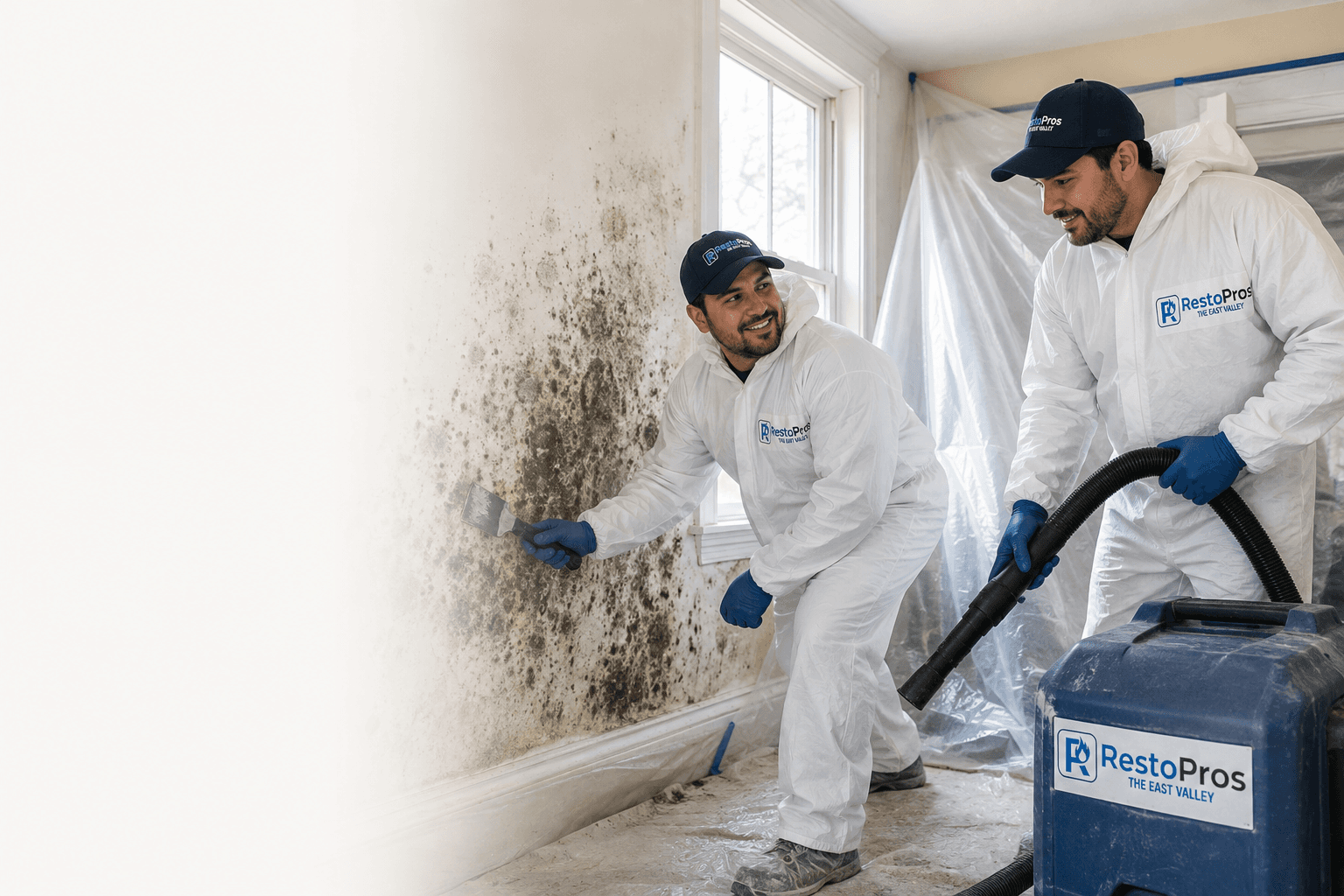
You've spotted something dark on the drywall behind the toilet, or along a window sill, or on the ceiling of a closet that shares a wall with the shower. Before you panic — or worse, scrub it and forget it — it helps to know what you're actually looking at. Here's how black mold typically appears, how to distinguish it from lookalikes, and the right next move for each case.
Key Takeaways
- 'Black mold' typically refers to Stachybotrys chartarum, but many common household molds look black — visual inspection alone can't identify species.
- Classic appearance: greenish-black patches, slimy when the area is wet and sooty when dry, spreading in circles, streaks, or clusters on materials that have been wet.
- Per EPA guidance, the species matters less than the response: any significant indoor mold growth should be removed and its moisture source fixed.
- Don't dry-scrub or blast it with bleach on porous surfaces — both can make the problem worse.
The Visual Signature of Black Mold
Color
Despite the name, black mold usually reads as greenish-black or very dark gray rather than jet black. Patches often show darker centers with slightly lighter, newer growth at the edges. On white drywall or ceiling texture the contrast is stark; on wood or dark grout it can hide longer.
Texture
Moisture changes its look. On actively wet material, black mold tends to appear slimy or wet-glossy — almost paint-like. Once the material dries out, the same colony turns dull, powdery, or sooty. Both states can shed spores when disturbed, which is why the scrub-first instinct backfires.
Growth pattern
Mold grows outward from its moisture source, so you'll typically see roughly circular spots that merge into irregular patches, streaks following a water path down a wall, or a band along the bottom edge of drywall that wicked up water from a floor leak. A defined 'water history' shape is one of the strongest clues you're looking at mold rather than dirt.
Location and smell
Black mold needs sustained moisture and loves cellulose — drywall paper, wood, insulation backing. That's why it shows up behind toilets and under sinks, on drywall after a slab or roof leak, in AC closets, around window sills where condensation collects, and inside wall cavities you can't see at all. A persistent musty, earthy odor often precedes any visible growth — in a closed-up Arizona house, your nose usually finds mold before your eyes do.
Black Mold vs. the Lookalikes
- Mildew: gray or white more often than black, powdery, sits on surfaces (shower grout, fabric) rather than growing into them, and wipes away easily. Mildew is a surface-cleaning job; mold in drywall is not.
- Dirt and soot: no growth pattern, no moisture history, distributed by air movement (look for matching marks near vents). A damp cloth removes dirt completely; mold usually stains or returns.
- Shadowing or ghosting on ceilings: uniform gray tracking along framing lines, caused by dust adhesion — common on East Valley ceilings — and unrelated to moisture.
- The test that matters: dab a small area with a drop of household bleach on a cotton swab. Mold typically lightens within a minute or two; dirt doesn't. (This is an identification aid on a small spot, not a cleaning method.)
Does It Matter If It's 'Toxic Black Mold'?
Less than the internet suggests. The EPA's mold guidance is blunt on this point: you don't need to identify the species, because all significant indoor mold growth should be removed and the underlying moisture problem fixed, regardless of type. Mold exposure can trigger allergy-type symptoms and irritation in many people, and some groups — infants, older adults, anyone immunocompromised or with respiratory conditions — should avoid exposure entirely. If anyone in the house is in those groups, err toward professional assessment rather than DIY.
"But It's a Desert — How Do I Have Mold?"
The most common thing we hear on mold jobs in Mesa and Gilbert. Outdoor humidity is irrelevant to the inside of your wall cavity. A slab leak, a roof leak from July's monsoon, an AC condensate clog, or a shower pan failure creates a sealed pocket of trapped moisture inside a cool, air-conditioned structure — a better mold habitat than most humid climates offer, because it never dries out on its own. Arizona homes don't get less mold; they get better-hidden mold.
What to Do If You've Found It
- Don't disturb it. Scrubbing, scraping, and dry brushing aerosolize spores and spread the colony to new surfaces.
- Skip the bleach on drywall and wood. Bleach's water carries into porous material and feeds the roots the chlorine never reaches — the patch comes back, often bigger.
- Find the water. Mold is a symptom; the diagnosis is a leak or condensation problem. Until the moisture source is fixed, any cleanup is temporary.
- Small and superficial (roughly under 10 square feet on a non-porous surface, per EPA's rule of thumb): careful DIY with detergent, gloves, and an N95 is reasonable.
- Larger than that, inside walls, on HVAC components, or after a known leak: professional remediation with containment is the right call — this is about preventing spread, not scrubbing harder.
Frequently Asked Questions
Is every black-colored mold 'toxic black mold'?
No. Many common household molds — Cladosporium, Alternaria, Aspergillus varieties — can appear black. Actual identification requires lab testing. Practically, it changes little: significant indoor growth gets removed and its moisture source fixed either way.
Can I just paint over black mold?
No — including with 'mold-killing' primers. Paint seals the surface while the colony continues in the material and the moisture problem persists behind it. Remediate, dry, then repaint.
What does black mold smell like?
Musty, earthy, damp — like wet cardboard or a closed-up cabin. In East Valley homes the smell is often strongest when the AC first kicks on, because the system pushes air through or past the colony.
When should I get a professional mold inspection?
After any water event that sat more than a day, whenever you smell mustiness without a visible source, or when a visible patch exceeds a couple of square feet or keeps returning. RestoPros of the East Valley includes moisture-meter mold checks in our free inspections — call (520) 482-3900.
Found Mold in Your East Valley Home? Get It Assessed Properly
Our IICRC-certified mold removal and remediation team serves Mesa and the entire East Valley with containment-first remediation: find the moisture, contain the area, remove contaminated materials safely, and treat so it doesn't come back. Not sure what you're looking at? Read the signs of mold after water damage every Mesa homeowner should know, or just send us a photo when you call.
And before you reach for the spray bottle, read does bleach kill mold — on drywall and wood it usually makes the problem worse, for reasons worth understanding first.