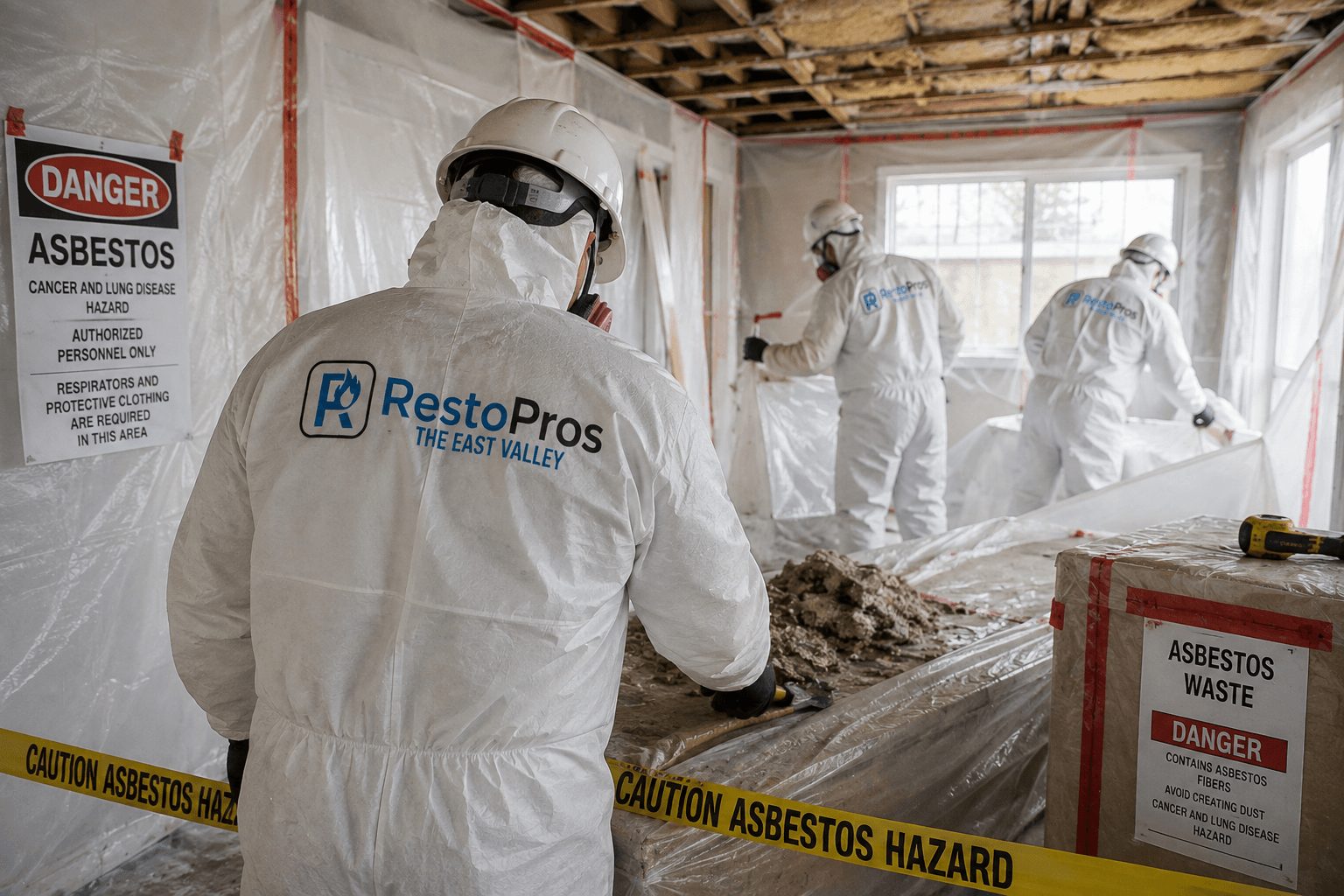
RestoPros crew in full PPE performing contained asbestos abatement in a Gilbert, AZ property
RestoPros

Asbestos Testing & Removal in Gilbert, AZ — Straight Answers First

Most of Gilbert's housing went up after asbestos left residential building materials. That's actually good news for the majority of homeowners here. The real exposure points in Gilbert are older — Heritage District commercial buildings being renovated, legacy agricultural outbuildings on remnant farm parcels, and the small pocket of pre-1990 homes scattered through older parts of town. RestoPros of the East Valley tests suspect materials first, removes only what needs to come out, and handles the restoration work that follows.

Google
starstarstarstarstar
5.0 Google Rating
verified

Licensed & Certified

IICRC Certified Technicians

shield

Fully Insured

Bonded for Your Protection

location_on

Local East Valley Pros

Mesa, Chandler, Gilbert, Tempe & Queen Creek

Gilbert was farmland before it was a suburb. The rapid growth from the mid-1990s into the late 2000s means most of the town's housing sits comfortably outside the asbestos era — asbestos was phased out of residential building materials through the 1980s and was largely gone from new construction by the mid-1990s. A 2003 house in Power Ranch almost certainly has no asbestos concern. That is an honest starting point, and we think it is worth stating clearly.

Where asbestos does appear in Gilbert is in the structures that predate the boom: older commercial buildings along the Heritage District corridors that are now being renovated and repurposed, outbuildings and agricultural structures on parcels that were working farms within living memory, and a smaller group of residential properties built in the 1970s and 1980s before Gilbert's growth took off. The risk is real in those contexts — but it is concentrated, not spread evenly across the town.

The moment asbestos becomes a hazard is when something disturbs it. Intact material left undisturbed is low risk. Renovation, demolition, lot clearing, or disaster damage that breaks, cuts, or crumbles asbestos-containing material releases microscopic fibers. Inhaled fibers accumulate in lung tissue over time and are linked to serious respiratory disease. That is why testing before demolition work begins is the only responsible sequence — not because every building is suspect, but because the stakes of getting it wrong are high enough to warrant a test.

Where Asbestos Risk Concentrates in Gilbert

Gilbert's exposure points are different from older East Valley cities. These are the specific contexts where asbestos-containing materials are genuinely plausible here.

Heritage District commercial renovation

Downtown Gilbert's older buildings are being actively converted — former retail, agricultural supply, and light-industrial structures repurposed as restaurants, offices, and mixed-use space. Commercial renovation and demolition work carries survey obligations that differ from single-family residential work. A pre-demolition asbestos survey is generally expected before commercial demo or significant structural renovation. Any contractor or property investor undertaking that type of project in the Heritage District should confirm survey requirements before breaking ground.

Legacy agricultural outbuildings

Gilbert was a farming community well into the second half of the twentieth century. Barns, equipment sheds, packing structures, and storage buildings on remnant farm parcels were commonly roofed and sided with asbestos-cement sheet — a durable, fire-resistant product also called transite. Transite is low risk while it is intact and unweathered. It becomes a hazard when it is cut, cracked, broken during demolition, or has deteriorated to the point where the surface is crumbling. Lot clearing that involves knocking down an old outbuilding is one of the highest-risk activities on a Gilbert parcel.

Pre-1990 residential pockets

A portion of Gilbert's housing stock predates the major growth era. These homes may contain the same asbestos-era materials found more broadly in Mesa and Tempe — drywall joint compound, vinyl floor tile, pipe insulation, popcorn ceiling texture. This group is much smaller in Gilbert than in neighboring cities, but the homes exist, and the risk is real for anyone opening walls or ceilings in one. The reliable test is the build year on your county property record, not the neighborhood name: if it comes back pre-1990, treat suspect materials as suspect until a lab says otherwise.

Lot clearing and redevelopment

Gilbert is still converting agricultural parcels to residential and commercial use. Clearing a site with older structures on it is exactly the activity that disturbs asbestos-containing material. Demolition of an old farmhouse, equipment building, or agricultural facility on a parcel being prepared for new construction may trigger pre-demolition survey requirements and creates a genuine exposure risk if asbestos-containing materials are present and not handled correctly.

Disaster damage to older structures

Water damage, fire, or storm events that affect pre-1990 buildings or agricultural structures can make asbestos-containing material friable — crumbly and fiber-releasing — that was previously stable. A roof failure on an older outbuilding that brings down a transite panel, or water damage that soaks and weakens original flooring in a pre-1990 home, can turn an intact, low-risk material into an active hazard. Cleanup and rebuilding in those situations should include material testing before anything is removed.

HVAC and mechanical in older commercial buildings

Pipe insulation, duct wrap, boiler insulation, and associated gaskets and cements from commercial mechanical systems installed before the late 1980s may contain asbestos. Heritage District buildings and any older commercial property undergoing mechanical upgrades or full gut renovation should have these systems evaluated before work begins — especially if demolition will involve opening ceilings or utility chases where older mechanical runs are concealed.

Gilbert by Area — Where Asbestos Risk Actually Applies

Gilbert's neighborhood age profile is unusually uniform for the East Valley — the boom-era subdivisions that define most of the town are largely outside the asbestos window. Here is an honest breakdown by area.

  • location_onHeritage District and older downtown GilbertThe densest concentration of pre-boom structures in Gilbert. Commercial buildings here range from early- to mid-twentieth century construction and include the full catalogue of asbestos-era commercial materials — floor tile, ceiling systems, pipe and duct insulation, roofing, and in some cases structural elements. Any renovation, tenant improvement, or demolition in this corridor warrants a pre-renovation survey. Pre-1990 residential properties in and around the Heritage District are also the most likely homes in Gilbert to contain asbestos-era materials.
  • location_onOlder pockets that predate the boomGilbert has scattered homes and small subdivisions built before the main growth surge, and they don't cluster neatly in one part of town. Rather than guess by neighborhood, check the build year on your county property record — it takes a minute and it is the only thing that actually settles the question. If it comes back pre-1990 and a water loss or renovation means opening original walls or ceilings, test the suspect material before debris removal starts.
  • location_onRemnant farm parcels across GilbertAgricultural parcels are not concentrated in one area of Gilbert — they are scattered across the town wherever development has not yet absorbed them. An outbuilding on any of these parcels could contain transite roofing or siding. If you are purchasing, clearing, or redeveloping a parcel with existing older structures, assume transite is possible and have the materials evaluated before demolition begins.
  • location_onPower Ranch, Seville, San Tan Ranch, and the main boom-era subdivisionsThese neighborhoods were built predominantly between the late 1990s and the mid-2000s — after asbestos was phased out of residential building materials. The standard housing stock in these communities does not present a plausible asbestos concern. Homeowners here dealing with a water loss, fire, or renovation project generally do not need asbestos testing unless their home was built before 1990 or the project involves unusual original materials. If you are unsure of your home's construction date, a free inspection will clarify quickly.
  • location_onMorrison Ranch, Agritopia, and central Gilbert mixed-era areasThese areas mix newer construction with older infill and some original agricultural context. Agritopia's intentional design around agricultural heritage means older structures may exist alongside new homes. Build era is the primary determinant of asbestos risk here — a newer home in either community has no meaningful concern, while any pre-1990 structure warrants the same precautions as older Heritage District properties.
  • location_onCommercial corridors — SanTan Village area and Gilbert RoadCommercial properties along major Gilbert corridors vary widely by age. Newer retail and office construction is outside the asbestos window. Older commercial buildings — particularly those that housed light industrial, agricultural supply, or trades businesses before Gilbert's growth era — may contain asbestos-era mechanical insulation, flooring, or roofing. Tenant improvement work or demolition in any older commercial building along these corridors should include a material assessment before work begins.
timelineOur Process

How Asbestos Abatement Works — From First Call to Clearance

The sequence matters. Testing before removal is not optional — it is what keeps a building or cleanup project from becoming a contamination event.

01

Inspect and identify suspect materials

We walk the property and identify materials that fall within the asbestos window by age, type, and condition. On pre-1990 residential jobs and any commercial or agricultural structure, this means cataloguing the materials that may be affected before any demolition or cleanup work begins.

02

Sample and test

Suspect materials are sampled by an accredited inspector and submitted to an accredited laboratory for polarized light microscopy analysis — the standard method for confirming asbestos presence and fiber type. Standard lab turnaround is two to five business days; rush turnaround is available when timelines require it. Nothing is removed based on visual identification alone.

03

Scope the work and handle required notifications

If testing confirms asbestos, we prepare a written scope before any abatement is scheduled. Past a certain quantity the job has to be reported to regulators before work starts — that is ADEQ in Arizona, working alongside the federal NESHAP rules, and it applies most often to commercial and demolition projects. We file the notifications and handle that paperwork. You get a clear, line-item scope before anything is touched.

04

Contain, isolate, and remove

The work area is sealed with plastic barriers and run at negative air pressure using HEPA filtration — meaning air flows into the containment zone rather than out, and fibers cannot escape. HVAC is shut down and sealed. Asbestos-containing material is wetted during removal to suppress fiber release, bagged in labeled waste containers, and handled by workers in full personal protective equipment including appropriate respirators. Nothing is dry-scraped or cut without controls in place.

05

Dispose and clear

Asbestos waste goes to an approved disposal facility with documentation — waste manifests are retained as part of the project record. After removal, the containment area is HEPA-cleaned before barriers come down. A licensed industrial hygienist performs air clearance testing; a written clearance certificate confirms the space is safe before it is reopened.

06

Restore

Once the space is cleared, we handle the restoration work — drywall, flooring, texture matching, paint, and any structural repairs required by the abatement. This is where coordinating abatement and restoration under one contractor saves time and prevents the gaps that open when separate crews hand off a project mid-stream.

What Asbestos Abatement Costs in Gilbert — and What Affects the Number

Abatement cost is driven by the type of material involved, how much of it there is, where it is located, and how much containment the project requires. A single room of vinyl floor tile in an open, accessible space is a straightforward job. Transite roofing panels on a demolished outbuilding, pipe insulation running through a tight crawl space, or ceiling texture across an entire commercial floor are larger projects that require more labor, more containment, and more disposal. Testing is a separate cost and is always worth it — it is the only way to scope the work accurately.

Insurance coverage depends on how the asbestos work is connected to the loss being claimed. Standalone abatement — testing and removing asbestos that was already present, not triggered by a covered event — is generally not covered. When abatement is necessary to complete the repair of a covered loss — a burst pipe requiring drywall removal, a fire that charred ceiling material — the abatement may be part of the covered scope, subject to policy limits and documentation of the connection. We work directly with adjusters and can provide the documentation they need to evaluate coverage.

The most expensive scenario in any abatement project is discovering asbestos mid-project, after demolition has already begun. Emergency abatement inside a partially demolished structure requires more containment, more time, and in some cases regulatory response. Testing first and building abatement into the project sequence is always less expensive than reacting to a mid-project discovery.

  • check_circleMaterial type, quantity, and location are the primary cost variables
  • check_circleTesting is a separate line item from abatement — budget for both
  • check_circleInsurance may cover abatement when it is tied to a covered loss; documentation is required
  • check_circleRush lab turnaround is available when project timelines require faster results

Not Sure Whether You Have an Asbestos Concern? Start With an Inspection.

If you are dealing with a pre-1990 Gilbert property, a Heritage District commercial building, an agricultural outbuilding, or a restoration project that may involve original materials, we will walk the property and tell you honestly whether testing makes sense. The inspection is free, and the written scope comes before any sampling or abatement is scheduled. Call (520) 482-3900 — we answer 24 hours a day and can usually get out to look within a business day. One honest note: abatement is scheduled work, not an emergency call-out, because nothing can be removed until lab results come back. If you have an active water or fire loss in an older building, say so on the phone — we can start emergency drying straight away and stage the asbestos work behind a rush test.

Get in Touch

Need a free inspection in Gilbert? Fill out the form and our local team will get back to you quickly.

schedule

Open 24/7 for Emergencies

helpFAQ

Asbestos Cleanup in Gilbert — FAQs

Almost certainly not. Asbestos was phased out of residential building materials through the 1980s and was largely gone from new construction by the mid-1990s. A home built in 2001 falls well outside that window, and the standard building materials used in boom-era Gilbert construction do not present a plausible asbestos concern. If your home has been significantly modified with materials from an older structure, or if something unusual turns up during renovation, that would be a reason to ask — but routine projects in 2000s-era Gilbert homes do not require asbestos testing.

Yes. Agricultural and industrial outbuildings built before the late 1980s were commonly roofed and sided with asbestos-cement sheet — also called transite. It is durable and low risk while intact, but breaking it apart during demolition releases fibers. Before knocking down any older outbuilding, have the roofing and siding materials evaluated. If transite is present, the demolition and disposal need to be handled as asbestos abatement work. This is a straightforward process when done correctly from the start.

Pre-demolition asbestos surveys are generally expected before commercial demolition or significant renovation work. The specific requirements depend on the scope of the project and the age and type of building. As a general rule, any Heritage District commercial building that pre-dates the 1990s should have suspect materials evaluated before structural work begins — flooring, ceiling systems, pipe and duct insulation, and roofing all fall within the asbestos window for that era. A licensed inspector can walk the building, sample suspect materials, and provide a written report before your contractor starts work.

It warrants quick attention. Broken transite or asbestos-cement roofing panels are a genuine exposure hazard if people are walking through the debris or if cleanup work is being done without knowing what the material is. Keep the area clear, avoid disturbing the debris further, and call us. We can assess the material, confirm whether asbestos is present, and manage the cleanup correctly. Acting quickly is better than leaving broken material exposed to weather or foot traffic.

It depends on how the abatement connects to the covered loss. Standalone asbestos removal — testing and taking out material that was already present without a triggering event — is generally not covered. When abatement is required to complete the repair of a covered loss, such as a water damage claim that requires removing asbestos-containing drywall, the abatement may fall within the covered scope. The key is documentation that links the abatement directly to the covered damage. We work with adjusters regularly and can provide the documentation needed to support a claim.

Think of it as two stages. Testing comes first — standard lab results take a few business days, with rush turnaround available when a project can't wait. Once results are back and you have a written scope, the abatement work itself on a single room typically runs one to three days. Larger jobs — whole-house work, commercial spaces, or agricultural structures — take longer depending on the material and the volume. You get an estimated timeline in writing before anything starts.

call

Emergency Help 24/7

CALL 520-482-3900

arrow_forward