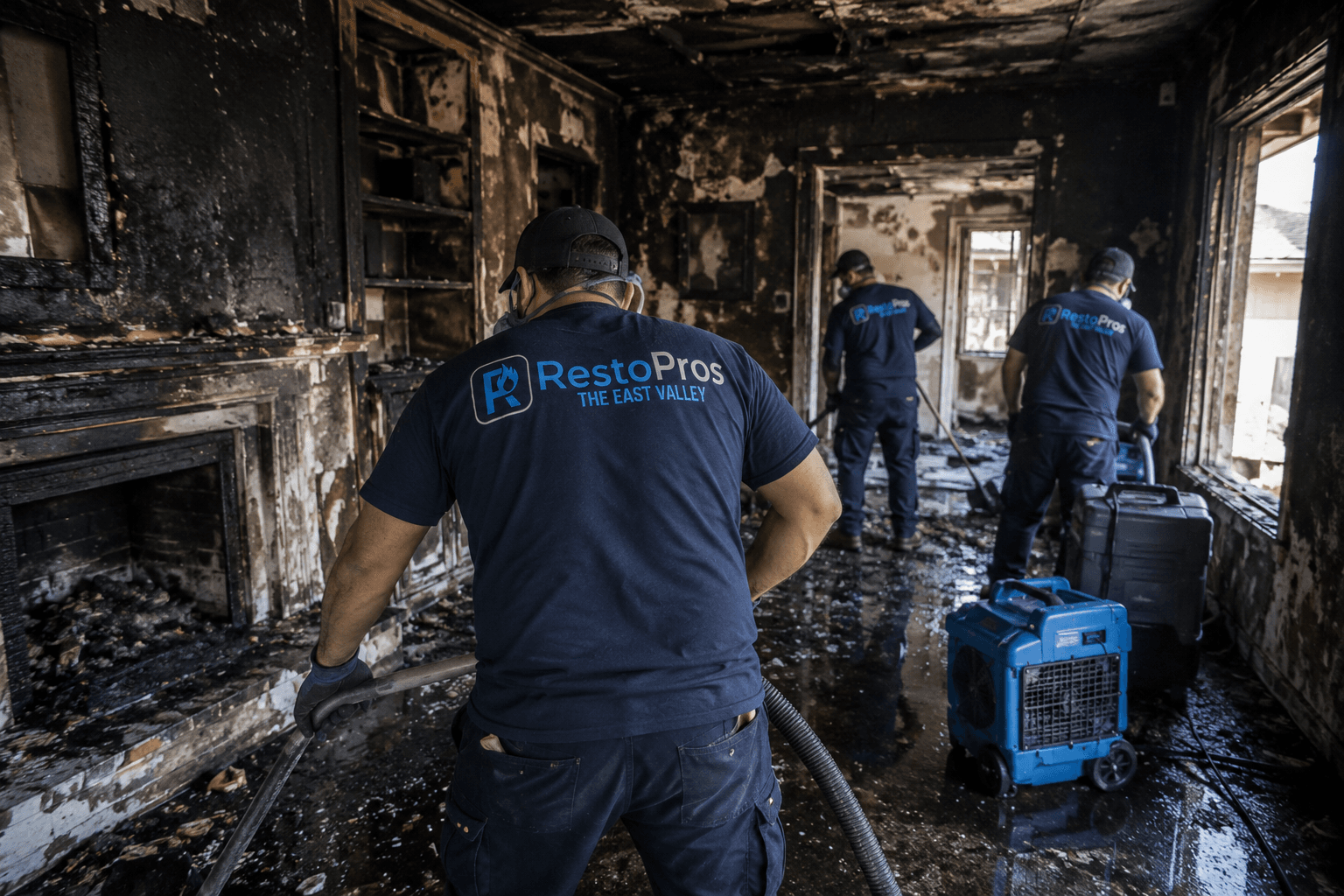
RestoPros technicians restoring fire and smoke damage in a two-story Gilbert, AZ home
RestoPros

Fire & Smoke Damage Restoration in Gilbert, AZ — 24/7 Emergency Response

In Gilbert's two-story homes, a fire on the ground floor becomes a smoke problem upstairs — heat drives residue up the stairwell and into the bedrooms, which is why the worst-smelling rooms are often the ones farthest from the flames. RestoPros of the East Valley responds 24/7 with emergency board-up, residue-matched soot removal, molecular deodorization, contents cleaning, and full rebuild.

Google
starstarstarstarstar
5.0 Google Rating
verified

Licensed & Certified

IICRC Certified Technicians

shield

Fully Insured

Bonded for Your Protection

location_on

Local East Valley Pros

Mesa, Chandler, Gilbert, Tempe & Queen Creek

Gilbert's housing has a specific consequence for fire damage that most homeowners discover only after the fact: this is a two-story town, and smoke goes up. Heat and combustion gases rise through the stairwell, spread across the upper-floor ceiling, and settle into bedrooms, closets, and the belongings inside them. Families regularly find the kitchen where the fire started needs cleaning and rebuilding, while the upstairs — untouched by flame — needs the most extensive deodorization and contents work in the house.

The open floor plans that define Gilbert's 1995–2008 construction boom make the ground floor behave the same way horizontally. Without doors and compartmentalization to slow it, smoke crosses the great room, kitchen, and dining area in moments and reaches the far side of the house well before anyone can respond. Combine vertical and lateral spread and a single contained fire can affect essentially the entire structure.

Two more Gilbert factors matter. First, these homes are built tight, so smoke doesn't ventilate out on its own the way it would in an older house — it stays until removed. Second, this is family territory: houses full of children's belongings, photographs, furniture, and irreplaceable items. Contents restoration is often the part of the job that matters most emotionally, and it's the part cheap bids write off wholesale rather than actually attempting.

How Fire and Smoke Behave in Gilbert Homes

The causes are ordinary. What's distinctive is where the smoke ends up in this city's housing.

Vertical smoke migration through stairwells

The defining Gilbert pattern. Heat carries residue up the open stairwell to the second floor, where it spreads across ceilings and settles into bedrooms and closets. Upper floors frequently need more deodorization and contents cleaning than the room the fire actually occurred in.

Open floor plans with nothing to slow lateral spread

Boom-era great-room layouts have few doors and little compartmentalization, so smoke crosses the entire main floor in moments. Scope on the ground floor is almost always wider than the burn area suggests.

Kitchen and cooking fires

The most common origin. Grease and food fires leave protein residue — a nearly invisible amber film with an intense rancid odor that coats cabinets, walls, and ceilings across a wide radius and rides the HVAC into the rest of the house.

Attached garage fires into shared attic space

Garages storing fuel, solvents, batteries, and equipment at extreme summer temperatures. Because garage and house attics commonly connect, smoke migrates overhead into the main structure and drops through ceiling penetrations and can lights.

Tight envelopes that hold smoke in

Modern construction limits air exchange by design. Smoke that gets into a Gilbert home doesn't dissipate over the following days — it settles onto surfaces and stays, making professional deodorization necessary rather than optional.

Suppression water through two floors

Firefighting water applied upstairs runs down through floor assemblies into the level below, so a fire loss in a two-story home is frequently a two-level water loss as well — on the standard 24-to-48 hour mold clock.

Fire & Smoke Response Across Gilbert

Layout and build era shape how far the smoke traveled before we arrive.

  • location_onPower RanchHeavily two-story, late-90s to mid-2000s. Stairwell smoke migration and upper-floor contents work are the signature scope here.
  • location_onSeville & San Tan RanchLarge 2000s homes with expansive open plans and long duct runs — wide lateral smoke spread and significant HVAC decontamination.
  • location_onMorrison Ranch & AgritopiaMixed-era neighborhoods where build year determines both the fire risk profile and how the structure holds odor.
  • location_onVal Vista Lakes & The IslandsLarger waterfront homes with high contents value, where item-by-item restoration rather than wholesale replacement makes a real difference to the claim.
  • location_onHeritage District & older GilbertPre-boom homes with aging electrical and older assemblies that hold smoke odor deeply; pre-1990 materials may need asbestos testing before demolition.
  • location_onSanTan Village & commercial GilbertRestaurants and retail where hood fires, grease residue, and reopening speed drive the entire job.
timelineOur Process

Our Gilbert Fire Restoration Process

Secure, stop the acid clock, dry, clean, deodorize, rebuild — with the upper floors scoped as carefully as the fire room.

01

Emergency Board-Up & Securing

Openings boarded, roof tarped, property secured. Call (520) 482-3900 any hour — crews typically reach Gilbert addresses within 60 to 90 minutes.

02

Multi-Level Assessment & Residue Testing

We scope every floor, not just the fire room — including upstairs bedrooms and closets where smoke settled. Residue type identified surface by surface, since each needs different chemistry.

03

Pre-Clean At-Risk Surfaces

Glass, metal, stone, and appliances treated within the first 24 to 72 hours, before acidic residue etches them permanently.

04

Extract & Dry Both Levels

Suppression water extracted from every affected floor and the structure dried with daily moisture verification — including ceiling assemblies between levels, which dry slowly and must be confirmed.

05

Soot Removal, Contents & HVAC

HEPA vacuuming and dry-sponge work before any wet cleaning, residue-matched chemistry, item-by-item contents processing including children's belongings and keepsakes, and duct decontamination.

06

Deodorize & Rebuild

Thermal fogging, ozone, or hydroxyl treatment after source removal, sealing primers on cleaned surfaces, then full reconstruction to pre-loss condition.

Gilbert Fire Restoration: Cost, Contents, and Coverage

Fire cost is driven by burn area, smoke travel, residue type, suppression water volume, HVAC involvement, and rebuild scope. Gilbert's two-story geometry pushes several of those upward at once: smoke reaches more rooms, water affects two levels, and contents work spans the whole house rather than one room. It's why a Gilbert fire estimate often looks larger than the visible damage suggests — and why an estimate that only scopes the fire room should be questioned.

Fire and smoke damage is covered by essentially every homeowner's policy, including smoke damage in rooms the flames never reached — which is the entire upstairs in many Gilbert losses. Adjusters expect professional cleaning, deodorization, and contents processing as line items. Document everything before cleanup begins, since residue photos are evidence that vanishes as work proceeds.

On contents specifically: push back on blanket write-offs. Ultrasonic cleaning and specialized textile processing recover a great deal, and in family homes the difference between replacing and restoring is often measured in things that can't be replaced at all. We assess item by item and document salvage for the claim. If you're displaced, we help document additional living expenses too.

  • check_circleEvery floor scoped — upstairs smoke damage is not an afterthought.
  • check_circleResidue testing before cleaning; wrong chemistry sets stains permanently.
  • check_circleItem-by-item contents restoration including keepsakes, not wholesale replacement.
  • check_circleDirect insurance billing with documentation adjusters can process without dispute.

Fire or Smoke Damage in Gilbert? We Scope the Whole House

In a two-story home the smoke damage upstairs is often worse than the fire damage down. Call RestoPros of the East Valley at (520) 482-3900 for 24/7 board-up, soot and odor removal, contents restoration, and rebuild across Gilbert.

Get in Touch

Need a free inspection in Gilbert? Fill out the form and our local team will get back to you quickly.

schedule

Open 24/7 for Emergencies

helpFAQ

Fire & Smoke Damage Restoration in Gilbert — FAQs

Because heat drives smoke upward through the stairwell, where it spreads across upper-floor ceilings and settles into bedrooms, closets, and everything stored in them. It's the standard pattern in Gilbert's two-story housing, and it's why we scope every floor rather than just the fire room.

Crews are on call 24/7 and typically arrive within 60 to 90 minutes — Power Ranch, Seville, San Tan Ranch, Morrison Ranch, Val Vista Lakes, Agritopia, and the Heritage District alike. Call (520) 482-3900 once the scene is safe.

Often, yes — and it's worth attempting rather than accepting a write-off. Ultrasonic cleaning handles many hard contents, and specialized processing recovers a lot of textiles and paper goods. We assess item by item and document what's salvageable for your claim.

It depends on scope and which areas are affected. Deodorization stages like ozone treatment require an unoccupied house, and significant structural work usually does too. Most homeowner's policies cover additional living expenses during displacement, and we help document those for your claim.

It's part of the same job and we handle it. Suppression water applied upstairs runs down through floor assemblies, so a fire loss becomes a two-level water loss — with saturated ceiling insulation between them. Extraction and verified drying on both levels is standard, because that's what prevents mold two months later.

Yes, when it's done properly: source residue removed first, then molecular neutralization by thermal fogging, ozone, or hydroxyl treatment, plus HVAC decontamination and sealing primers. Odor that returns on hot afternoons after a 'finished' job means residue was left in ducts, insulation, or cavities — that's a redo, not a fragrance problem.

call

Emergency Help 24/7

CALL 520-482-3900

arrow_forward