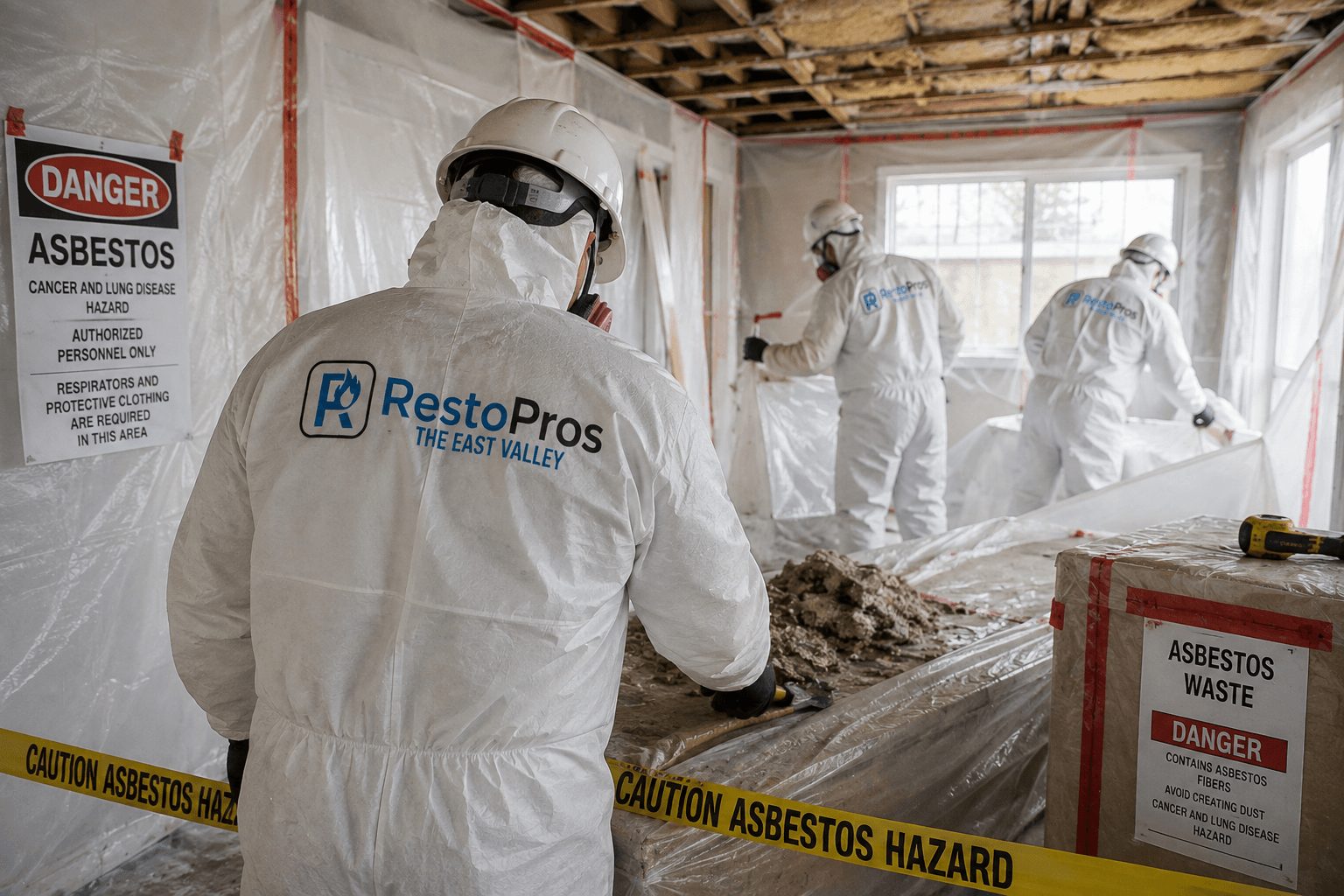
Licensed asbestos abatement crew preparing containment in a mid-century Tempe, AZ rental home prior to renovation
RestoPros

Asbestos Removal & Abatement in Tempe, AZ — Testing, Safe Removal, Clearance

Tempe has the oldest housing stock in the East Valley, and it's also the city with the most renovation and rental-turnover activity happening inside it. That combination — pre-1980 materials and constant remodeling pressure — is exactly when asbestos becomes a risk. RestoPros of the East Valley coordinates licensed testing, full ADEQ-compliant abatement, and clearance verification for Tempe homeowners, landlords, investors, and property managers. Free inspection and written scope before any work begins.

Google
starstarstarstarstar
5.0 Google Rating
verified

Licensed & Certified

IICRC Certified Technicians

shield

Fully Insured

Bonded for Your Protection

location_on

Local East Valley Pros

Mesa, Chandler, Gilbert, Tempe & Queen Creek

A large portion of Tempe's housing stock was built between 1950 and 1980 — the decades when asbestos was actively added to building materials for its fire resistance, durability, and insulating properties. Popcorn and acoustic ceiling texture, vinyl floor tile and the mastic beneath it, plaster systems over lath, pipe insulation, and drywall joint compound from that era all have documented histories of asbestos content. The materials aren't dangerous until they're disturbed. In a house untouched since 1972, intact positive-testing materials would often sit harmlessly for decades more.

The problem in Tempe is that those houses are being touched constantly. Tempe's ASU-adjacent neighborhoods hold a dense concentration of investor-owned rentals and student-occupied properties — homes turned over, renovated on tight budgets, and sometimes DIY-remodeled between tenants by owners who don't know what the ceiling texture contains. Dry-scraping a popcorn ceiling is the most common asbestos exposure event we see. The scraper doesn't know, the owner often doesn't know, and the dust settles into carpets, ductwork, and the HVAC system before anyone tests. The right sequence is test, then remove.

If you're a landlord, property manager, or investor working in Tempe's older housing stock, the regulatory picture adds a layer that doesn't apply to an owner-occupant doing work in their own home. Arizona regulates asbestos through ADEQ alongside federal NESHAP, and those requirements scale with the amount of material disturbed and the building type. A licensed abatement contractor handles notification, compliant work practices, and waste disposal — so navigating the regulatory chain isn't on you to manage alone.

Why Asbestos Risk Is Concentrated in Tempe's Renovation Market

Three factors specific to Tempe's housing landscape determine where asbestos exposure events happen and who's most likely to encounter them.

Mid-century housing predating the East Valley's newer suburbs

Tempe's residential core — Maple-Ash, Holdeman, Mitchell Park, University Park — was built primarily in the 1950s through 1970s. That's a decade or more older than the Mesa and Chandler subdivisions that dominate those cities' housing markets. The older the construction date, the higher the probability that multiple material categories contain asbestos. A 1958 Tempe bungalow and a 1978 Gilbert tract home are in the same general era but not the same risk profile.

Investor-flip and rental-turnover renovation pressure

Tempe's ASU-adjacent neighborhoods hold investor-owned and student-rental properties that turn over and get renovated at a rate the rest of the East Valley doesn't match. Low-bid contractors, tight timelines, and minimal pre-renovation testing are common on those jobs. The ceiling dry-scraped by a handyman crew may contain material that should have been abated — and that upfront abatement cost is a fraction of post-exposure remediation.

Popcorn ceiling texture as the highest-frequency exposure source

Acoustic and popcorn ceiling texture applied before 1978 is one of the most common asbestos-containing materials in residential properties, and Tempe's housing stock is full of it. Intact and painted-over, it poses minimal risk. Disturbed — scraped dry or sanded — it releases fibers. Testing costs little and takes a few days. Skipping it and getting it wrong costs far more.

Sheet flooring and mastic over original subfloors

Vinyl sheet flooring and 9-inch or 12-inch floor tile from the 1950s–70s, plus the black adhesive mastic bonding them, frequently contain asbestos. The tile may be manageable intact, but the mastic is almost always positive. Removing flooring without testing — common in kitchen and bathroom gut jobs — creates a contamination event requiring remediation of the subfloor and adjacent surfaces.

Landlord and property-manager obligations under ADEQ and NESHAP

NESHAP and ADEQ require that renovation or demolition disturbing a threshold of suspect material in non-single-family buildings follow specific notification and work-practice rules. Landlords renovating multi-family properties in Tempe — a duplex, a triplex, an apartment complex — face those requirements, and the consequences for ignoring them are real. A licensed contractor handles the notification chain; an unlicensed crew puts that liability on the owner.

Pre-demolition survey requirements triggered before the bid is accepted

NESHAP sets quantity thresholds — linear feet of pipe insulation, square feet of floor tile or ceiling material — that trigger a mandatory survey before any demolition or renovation work begins in commercial buildings and residential structures with more than four dwelling units. That survey must happen before demo, not concurrent with it. For a tenant improvement in a 1968 Mill Avenue building or a gut renovation of a 1970s Tempe apartment complex, the practical consequence is that an abatement contractor needs to be in the door before the general contractor's demo crew — not brought in as an afterthought when asbestos turns up mid-project.

Asbestos Abatement Across Tempe's Older Neighborhoods

Build era and occupancy pattern determine where the highest-frequency asbestos disturbance events occur in Tempe.

  • location_onMaple-Ash Historic DistrictOne of Tempe's oldest residential areas, with homes dating from the 1920s through 1950s. Original plaster walls, lath ceilings, and early linoleum and floor tile are common. Any renovation — from a kitchen update to a bathroom gut — warrants pre-demolition sampling before drywall, flooring, or ceiling materials are touched.
  • location_onMitchell ParkPrimarily post-war construction from the late 1940s and 1950s. Many homes retain original acoustic ceiling texture, 9×9 floor tile in kitchens and bathrooms, and vintage plumbing insulation. The neighborhood sees steady investor activity, and pre-renovation testing here is particularly important given the density of that housing era.
  • location_onHoldemanMid-century single-family homes, many with original popcorn ceilings in living areas and bedrooms. Investor and landlord-renovated properties in Holdeman are the source of some of the more common exposure events we're called to address — typically after work has already begun without a test.
  • location_onUniversity Park & ASU-Adjacent RentalsDense single-family and small multi-family rentals surrounding ASU turn over frequently and get renovated fast. The combination of 1950s–70s construction and investor-paced timelines is where accidental asbestos exposure is most likely. Multi-family properties here also carry ADEQ obligations that go beyond what an owner-occupant faces.
  • location_onOlder Tempe Commercial and Multi-Family StockTempe's 1960s–70s commercial corridors along Mill Avenue and Broadway include the full asbestos-era catalogue: floor tile, ceiling tile, pipe insulation, boiler insulation, and roofing systems. Tenant improvements and renovations in those buildings require a NESHAP-compliant pre-demolition survey before the demo scope is finalized — not after the bid is awarded.
  • location_onWarner Ranch & South Tempe Transition PropertiesSouth Tempe's 1980s–90s residential neighborhoods are mostly below the primary asbestos-concern threshold. Homes built in the late 1970s can still contain materials worth testing, particularly in a gut renovation. A pre-demo survey is the practical way to confirm what you're working with before demo begins.
timelineOur Process

How Asbestos Abatement Works in a Tempe Property

Licensed, documented, and compliant with ADEQ and NESHAP requirements — here's the sequence from first call to clearance.

01

Free Inspection & Risk Assessment

We walk the property before any testing or abatement planning, identify suspect materials by location and condition, and give you a written finding describing what to test, what to prioritize, and what the options are. If work hasn't started yet, this is the most valuable step — it sets the project up correctly from the start.

02

Licensed Sampling & Laboratory Testing

Bulk samples are collected by a licensed inspector and submitted to an accredited laboratory for PLM analysis. Results typically return within 2 to 5 business days; rush turnaround is available. We coordinate testing before any demolition touches suspect materials.

03

ADEQ Notification & Abatement Planning

When regulated quantities are confirmed, ADEQ and NESHAP notification requirements apply before work begins. We handle that filing as part of the abatement scope, along with the work plan covering containment, work practices, and waste disposal routing.

04

Full Containment & Negative-Pressure Work Zone

The work area is sealed with poly barriers under negative air pressure with HEPA filtration — the same containment used for mold remediation, adapted for asbestos fiber-control requirements. No contaminated air leaves the work zone; no unprotected person enters during removal.

05

Licensed Removal & Regulated Waste Disposal

Materials are wet-method removed, double-bagged in labeled waste, and transported by a licensed hauler to a permitted disposal facility. Nothing goes into a general dumpster. All manifests are retained as part of your project documentation.

06

Air Clearance Testing & Project Closeout

A licensed industrial hygienist conducts final air monitoring after removal and decontamination. Clearance is issued in writing only when results meet regulatory standards. You receive the complete project file: sampling results, clearance certificate, waste manifests, and the ADEQ notification record.

Asbestos Abatement in Tempe: Cost Drivers and What Insurance Typically Covers

Three variables drive abatement cost more than anything else: the quantity of material involved (square footage of flooring, linear footage of pipe insulation, surface area of ceiling texture), the accessibility of that material and what it takes to contain the space properly, and whether the project involves a residential single-family home or a multi-family or commercial building where NESHAP notification adds a defined process step. Testing adds to the timeline but not dramatically to the cost — and it's the only number that tells you whether abatement is required at all. Getting a written scope after testing is the point where cost becomes defined rather than estimated in the abstract.

For renovation and flip projects, the sequence that minimizes total cost is: test first, integrate abatement into the demo phase if positive, and price the overall project accordingly. The most expensive scenario is one where demo has begun, asbestos is discovered mid-project, the work site is shut down, and abatement happens on emergency terms inside an already-disrupted project. Testing before demo is a small front-loaded cost that prevents a much larger unplanned one.

Standalone asbestos abatement as a proactive project or renovation pre-step is generally not covered by property insurance. The exception is when asbestos material must be disturbed or removed to complete the repair of a covered loss — water damage reaching original floor tile, fire damage requiring plaster removal in a pre-1980 home. In those situations, the abatement required to restore the property correctly is typically included in the covered loss claim, provided the trigger loss itself is accurately documented and reported. We provide the itemized scope documentation that adjusters need to process those claims.

  • check_circleFree inspection and written scope before sampling or abatement is scheduled.
  • check_circlePre-renovation testing coordinated — the step that keeps a demo project from becoming an emergency.
  • check_circleADEQ notification and NESHAP compliance handled as part of the abatement scope.
  • check_circleFull closeout documentation: sampling results, air clearance certificate, waste manifests, notification records.

Testing or Abatement in a Tempe Property? Start with a Free Inspection.

Whether you're a homeowner, investor, landlord, or property manager — if the project touches a Tempe home built before 1980, the conversation starts with testing, not with demo. Call RestoPros of the East Valley at (520) 482-3900 for a free inspection and written scope. ADEQ-compliant abatement, licensed sampling, full clearance documentation.

Get in Touch

Need a free inspection in Tempe? Fill out the form and our local team will get back to you quickly.

schedule

Open 24/7 for Emergencies

helpFAQ

Asbestos Cleanup in Tempe — FAQs

Age is the primary indicator. Homes built before 1980 are likely to contain asbestos in at least one material — popcorn ceiling texture, vinyl floor tile, floor mastic, drywall joint compound, or pipe insulation are the most common categories in Tempe's housing stock. The only way to know for certain is bulk sampling submitted to an accredited lab. Visual inspection cannot identify asbestos; the material looks identical to its non-asbestos counterparts.

If the property was built before 1980 and you're planning demolition of ceilings, flooring, or walls, yes. Testing before demo is both the practical choice that prevents mid-project shutdowns and the regulatory expectation for commercial and multi-family buildings under ADEQ and NESHAP. A pre-demo survey tells you what you're working with and lets you price the project accurately before a single wall comes down.

An owner-occupant doing work in their own single-family home has different obligations than a landlord or investor renovating a tenanted or recently vacated property. NESHAP requirements extend to commercial buildings and residential structures with more than four dwelling units. For Tempe's duplexes, triplexes, and apartment properties, pre-demolition survey requirements apply at certain thresholds. A licensed abatement contractor navigates that distinction and handles the notification chain.

If laboratory analysis confirms asbestos-free, a homeowner can remove intact popcorn texture using standard precautions — wet methods, plastic drop cloths, N95 respirator. If the test is positive, a licensed abatement contractor is required: containment, negative air pressure, regulated waste disposal. The test result determines the work practice.

Yes — this is a scenario we plan for in Tempe's pre-1980 housing stock. Original vinyl sheet flooring and tile, along with the mastic beneath, frequently contain asbestos. When a covered water loss saturates original flooring, the restoration scope includes testing before any material is lifted or cut. If abatement is needed to complete the covered repair, it's typically includable in the claim — documentation of the trigger loss is what makes that work.

Lab turnaround runs 2 to 5 business days standard; rush is available. Once abatement is scoped, a single-room project — a bathroom floor or a bedroom ceiling — typically takes 1 to 3 days, plus air clearance testing. Projects covering multiple material types or multiple rooms take longer. Your written scope includes the specific timeline.

call

Emergency Help 24/7

CALL 520-482-3900

arrow_forward