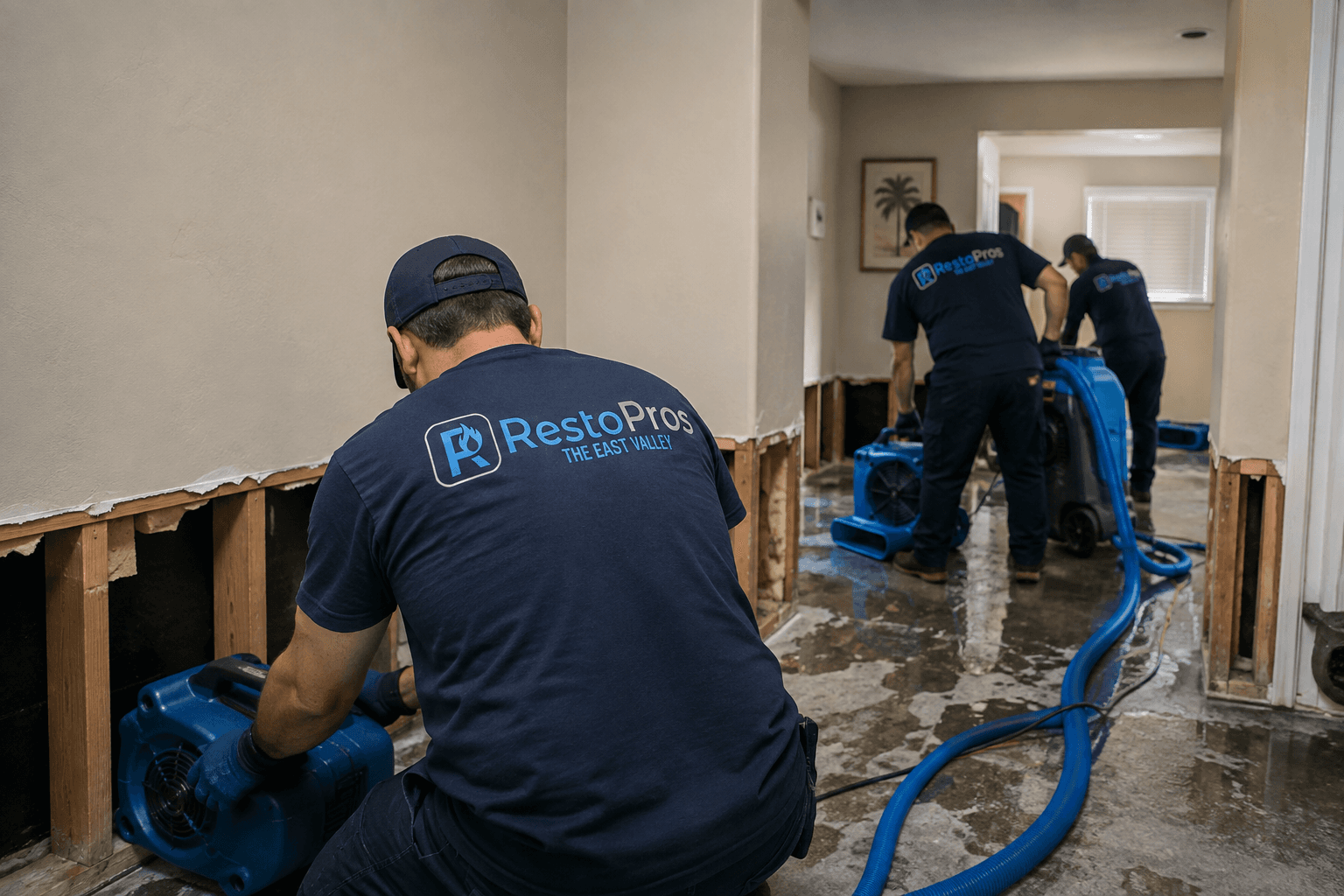
Water damage restoration technician extracting water from a new-construction Queen Creek, AZ home after a builder-grade fitting failure
RestoPros

Water Damage Restoration in Queen Creek, AZ — New Construction, Acreage, and San Tan Valley

Water losses in Queen Creek look different from anywhere else we serve. Much of the housing stock is less than twenty years old, which means failures aren't aged pipe — they're builder-grade push-fit fittings, improperly supported RO drain lines, and water softener connections on properties that are often still inside their builder warranty window. Larger lots bring detached workshops, barns, and horse facilities that suburban restoration companies rarely scope. And the Queen Creek Wash and San Tan foothill drainage channels can push flash flooding across low-slung single-story floor plans faster than most homeowners expect. Call (520) 482-3900 any hour for a free inspection with moisture mapping and a written scope.

Google
starstarstarstarstar
5.0 Google Rating
verified

Licensed & Certified

IICRC Certified Technicians

shield

Fully Insured

Bonded for Your Protection

location_on

Local East Valley Pros

Mesa, Chandler, Gilbert, Tempe & Queen Creek

Queen Creek's restoration profile is almost the inverse of older Valley cities. Failures here are rarely from age — they come from shortcuts common in high-volume builder construction: a push-fit PEX fitting not seated correctly, an RO drain line zip-tied without a proper standpipe, a water softener brine tank with no drain-pan liner. If your home is still inside its builder warranty period, documenting the failure properly matters twice — it supports both an insurance claim and a warranty claim, which have different paperwork requirements. We build scopes and photo documentation that work for both.

The semi-rural character adds scope that most suburban restoration companies don't carry. Queen Creek properties frequently include detached garages, workshops, barns, and covered patios — none of which are 'in the house' but all of which sustain real water damage. Horse properties require planning: access routes, staging, and exclusion zones that account for animals. Outlying parcels in Queen Creek and San Tan Valley are often on private septic rather than city sewer, which changes the classification and handling protocol when a backup occurs.

We respond across all of Queen Creek and San Tan Valley — Cortina, Montelena, Harvest, the Ellsworth Loop corridor, Church Farm, and the rural-parcel pockets off Ironwood Road and Crismon. If you're east of the 347 and south of the Superstition Freeway, we're your closest IICRC-certified crew. Emergency arrivals typically run 60 to 90 minutes. Extraction, moisture mapping, verified structural drying, and reconstruction — from a finished interior room to a barn floor.

Why Queen Creek Homes Flood — And Why It's Not the Pipe You'd Expect

New construction dominates Queen Creek's housing stock, so the failure mechanisms here differ sharply from the aging-infrastructure problems found in older East Valley cities.

Builder-grade push-fit fittings on PEX plumbing

High-volume tract construction relied heavily on push-to-connect fittings that can back out under pressure cycling if not seated against a full-depth stop or if the pipe end was cut slightly out of square. A fitting that holds for two years of pressure test and two more of normal use can still fail — and when it does, it's inside a finished wall in a home many people assume is 'new enough to be fine.' We see these regularly in Queen Creek construction from the mid-2010s onward.

Reverse-osmosis and water softener system failures

Queen Creek's growth brought a wave of RO systems and whole-home water softeners, often installed by subcontractors working fast on tract homes. Drain lines without a proper air-gap standpipe can back-siphon; brine tanks without drain pans sit on particle-board cabinet floors; saddle-valve RO supply connections have a well-documented tendency to fail at the clamp over time. These are the fittings you don't think about until a cabinet is soaked and the floor underneath is soft.

Queen Creek Wash and San Tan foothill flash flooding

The Queen Creek Wash collects runoff from the San Tan Mountains and moves fast during a heavy monsoon event. Single-story floor plans built on grade — the dominant design in Queen Creek — are especially vulnerable to sheet flooding through garage doors and ground-level openings. Flood damage from the wash requires separate NFIP or private flood coverage; standard homeowners policies exclude it. We document the loss and work with whatever coverage applies.

Septic-adjacent backups on outlying parcels

Homes on larger lots east of the Ellsworth Loop and throughout much of San Tan Valley are frequently on private septic rather than municipal sewer. When a septic system backs up into the house, the water is Category 3 contaminated regardless of source — the containment and material handling protocols are the same as a municipal sewer backup, but investigating and remediating the septic system itself is a separate track.

Detached structures and outbuildings

A garage workshop, hay barn, covered arena, or well house isn't 'the home,' but it sustains real damage. Supply lines run to outdoor structures, irrigation connections near outbuildings can back up, and flat-roofed ramadas pond monsoon rain onto concrete that drains toward the structure. We scope detached buildings with the same moisture mapping and drying verification we apply inside.

Irrigation and landscape supply line proximity

Large Queen Creek lots carry extensive drip and spray irrigation close to the home's perimeter. A sheared irrigation head can saturate soil at the foundation and wick moisture into slab edges and block-wall bases for days before it's noticed. Perimeter moisture reads differently on thermal imaging than an interior supply failure — the scope needs to account for the outside source, not just the damp materials inside.

Water Damage Response Across Queen Creek and San Tan Valley

Queen Creek's communities vary from dense new-construction neighborhoods to large rural parcels — the failure type and property scope changes accordingly.

  • location_onCortinaAn established Queen Creek community with homes predominantly from the mid-2000s — old enough that first-generation push-fit fittings and builder-grade water softener installs are reaching the age where connections start to fail. We see recurring supply-line and appliance-connection losses here.
  • location_onMontelenaMid-to-large single-story homes on quarter-acre lots with open great rooms and kitchen layouts that flow into one another. A supply line failure near the kitchen island can travel the full width of an open floor plan before hitting a wall — moisture mapping across these continuous spans is essential to find where the water actually went versus where it's visible.
  • location_onHarvestA newer master-planned community with homes built from the late 2010s forward. Builder-grade PEX and push-fit connections, water softener systems in nearly every home, and RO systems under kitchen sinks. Homes here are frequently still inside their original builder warranty period, so we document failures with warranty-track as well as insurance-track in mind.
  • location_onEllsworth Loop corridorThe retail and residential spine of Queen Creek, with a mix of newer single-family homes and some light commercial properties. Losses near the wash drainage infrastructure require flood-vs-plumbing determination for coverage purposes.
  • location_onChurch Farm and larger-lot areasOne-acre-plus parcels with detached garages, casitas, workshops, and in some cases equestrian facilities. Restoration scope on these properties consistently extends beyond the main house footprint. We plan around livestock, coordinate gate access for large equipment, and scope every structure on the parcel that sustained damage.
  • location_onSan Tan ValleyA Census-designated place and not an incorporated town, San Tan Valley shares Queen Creek's new-construction profile but with a higher proportion of properties on private septic. Backup events here are more likely to be Category 3 than they appear, and we verify contamination status before any drying decision is made.
timelineOur Process

Our Water Damage Restoration Process in Queen Creek

The same IICRC-standard steps as anywhere — scoped for larger properties, new-construction failure modes, and dual-track documentation when builder warranty is in play.

01

24/7 Call & Dispatch

Call (520) 482-3900 any time. Emergency crews serve Queen Creek and San Tan Valley with typical arrival in 60 to 90 minutes. Tell us upfront if the property has livestock or outbuildings to scope — it helps us bring the right equipment on the first truck.

02

Source Identification & Moisture Mapping

We stop the active source, then map the moisture footprint with calibrated meters and thermal imaging across every affected space — including detached structures. On new construction, we photograph the failed component before anything is disturbed, because that evidence matters for both an insurance and a warranty claim.

03

Water Classification & Containment

Supply-line failures are Category 1; appliance drain water is typically Category 2; septic backups and soil contact are Category 3. The classification determines what porous materials stay versus come out and what containment the work requires. We don't skip this on 'clean' losses — misclassifying a gray-water event leads to mold in thirty days.

04

Extraction

Standing and absorbed water extracted from every affected surface — flooring, wall bases, subfloor where accessible, and any concrete or block in outbuildings. On horse properties we establish temporary exclusion zones around the work area before equipment comes in.

05

Structural Drying with Verified Readings

Desiccant and refrigerant dehumidifiers, air movers positioned for materials and layout, and daily moisture readings logged until every material reaches the verified dry standard. Large open-plan Queen Creek floor plans need more equipment than raw square footage suggests — we size for the geometry.

06

Scope, Document & Rebuild

Final moisture verification, photo documentation for both insurance and builder warranty submissions, itemized line-item scope, and reconstruction — flooring, drywall, cabinets, texture, paint — so you get a finished space, not a report and a separate contractor to find.

Queen Creek Water Damage: What Drives Cost and What Insurance Covers

Cost is determined by how much water moved, where it went, what it touched, and how quickly the call came in. A failure caught within an hour in a single room is a fundamentally smaller job than one found two days later with saturated subfloor and cabinetry. On large Queen Creek lots, scope grows if water reached an outbuilding or adjacent casita. The free inspection gives you the real footprint and a written line-item estimate before any commitment.

Builder warranty and homeowners insurance can both apply to the same loss. Your homeowners policy covers sudden damage to your home's structure and contents. Your builder's warranty may cover the defective fitting that caused it — parallel tracks, not competing ones. We photograph failed components before removal and produce a written scope that works for both. Flood damage from the Queen Creek Wash requires separate flood coverage; standard homeowners policies exclude surface water.

On septic-related backups, the cost driver is what the Category 3 water touched. Porous materials it contacted — drywall, insulation, carpet, subfloor — typically need to come out rather than being dried in place, which changes the rebuild scope. The written scope explains exactly what came out and why, in language an adjuster expects to see.

  • check_circleFree inspection with thermal imaging and moisture mapping — the real footprint before any estimate.
  • check_circleDual-track documentation for insurance claims and active builder warranty claims.
  • check_circleWater classification on every job — Category 1, 2, or 3 — because it drives material decisions.
  • check_circleDirect insurance billing on covered losses; no upfront payment required for approved claims.

Water Damage in Queen Creek or San Tan Valley? Call Now for a Free Inspection

New construction failure, flash flooding, a septic backup, or damage to a detached structure — call RestoPros of the East Valley at (520) 482-3900 any hour. IICRC-certified crew, 60–90 minute emergency response, free inspection with written scope, and documentation that works for both your insurer and your builder warranty.

Get in Touch

Need a free inspection in Queen Creek? Fill out the form and our local team will get back to you quickly.

schedule

Open 24/7 for Emergencies

helpFAQ

Water Damage Restoration in Queen Creek — FAQs

Yes. Builder-grade push-fit PEX fittings, water softener connections without drain pans, and RO drain lines without air-gap standpipes are common failure sources in Queen Creek homes a few years old. 'New' doesn't mean 'correctly installed.' If your home is still inside its builder warranty period, we photograph failed components before removal so the documentation supports that claim.

We do it regularly on Queen Creek and San Tan Valley properties. We establish staging and exclusion zones around equipment to keep animals calm. Detached barn and arena structures are scoped as part of the job. Let us know when you call so we bring the right configuration.

Different cause, same classification. Whether the source is municipal or your private septic system, the wastewater is Category 3 contaminated. Porous materials it contacted need to come out, not be dried in place. We document the contamination determination so the material decisions are clear for your adjuster.

Surface water flooding from the wash or overland runoff is excluded from standard homeowners policies — it requires separate NFIP or private flood coverage. We'll help identify whether the source was internal (a burst pipe, which is covered) or external flooding, because that distinction drives the coverage question. We restore the damage regardless.

Yes. We scope every structure on the property that sustained damage — detached garages, workshops, covered patios, casitas, barns. We moisture-map concrete slabs and wood-frame outbuildings the same way we do interior rooms. A half-restored property with a saturated workshop slab is still a moisture problem.

Separate tracks, both can apply simultaneously. Your homeowners policy covers the damage to structure and contents. Your builder's warranty covers defective workmanship that caused the failure. We photograph the failed component before removal and produce a written scope that works for both. Notify your builder warranty provider and your insurer — our documentation supports both claims.

call

Emergency Help 24/7

CALL 520-482-3900

arrow_forward