
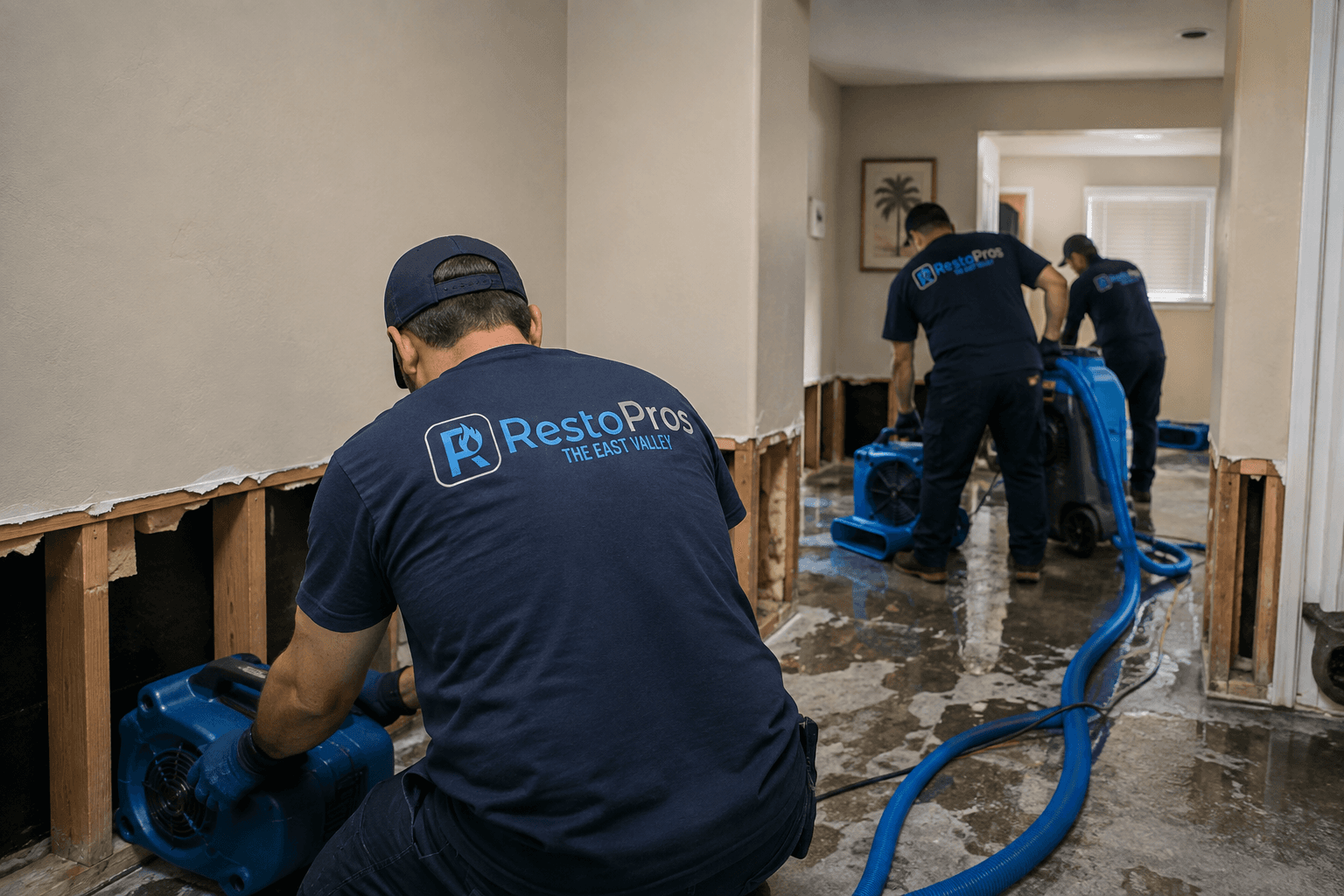
Search this question and you'll find national averages that range so widely they're useless — because 'water damage' covers everything from a mopped-up dishwasher leak to a whole-home sewage backup. What you actually need is to understand what moves the number, so you can read an estimate intelligently and spot both padding and dangerous corner-cutting. That's this guide.
Key Takeaways
- Six factors set the price: water category, spread, materials affected, dwell time, mold presence, and rebuild scope.
- Minor single-room dry-outs sit in the hundreds-to-low-thousands range; whole-home Category 3 losses run well into five figures. The spread is real, and it's driven by physics, not markup.
- For covered claims, your real cost is usually your deductible — which changes which decisions matter.
- The most expensive estimate is a cheap one that skips proper drying: incomplete drying converts a water job into a mold job.
Why Nobody Can Quote Water Damage Over the Phone
Two flooded kitchens can differ in cost by 10x. One took clean supply-line water for twenty minutes on tile; the other took the same water for two days while the family was in Flagstaff, wicking into cabinets, drywall, and the wood floor of the adjacent dining room. From the doorway they look similar. Under a moisture meter they are completely different projects. Any company that gives you a firm number before mapping moisture is guessing — in one direction or the other.
The 6 Factors That Set the Price
1. Water category (clean, gray, or black)
Category 1 (clean supply water) allows drying most materials in place. Category 2 (gray — appliance discharge, tub overflow) requires sanitization and more removal. Category 3 (black — sewage, rising flood water) mandates removing porous materials it touched, full PPE and containment, and disinfection. Category alone can double or triple a job. Our guide to clean, gray, and black water covers this in depth.
2. How far it spread (class)
The industry grades jobs by how much surface area absorbed water. One corner of one room needs a couple of air movers for three days. Water that ran across an open floor plan into three rooms — the standard outcome in newer Gilbert and Queen Creek homes — needs a full equipment array and longer drying.
3. What it soaked into
Tile over slab shrugs off water. Laminate flooring dies almost immediately. Wood floors sometimes save with rapid response and specialty drying mats — a genuine cost fork. Drywall wicks; insulation holds water; cabinets swell at the toe-kick. The materials list is most of the estimate.
4. How long it sat
Hours versus days is the single biggest cost multiplier. Water migrates continuously, categories degrade over time (clean water doesn't stay clean), and in a closed Arizona house, the mold clock runs at 24–48 hours. The same leak discovered Monday versus Friday can be a different order of magnitude.
5. Whether mold already started
If growth is present, remediation gets added to the scope: containment, HEPA filtration, removal, treatment, and verification. This is the line item early callers never pay.
6. The rebuild
Mitigation (extraction, demolition, drying) is phase one. Putting the house back — drywall, texture-matching, paint, flooring, baseboards, cabinets — is phase two, and on larger losses it's the bigger number. Estimates that look surprisingly low often just aren't counting it.
Realistic Scenario Tiers
- Minor: one room, clean water, caught fast, mostly dry-in-place — typically hundreds to low thousands, a few days of equipment.
- Moderate: multiple rooms or wet drywall/flooring requiring removal, standard drying and repairs — typically low-to-mid four figures through mitigation and basic rebuild.
- Major: whole floors, Category 3 water, mold present, or long dwell time — five figures, driven mostly by demolition scope and reconstruction.
We publish these as honest ranges, not quotes. Every RestoPros job starts with a free inspection and a written, line-item scope — you see exactly which tier you're in and why before any work begins.
How Insurance Changes the Math
Most sudden and accidental water losses — burst pipes, appliance failures, water heater ruptures — are covered under Arizona homeowner's policies. For covered claims, your out-of-pocket is typically your deductible, and the pricing conversation shifts from 'what does this cost' to 'is the scope complete and properly documented.' That's where a restoration company earns its keep: moisture logs, photo documentation, and industry-standard estimates that adjusters can approve without rounds of dispute. We bill carriers directly, so covered work doesn't wait on your checking account. Gradual leaks and deferred maintenance are the standard exclusions — one more reason speed matters.
Why the Cheap Bid Is Usually the Expensive One
The corner that gets cut is always the same: drying time and verification. Pulling equipment on day two because 'it looks dry' leaves moisture inside wall cavities and under flooring, and thirty days later there's a musty smell and a remediation project that costs more than the original job — often no longer covered, because now it reads as neglect. Insist on daily moisture readings and a dry-standard sign-off from whoever you hire. We put ours in writing.
Frequently Asked Questions
What does water damage restoration cost per square foot?
Per-square-foot figures mislead more than they help, because category and materials dominate. A hundred square feet of Category 1 on tile costs a fraction of the same footage of Category 3 in carpeted bedrooms. Insist on a line-item scope instead of a square-foot rule of thumb.
Does homeowner's insurance really cover most of this?
For sudden events, usually yes — mitigation and resulting repairs, minus your deductible. Slow leaks, maintenance failures, and rising floodwater (separate flood policy) are the standard gaps. We help you understand which side of the line your loss falls on before work starts.
Is a free inspection actually free?
Ours is. We inspect, map moisture, and give you a written scope and estimate. If it's small enough to handle yourself, we'll tell you that too — homeowners remember honesty longer than invoices.
How fast do you need to start to keep costs down?
Extraction within hours and drying started the same day is the cost-minimizing path. Every day of delay adds materials to the demolition list and raises mold risk. We respond 24/7 across the East Valley, typically within 60–90 minutes: (520) 482-3900.
Get a Real Number, Free
Skip the internet averages. RestoPros of the East Valley will inspect your water damage for free anywhere in Mesa, Gilbert, Chandler, or the rest of the East Valley, and hand you a written, line-item estimate — with direct insurance billing for covered losses. Call (520) 482-3900.