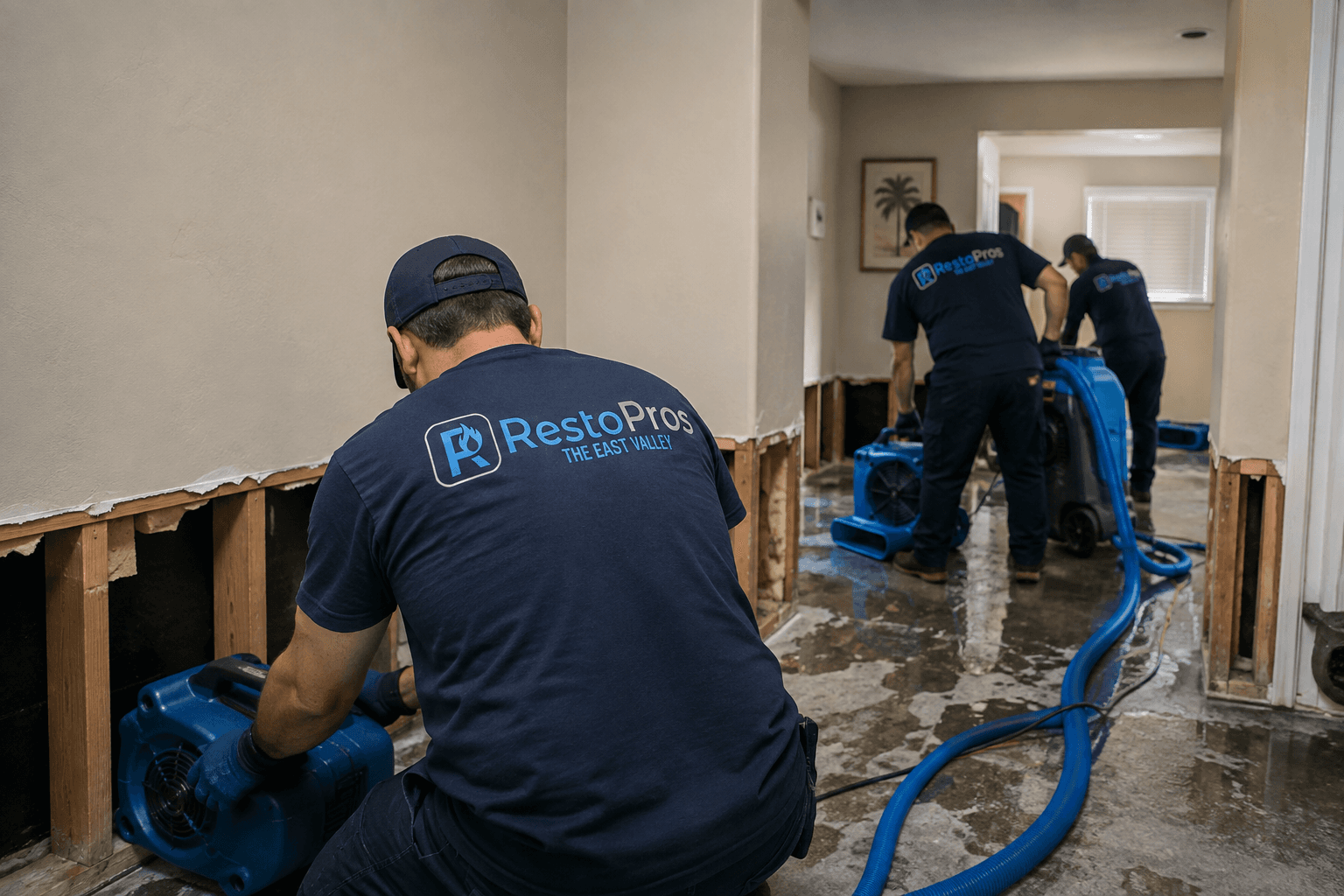
RestoPros technician extracting standing water from a flooded Mesa, AZ home
RestoPros

Water Damage Restoration in Mesa, AZ — 24/7 Emergency Response

Burst pipe at midnight in Dobson Ranch? Slab leak surfacing through the tile in Red Mountain? Monsoon water in an Eastmark attic? RestoPros of the East Valley answers 24/7 and typically reaches Mesa addresses within 60–90 minutes with truck-mounted extraction, commercial drying equipment, and IICRC-certified technicians. We remove the water, dry the structure to verified standards, stop mold before it starts, and repair the damage — billing your insurance carrier directly.

Google
starstarstarstarstar
5.0 Google Rating
verified

Licensed & Certified

IICRC Certified Technicians

shield

Fully Insured

Bonded for Your Protection

location_on

Local East Valley Pros

Mesa, Chandler, Gilbert, Tempe & Queen Creek

Mesa is the largest city in the East Valley and the most varied — which means water damage here doesn't have one profile, it has five. Post-war homes near Downtown and the Historic district hide galvanized supply lines and cast-iron drains at the end of their service life. The 1970s and 80s tracts around Dobson Ranch sit on slabs where four decades of Arizona hard water have been quietly pitting copper from the inside. Hillside homes in Las Sendas run longer plumbing lines through bigger footprints. And master-planned Eastmark and Cadence are now old enough that builder-grade supply fittings and first-generation water heaters are reaching the age where they fail.

What every one of those homes shares is the clock. Water spreads through drywall, baseboards, and flooring by the hour, and inside a sealed, air-conditioned Mesa house in July, mold can establish in wall cavities within 24 to 48 hours. Extraction speed is the single biggest factor in whether your loss stays a drying job or becomes a demolition-and-rebuild project.

Our Mesa water damage crews handle the whole arc: emergency water removal, moisture mapping with meters and thermal imaging, structural drying documented with daily readings, antimicrobial treatment, and the reconstruction that puts your home back together. One team, one accountable scope, from the first call to the final walkthrough.

Why Mesa Homes Flood

After years of restoring properties across this city, the causes cluster into a predictable set — and most of them are specific to how Mesa was built and what comes out of its taps.

Slab leaks from hard-water pipe corrosion

Mesa's water is mineral-heavy, and decades of it running through copper lines cast beneath a concrete slab pits the pipe from the inside until it weeps. The first sign is often a warm patch on the floor, a water bill that climbed for no reason, or flooring that darkens and stays dark. Slab leaks can run for months before anyone notices — which is why they produce some of the worst hidden damage we see.

Water heater failures in garages and hall closets

Hard-water sediment builds inside the tank, traps heat against the steel, and shortens a heater's life to roughly 6–10 years here. When one lets go it releases 40–50 gallons at once, and because Mesa homes typically put the heater in the garage or an interior hallway closet, the water either wrecks stored belongings and garage drywall or runs straight into bedrooms and hallways.

AC condensate backups during the long cooling season

Your air conditioner runs most of the year here and pulls gallons of condensation out of the air every hot day. When the drain line clogs — which it does, reliably — that water backs up into the pan and finds the ceiling below the air handler. Brown ceiling rings around a hallway or closet in August are the classic Mesa presentation.

Aging supply lines and angle stops

Braided supply lines behind toilets, under sinks, and at washing machines are the most common failure point in any home, and they have a 15–25 year service life. Across Mesa's enormous 1970s–2000s housing stock, a very large number of those fittings are past due right now.

Monsoon roof and wall intrusion

Microbursts lift tiles and drive rain sideways into attics and wall assemblies. The homeowner often sees nothing until a ceiling stains days later — by which point insulation is saturated and the mold clock has been running the whole time.

Sewer backups in the older grid

Central Mesa's mature, tree-lined streets sit over clay and cast-iron sewer laterals that roots find. A backup is Category 3 water — a very different and more hazardous cleanup than a clean supply-line break.

Water Damage Response Across Mesa

We work the whole city, and the housing story changes as you move across it. Knowing what's likely in your area shapes how we inspect.

  • location_onDobson Ranch & west Mesa1970s–80s slab-on-grade construction where original copper supply lines and aging water heaters drive most calls. Slab leaks are disproportionately common here.
  • location_onDowntown & Historic MesaPre-war and mid-century homes with galvanized supply lines, cast-iron drains, and plaster walls that behave differently under drying than modern drywall.
  • location_onLas Sendas & northeast MesaLarger hillside homes with long plumbing runs, multi-story layouts where an upstairs failure cascades, and pool and irrigation systems adding outdoor water sources.
  • location_onEastmark, Cadence & southeast MesaNewer master-planned construction now hitting the age where builder-grade fittings, water softener loops, and first-generation water heaters fail. Open floor plans let water travel far, fast.
  • location_onRed Mountain & northeast corridorA mix of 80s–2000s homes; monsoon roof intrusion and AC condensate issues show up heavily here every summer.
  • location_onSuperstition Springs & southeast MesaEstablished 80s–90s subdivisions where supply lines, angle stops, and original water heaters are all reaching end-of-life simultaneously.
timelineOur Process

How We Restore Water-Damaged Mesa Homes

Every job runs the same documented path, so you and your insurance adjuster always know what's happening and what's next.

01

Call & Dispatch

Call (520) 482-3900 any hour. A live local team member takes the details and dispatches a crew — typically on site at your Mesa address within 60 to 90 minutes.

02

Find the Source & Map Moisture

We stop the water, then map exactly how far it traveled using moisture meters and thermal imaging — including water hidden inside walls, under flooring, and above ceilings. You get a written scope before work begins.

03

Extraction

Truck-mounted and portable extractors pull standing water fast, from a soaked bedroom carpet to a fully flooded first floor, stopping further saturation of drywall, framing, and flooring.

04

Structural Drying

Commercial air movers and dehumidifiers dry the structure over the following days. We log moisture readings daily and adjust equipment until every material reads at dry standard — verified, not assumed.

05

Clean, Sanitize & Prevent Mold

Affected surfaces are cleaned and sanitized, antimicrobial treatment is applied to prevent growth, and any gray or black water contamination is handled with proper containment.

06

Repair & Rebuild

We put the home back: drywall, texture matching, paint, baseboards, flooring, and full reconstruction where needed — closing out with documentation for your insurer.

What Mesa Water Damage Restoration Costs — and Who Pays

Nobody can price water damage honestly over the phone, because two flooded kitchens can differ tenfold. What sets the number is the water category (clean supply water versus gray or sewage), how far it spread, which materials absorbed it, how long it sat before extraction started, and whether mold already began. A single room of clean water on tile caught within hours is a modest drying job. The same leak discovered five days later, wicked into cabinets, drywall, and wood flooring, is a demolition and rebuild project.

For covered claims, your real out-of-pocket is usually just your deductible. Most Arizona homeowner's policies cover sudden and accidental water damage — burst pipes, water heater ruptures, appliance failures — while excluding gradual leaks, deferred maintenance, and rising floodwater, which requires separate flood insurance. Slab leaks get a three-part answer: the resulting damage is typically covered, the concrete access work often is, and the pipe repair itself usually isn't.

Every job we take starts with a free inspection and a written, line-item estimate, so you see the scope before approving anything. We document cause, moisture readings, and damage to insurance standards, communicate directly with your adjuster, and bill your carrier for covered mitigation — so the work starts while the claim processes.

  • check_circleFree inspection with moisture mapping and a written scope of work — no obligation.
  • check_circleDirect insurance billing on covered losses; we handle the adjuster communication.
  • check_circleDaily moisture logs so you can verify your home is genuinely dry, not just dry-looking.
  • check_circleOne team from extraction through reconstruction — no coordinating separate contractors.

Water in Your Mesa Home? Every Hour Counts

Standing water spreads, materials absorb, and mold starts within 24–48 hours in Arizona heat. Call RestoPros of the East Valley at (520) 482-3900 for 24/7 emergency water damage restoration in Mesa — free inspection, written estimate, direct insurance billing.

Get in Touch

Need a free inspection in Mesa? Fill out the form and our local team will get back to you quickly.

schedule

Open 24/7 for Emergencies

helpFAQ

Water Damage Restoration in Mesa — FAQs

We're based in the East Valley with crews on call 24/7, including nights, weekends, and holidays. Emergency arrivals at Mesa addresses typically run 60 to 90 minutes — from Dobson Ranch to Las Sendas to Eastmark. Call (520) 482-3900 the moment you find water; extraction speed is the biggest single factor in your final cost.

Those are two of the classic signs, and together they're strongly suggestive. Confirm it yourself in five minutes: turn off every fixture and appliance that uses water, then watch the low-flow indicator on your water meter. If it's still moving, water is escaping somewhere. Given Mesa's hard water and slab-on-grade construction, slab leaks are one of the most common hidden losses we handle.

Typical structural drying runs 3 to 5 days with commercial dehumidifiers and air movers, verified by daily moisture readings. Repairs add time depending on scope — replacing baseboards is a day, while rebuilding flooring and drywall across several rooms can take a few weeks. You'll get a timeline specific to your loss after our inspection.

Yes — outdoor humidity has almost nothing to do with it. Moisture trapped inside walls, under flooring, or above ceilings in a sealed, air-conditioned house creates exactly the pocket mold needs, and growth can start within 24 to 48 hours. Monsoon season compresses that further. Every water job we run includes antimicrobial treatment and verified drying specifically to prevent it.

Most Arizona policies cover sudden and accidental discharges — burst pipes, water heater ruptures, appliance failures. Gradual leaks and maintenance issues are generally excluded, and rising floodwater from monsoon flash flooding requires separate flood coverage. We document everything to insurance standards, work directly with your adjuster, and bill your carrier for covered work.

Yes, with full containment, negative air with HEPA filtration, removal and disposal of contaminated porous materials, and EPA-registered disinfection per IICRC S500. Sewage is a biological hazard, not just a mess — keep people and pets out of the area, don't run fans or a shop-vac, and call us right away.

call

Emergency Help 24/7

CALL 520-482-3900

arrow_forward