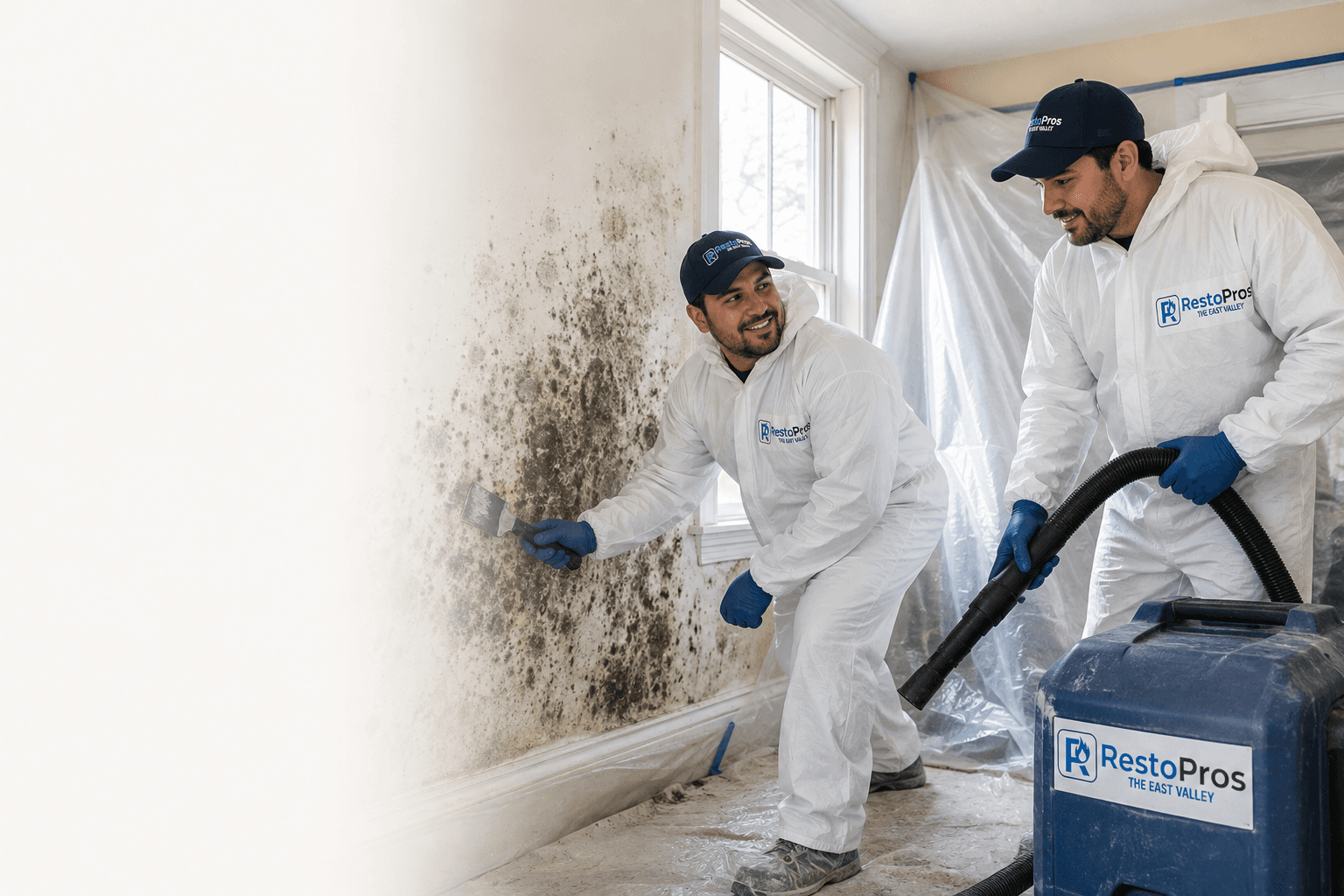
IICRC-certified technician performing mold inspection and containment in a Mesa, AZ home
RestoPros

Mold Removal & Remediation in Mesa, AZ — Inspection, Containment, Verification

Musty smell with no visible source? Dark growth spreading on drywall after a leak? RestoPros of the East Valley provides free mold inspections across Mesa with moisture meters and thermal imaging, then full IICRC-standard remediation: containment, safe removal, antimicrobial treatment, and verified drying — plus the moisture fix that keeps it from coming back.

Google
starstarstarstarstar
5.0 Google Rating
verified

Licensed & Certified

IICRC Certified Technicians

shield

Fully Insured

Bonded for Your Protection

location_on

Local East Valley Pros

Mesa, Chandler, Gilbert, Tempe & Queen Creek

The most common thing we hear on Mesa mold calls is some version of "but this is the desert." It's an understandable assumption and a completely wrong one. Outdoor humidity has almost no bearing on what's happening inside your wall cavity. A slab leak, an AC condensate backup, a monsoon roof penetration, or a supply line that wept for a month creates a sealed, dark, damp pocket inside an air-conditioned house — and that's a better mold habitat than most humid climates offer, because nothing in there ever dries out on its own.

What Arizona actually changes is where mold hides. In wetter climates, growth appears on visible surfaces where you notice it early. Here it concentrates in the places moisture gets trapped: behind baseboards over a slab leak, inside the ceiling under a clogged AC drain line, in attic insulation under a lifted monsoon tile, beneath flooring, and inside the duct system. Mesa mold tends to be found by nose before it's found by eye.

Our remediation follows the IICRC standard, and it always starts the same way: find the moisture, because mold is a symptom and moisture is the diagnosis. Then containment under negative air pressure with HEPA filtration, removal of contaminated materials, treatment of what remains, verified drying, and reconstruction. Remediation that doesn't fix the water source isn't a repair — it's a subscription.

Where Mold Actually Grows in Mesa Homes

Six moisture sources account for the large majority of Mesa mold jobs, and each one has a characteristic hiding place.

AC condensate backups

Your air conditioner runs most of the year and produces gallons of condensation on hot days. A clogged drain line puts that water into the pan, the ceiling below, or the air handler closet — and because it's continuous rather than sudden, growth is often well established before a ceiling stain appears.

Slab leaks under flooring

Hard-water corrosion pits copper lines cast under the slab. Moisture wicks up into flooring assemblies and the bottom few inches of wall, feeding growth in wall bases and beneath tile, wood, or carpet where nothing is visible. This is Mesa's most under-diagnosed mold source.

Monsoon roof intrusion into attic insulation

A microburst lifts a tile in July, rain enters, and insulation absorbs and holds it. Attic mold in a Mesa home in September usually traces back to a storm nobody thought caused damage.

Unaddressed water damage

The single most preventable cause. Water that was extracted but not dried to standard leaves moisture inside cavities, and growth follows within 24–48 hours in Arizona heat. It's why we log daily moisture readings rather than pulling equipment when surfaces look dry.

Plumbing leaks in enclosed cabinets and closets

A weeping supply line inside a closed vanity or an interior water heater closet is dark, still, and warm — growth conditions with a door on them. These are frequently discovered by smell weeks or months in.

Duct systems that distribute it

Once growth reaches the coil, drain pan, or duct interior, the AC becomes a distribution system, pushing spores and musty odor into every room on every cycle. A musty blast when the system first kicks on is the diagnostic signature.

Mold Inspection & Remediation Across Mesa

Build era shapes where we look first — the moisture sources differ meaningfully across the city.

  • location_onDobson Ranch & west Mesa1970s–80s slab-on-grade homes where slab leaks feed hidden growth in wall bases and under flooring — often for months before discovery.
  • location_onDowntown & Historic MesaOlder assemblies with plaster and lath, more concealed cavities, and pre-1990 materials that may require asbestos testing before removal work begins.
  • location_onLas Sendas & northeast MesaLarger multi-story homes where an upstairs leak seeds growth in ceiling assemblies below, plus more extensive duct runs for spores to travel.
  • location_onEastmark & southeast MesaNewer, tighter construction with less passive air exchange — when moisture gets in, it stays, and growth in sealed cavities is common.
  • location_onRed Mountain & northeast corridorHeavy AC condensate and monsoon attic intrusion cases, particularly in the weeks following summer storms.
  • location_onSuperstition Springs & southeast MesaEstablished subdivisions where aging supply fittings produce the slow, enclosed leaks that generate the most hidden growth.
timelineOur Process

Our Mesa Mold Remediation Process

IICRC-standard work, documented at every stage — and containment-first, because the real risk is spreading spores, not the scrubbing.

01

Free Inspection & Moisture Mapping

We locate the moisture source with meters, thermal imaging, and where needed borescope inspection of cavities — establishing the real footprint rather than the visible patch, and giving you a written scope before work begins.

02

Testing When It's Warranted

Per EPA guidance, species identification rarely changes the response — all significant indoor growth gets removed. We coordinate third-party testing when a real estate transaction, landlord dispute, health concern, or insurance requirement calls for documented results.

03

Containment & Negative Air

Plastic barriers seal the work area under negative pressure with HEPA filtration, so removal doesn't seed the rest of the house. This is the step cheap bids skip, and it's the difference between removing mold and redistributing it.

04

Removal & HEPA Cleaning

Contaminated porous materials are removed and bagged; salvageable surfaces are HEPA vacuumed and cleaned. We don't paint or seal over active growth.

05

Treat & Dry to Standard

EPA-registered antimicrobial on remaining surfaces, and structural drying with daily readings until materials reach dry standard — because residual moisture means the colony returns.

06

Verify & Rebuild

Visual clearance and moisture verification, third-party clearance testing where appropriate, then reconstruction — drywall, texture, paint, flooring — so you get a finished room, not a bare stud wall.

Mesa Mold Remediation: Cost, Insurance Caps, and Honest Scoping

Five things set the price: how much area is genuinely affected (not just visible), how hard it is to reach, what's feeding it, how much containment the removal requires, and what verification you need at the end. Small surface remediation on accessible materials runs in the hundreds. A typical contained single-area job — a bathroom wall, a closet, a cabinet run — generally lands in the low thousands in our market. Multi-room work, HVAC involvement, or mold following a long-unnoticed slab leak goes higher, driven mostly by demolition and rebuild scope.

Insurance follows one rule: mold is covered when it results from a sudden, covered water event, and excluded when it results from long-term moisture, humidity, or deferred maintenance. On top of that, most Arizona policies carry a mold sublimit — $5,000 to $10,000 is common — which caps mold-specific payment even on covered claims. Two consequences worth internalizing: report water events immediately, because dwell time turns covered water claims into excluded mold claims, and make sure the sublimit gets spent on accurately scoped work.

Our inspection is free, the scope comes in writing, and we'll tell you honestly when a problem is small enough to handle yourself. When comparing bids, ask any company three questions: what's your containment plan, what moisture source did you identify and who's fixing it, and what verification do I get at the end.

  • check_circleFree inspection with moisture mapping — the real footprint, not a guess from the visible patch.
  • check_circleContainment under negative air with HEPA filtration on every remediation.
  • check_circleMoisture source identification included; remediation without it is temporary by definition.
  • check_circleVerification at completion, plus third-party clearance testing coordinated when needed.

Suspect Mold in Your Mesa Home? Start With a Free Inspection

Whether you can see growth or just smell something musty, the answer starts with finding the moisture. Call RestoPros of the East Valley at (520) 482-3900 for a free Mesa mold inspection — IICRC-certified remediation, containment-first, with the moisture fix included.

Get in Touch

Need a free inspection in Mesa? Fill out the form and our local team will get back to you quickly.

schedule

Open 24/7 for Emergencies

helpFAQ

Mold Remediation in Mesa — FAQs

Our inspection is free — we locate moisture with meters and thermal imaging and give you a written finding and scope. Third-party laboratory testing is a separate paid service that we coordinate when a transaction, dispute, or health situation calls for documented results. For most homeowners, the free moisture inspection answers the question.

Inside your walls, absolutely. Outdoor humidity doesn't reach the cavity behind your drywall — but a slab leak, AC condensate backup, or monsoon roof leak does, and a sealed, air-conditioned house traps that moisture indefinitely. Growth can establish within 24 to 48 hours. Arizona homes don't get less mold; they get better-hidden mold.

When the mold results from a sudden, covered water event — yes, generally, up to your policy's mold sublimit, commonly $5,000 to $10,000. Mold from gradual leaks, humidity, or maintenance issues is typically excluded entirely. Reporting water losses fast is the single best thing you can do to keep mold on the covered side of that line.

Not on drywall, wood, or anything porous. Bleach's water carries into the material and feeds the roots the chlorine never reaches, so the patch returns — often larger. It also aerosolizes spores as you scrub. Small surface growth on non-porous material can be cleaned with detergent, gloves, and an N95; anything in walls, on HVAC, or larger than about 10 square feet needs containment.

Small contained jobs run 1 to 3 days. A typical single-area remediation including drying and verification runs 3 to 5 days. Multi-room work or remediation following a slab leak can run one to several weeks, mostly for the rebuild phase. Your written scope includes the timeline.

It's the most diagnostic pattern there is — the system is pushing air across or past growth on the coil, in the drain pan, or in the ducts. It needs the moisture source corrected and the affected components properly cleaned or remediated, not a fogger sprayed into a vent. We'll inspect and coordinate with your HVAC company so the whole loop closes.

call

Emergency Help 24/7

CALL 520-482-3900

arrow_forward