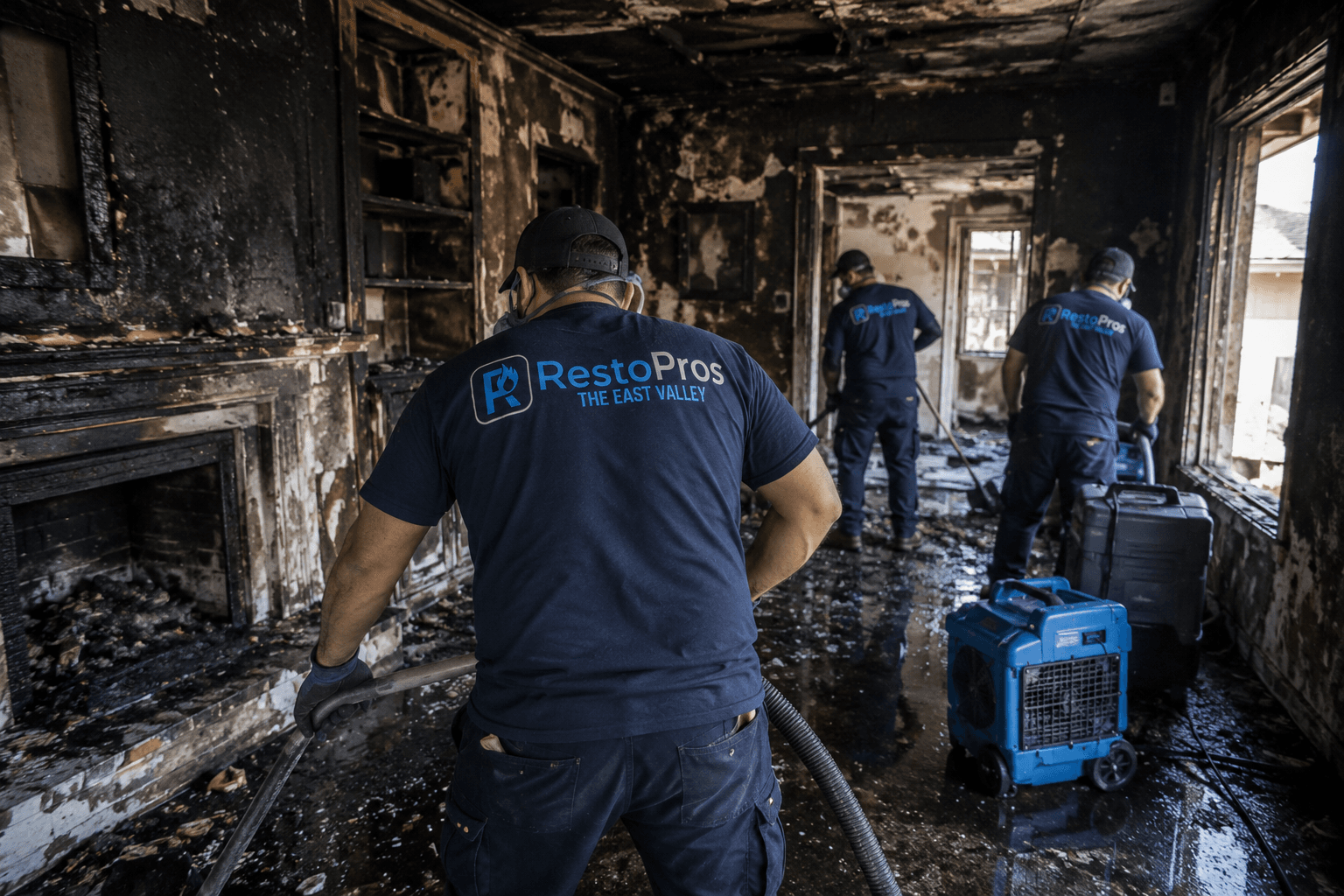
Fire and smoke damage restoration underway in a Mesa, AZ home
RestoPros

Fire & Smoke Damage Restoration in Mesa, AZ — Board-Up to Rebuild

After the engines leave, a second clock starts: acidic soot begins permanently etching glass, metal, and finishes within days, and the water used to fight the fire is already soaking into your structure. RestoPros of the East Valley responds 24/7 across Mesa with emergency board-up and tarping, soot and odor removal, contents cleaning, structural drying, and full reconstruction — with direct insurance billing from day one.

Google
starstarstarstarstar
5.0 Google Rating
verified

Licensed & Certified

IICRC Certified Technicians

shield

Fully Insured

Bonded for Your Protection

location_on

Local East Valley Pros

Mesa, Chandler, Gilbert, Tempe & Queen Creek

Most people are surprised to learn that fire restoration is really three simultaneous problems. There's the fire damage itself — charred structure and destroyed contents. There's smoke damage, which reaches far beyond the burn area and does its worst work in the days after the fire, as acidic residue etches surfaces and embeds odor into porous materials. And there's water damage, because suppression puts hundreds or thousands of gallons into the building, and in an Arizona August that water is on the 24-to-48-hour mold clock like any other loss.

Handling only one of those creates the classic bad outcome: a home that's been cleaned and repainted but smells like smoke every time the afternoon heats up, or one that looks restored while mold grows in the wall cavities that suppression water soaked. Restoration has to address all three, in the right order.

Mesa's specific fire profile reflects its housing spread. Kitchen fires are the most common everywhere, but central and downtown Mesa's older homes add aging electrical systems to the mix — original panels, aluminum branch wiring in some 1960s–70s construction, and decades of added circuits. Garages and workshops are another Mesa signature, with the heat, stored chemicals, and equipment that come with them. And monsoon lightning starts a handful of structure fires across the East Valley every summer.

How Fires Start in Mesa Homes — and What They Leave Behind

The cause shapes the residue, and the residue dictates the cleaning chemistry. These are the cases we run most across the city.

Kitchen and cooking fires

The most common residential fire by a wide margin. Even a small grease fire produces protein residue — a nearly invisible amber film with an intense, rancid odor that spreads through the kitchen and into the HVAC system. Homeowners scrub the stove, find nothing else, and can't understand why the smell persists. The film is on every cabinet, wall, and ceiling in a wide radius.

Electrical fires in older Mesa homes

Central and downtown Mesa's mid-century housing carries aging panels, original branch wiring, and decades of accumulated modifications. Electrical fires often start inside walls or ceilings, meaning smoke penetrates cavities and insulation before flames are ever visible.

Garage and workshop fires

A Mesa staple: garages storing fuel, solvents, batteries, and equipment, at 130°+ in summer. These fires burn synthetics and chemicals, producing wet, greasy smoke residue that is among the hardest to clean and the most odor-intensive.

Monsoon lightning strikes

Summer storms start structure fires across the East Valley every year, often igniting in attics where the strike enters — which means smoke fills the attic and travels down through ceiling penetrations into living space.

Suppression water damage

Firefighting introduces large volumes of water into the structure. It soaks drywall, insulation, and framing, runs down through floors, and in Arizona heat begins growing mold within 24 to 48 hours. Structural drying is a core part of every fire job we run, not an afterthought.

HVAC redistribution

If the system was running during or after the fire, it inhaled smoke and distributed residue to rooms the fire never reached. Duct cleaning and equipment decontamination are frequently necessary even in homes with minimal visible damage.

Fire & Smoke Damage Response Across Mesa

We respond citywide, and building age changes both the fire profile and the restoration approach.

  • location_onDowntown & Historic MesaOlder homes with aging electrical, plaster assemblies that hold odor differently than drywall, and pre-1990 materials requiring asbestos testing before demolition.
  • location_onDobson Ranch & west Mesa1970s–80s homes where kitchen and garage fires dominate, and where original wiring has often been extended repeatedly over the decades.
  • location_onLas Sendas & northeast MesaLarger multi-story homes where smoke rises and spreads through stairwells and extensive duct systems, affecting far more of the house than the fire itself.
  • location_onEastmark & southeast MesaNewer construction with tight envelopes — smoke that gets in doesn't ventilate out passively, so deodorization matters even more.
  • location_onRed Mountain & northeast corridorMixed housing where monsoon lightning and garage fires both show up, often with attic involvement.
  • location_onCommercial Mesa & Falcon FieldRestaurants, offices, and light industrial where every closed day is lost revenue — we prioritize reopening and produce the documentation commercial policies require.
timelineOur Process

Our Mesa Fire Restoration Process

Sequenced deliberately — because pre-cleaning at-risk surfaces in the first 72 hours saves things that can never be recovered later.

01

Emergency Board-Up & Tarping

First priority is securing the structure: board up openings, tarp the roof, and make the site safe against weather, animals, and entry. Call (520) 482-3900 any hour — we typically reach Mesa addresses within 60 to 90 minutes.

02

Assessment & Residue Testing

We identify residue type surface by surface — dry, wet, protein, or fuel — because each requires different cleaning chemistry, and the wrong one sets stains permanently. You get a written scope and we document everything for your insurer.

03

Pre-Clean the 72-Hour Surfaces

Glass, metal, stone, and appliances get immediate attention, because acidic residue permanently etches and pits them within days. This step happens before full scoping is even complete.

04

Water Extraction & Structural Drying

Suppression water is extracted and the structure dried with commercial equipment and daily moisture readings — preventing the mold problem that otherwise follows every fire.

05

Soot Removal & Contents Cleaning

HEPA vacuuming and dry-sponge work first (never wet-wiping dry soot, which smears it permanently), then residue-matched wet cleaning and degreasing. Salvageable contents are cleaned item by item rather than written off wholesale.

06

Deodorize, Then Rebuild

Thermal fogging, ozone, or hydroxyl treatment to neutralize odor at the molecular level after source removal, HVAC decontamination, sealing primers on cleaned surfaces, then full reconstruction to pre-loss condition.

Mesa Fire Restoration: Cost, Coverage, and Contents

Fire losses vary more widely than any other restoration category, from a contained kitchen fire needing cleaning and deodorization to a structural loss requiring demolition and full rebuild. What drives the number: the burn area, how far smoke and residue traveled, the residue type (protein and wet smoke cost more to clean than dry smoke), how much suppression water entered, whether the HVAC needs decontamination, and the reconstruction scope — which on larger fires is the majority of the total.

Fire and smoke damage is covered by essentially every homeowner's policy, including smoke damage to areas the flames never reached — and adjusters expect professional cleaning, deodorization, and contents processing as standard line items on fire claims. Two things protect your claim: document everything before cleanup begins, since photos of residue are evidence that disappears as work proceeds, and insist on item-by-item contents assessment rather than a blanket total-loss assumption. Good contents cleaning routinely saves things families had written off.

We provide a free assessment, a written line-item scope, and direct billing to your carrier. If you're displaced, we can also help document additional living expenses, which most policies cover.

  • check_circle24/7 emergency board-up and tarping to secure the property immediately.
  • check_circleResidue testing before cleaning — the wrong chemistry makes damage permanent.
  • check_circleItem-by-item contents assessment, not blanket write-offs.
  • check_circleDirect insurance billing and full documentation for your fire claim.

Fire or Smoke Damage in Mesa? Call Before the Soot Sets

Acidic residue starts permanently etching glass, metal, and finishes within 72 hours. Call RestoPros of the East Valley at (520) 482-3900 for 24/7 emergency board-up, smoke and soot removal, deodorization, and rebuild across Mesa — with direct insurance billing.

Get in Touch

Need a free inspection in Mesa? Fill out the form and our local team will get back to you quickly.

schedule

Open 24/7 for Emergencies

helpFAQ

Fire & Smoke Damage Restoration in Mesa — FAQs

It depends on the smoke, not the flame. A tiny protein fire from burnt food can odor-contaminate an entire floor and coat the HVAC, and a small smoldering fire produces the worst residue there is. If smell or film extends beyond the immediate fire area, get an assessment — ours is free.

Because the most common instinct — wiping with a wet cloth — drives dry soot into paint and drywall texture and converts removable powder into permanent staining. Different residue types need different chemistry, and using the wrong one sets the damage. Ventilate, stay off the residue, and let the assessment come first.

Yes, when it's done properly: source removal first, then neutralization with thermal fogging, ozone, or hydroxyl treatment, plus HVAC decontamination and sealing primers on cleaned surfaces. Odor that returns on hot afternoons after a 'completed' job means residue was left in ducts, insulation, or cavities.

More than most people expect. Hard contents, many textiles, and a surprising share of household items are recoverable when the right chemistry reaches them before acid damage sets. We assess item by item and document salvage for your claim rather than defaulting to write-offs.

It's a full water damage loss on top of the fire, and it's on the same 24–48 hour mold clock in Arizona heat. Structural drying with daily moisture verification is a standard part of every fire job we run — skipping it is how a restored home develops a mold problem two months later.

Board-up and pre-cleaning of at-risk surfaces ideally within 24 to 72 hours — that's the window in which acidic residue permanently etches glass, metal, and stone. We respond 24/7 across Mesa at (520) 482-3900.

call

Emergency Help 24/7

CALL 520-482-3900

arrow_forward