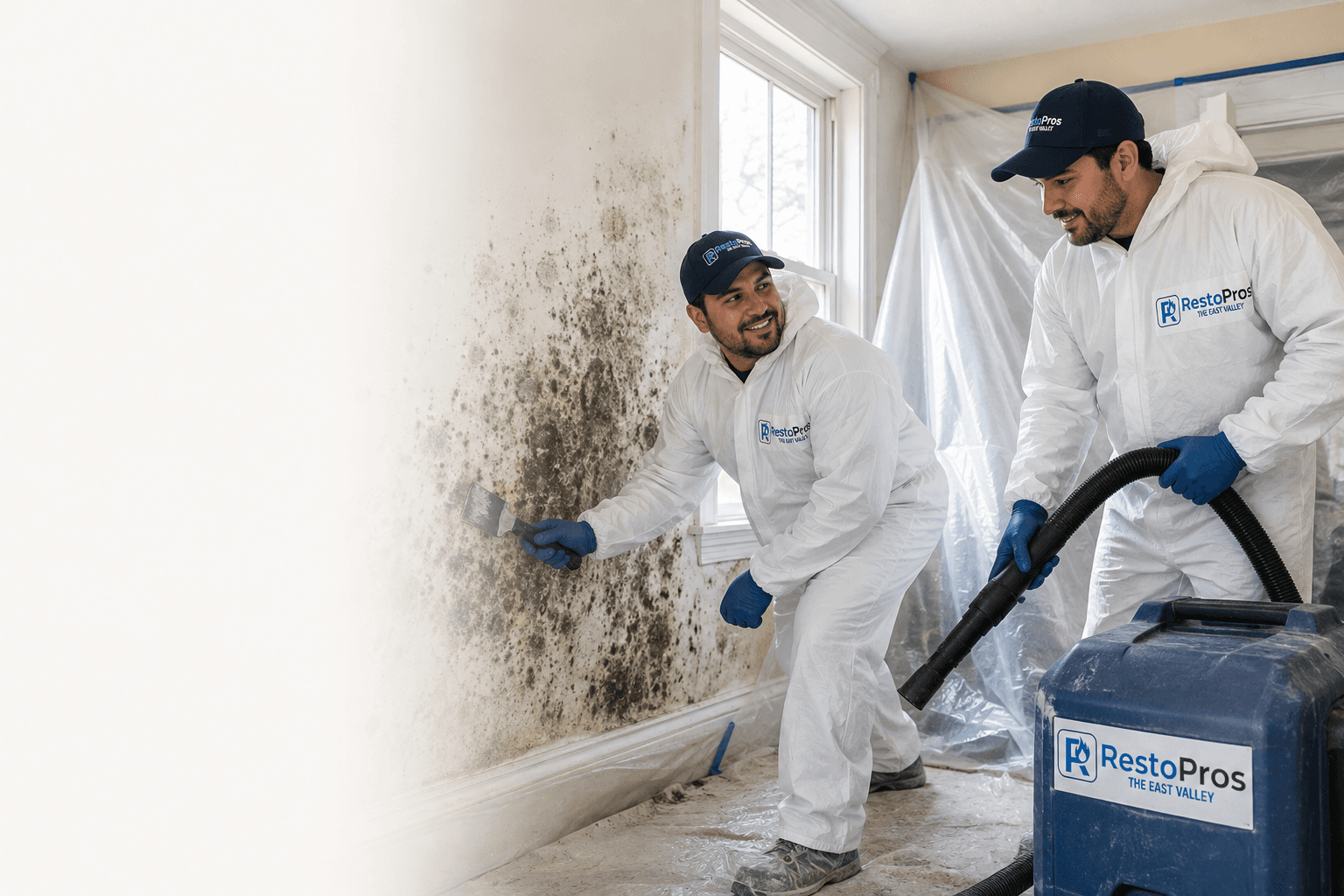
Chandler mold has a specific origin story, and it starts under the concrete. This city's combination of slab-on-grade construction and unusually mineral-heavy water means copper supply lines cast beneath the foundation corrode from the inside until they weep. That water doesn't announce itself — it wicks up through the slab into flooring assemblies and the bottom few inches of drywall, where it feeds growth in a dark, enclosed, permanently damp environment. Homeowners typically discover it by smell, months in, after the visible surfaces have looked normal the entire time.
The second Chandler pattern is polybutylene. Large parts of north Chandler and the areas around Andersen Springs were plumbed with gray poly pipe between 1978 and 1995. When it fails it bursts rather than drips, and if the burst happened inside a wall while nobody was home, the mold that follows is a cavity problem rather than a surface one.
Both patterns mean the same thing for how we work: inspection before assumption. We map moisture with meters and thermal imaging — and borescope cavities when the readings warrant — so the remediation scope matches the actual contamination rather than the visible patch. Then containment, removal, treatment, verification, and rebuild, with the moisture source corrected as part of the project rather than left for later.