
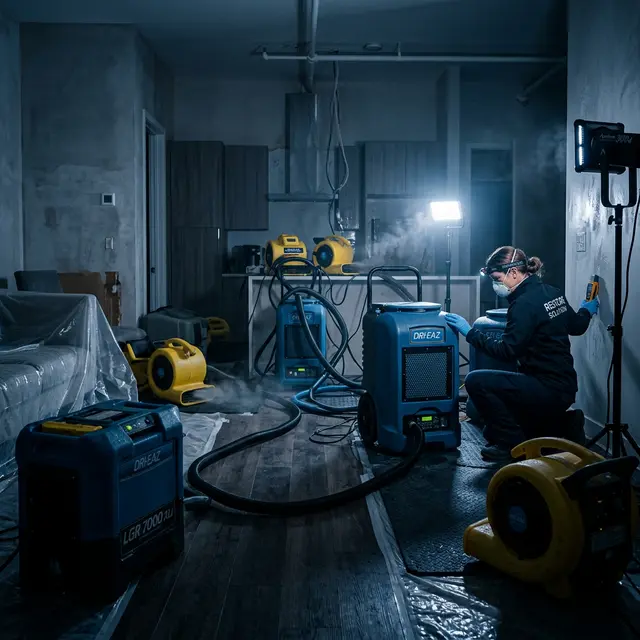
Most water damage announces itself. A slab leak doesn't. It's a pinhole in a copper line running under your concrete foundation, releasing water into the soil and up into your flooring for weeks or months before anything looks wrong. By the time many East Valley homeowners discover one, they're not dealing with a plumbing repair — they're dealing with saturated flooring, mold under the baseboards, and a water bill that's been quietly climbing since spring.
Here's how to catch one early: the signs, the simple test you can run yourself this afternoon, how professional detection pinpoints a leak without tearing up your floor, and how the repair and insurance sides actually work.
Key Takeaways
- Slab leaks are common in the East Valley because hard, mineral-heavy water corrodes copper lines run beneath post-1970s concrete slab foundations.
- The five-minute water meter test can confirm a hidden leak today — before any floor is touched.
- Modern detection is non-invasive: electronic amplification, thermal imaging, and pressure isolation locate leaks within inches.
- Insurance usually covers the resulting water damage and often the access work — but not the pipe repair itself.
Why Arizona Homes Get Slab Leaks
Three ingredients, all standard in Mesa, Chandler, and Gilbert construction: copper water lines routed under or through the slab, water hard enough to scale a kettle in a month, and expansive desert soil that shifts with moisture and temperature. The minerals and dissolved chemistry in Valley water slowly pit copper from the inside; soil movement and slab settling stress the lines from the outside; and hot-water lines fail first because heat accelerates both. Homes from the 1970s through the 1990s are the classic victims, but we've opened slabs on much newer houses too.
8 Signs of a Slab Leak
- Warm spots on the floor — the most distinctive sign. A hot-water line leaking under tile or concrete gently heats the floor above it. If the dog has a new favorite spot, pay attention.
- A water bill that climbed without explanation. Compare against the same month last year, not last month — Valley usage swings seasonally.
- The sound of running water when everything is off, often clearest at night near walls or floors.
- A drop in water pressure at fixtures, especially on the hot side.
- Damp carpet edges, cupping wood planks, or tile grout that darkens and stays dark.
- A musty smell along baseboards or in rooms with no visible moisture — mold under flooring announces itself by odor first.
- Hairline cracks appearing in flooring or drywall as saturated soil moves under the slab.
- White, chalky mineral residue (efflorescence) on the slab edge or garage floor where moisture is wicking through concrete.
The 5-Minute Test You Can Do Right Now
Turn off every fixture and appliance that uses water — taps, ice maker, softener regeneration, irrigation. Find your water meter (usually in a ground box near the street), and watch the low-flow indicator: a small triangle, star, or dial that spins with any flow. If it's moving with the whole house shut off, water is going somewhere it shouldn't. To narrow it down, close the house-side main shutoff: if the indicator stops, the leak is inside the house envelope — and if you've also got warm floor spots, a slab leak just became the leading suspect.
How Professional Slab Leak Detection Works
Nobody should be jackhammering concrete to search for a leak. Modern detection locates it first, precisely, from above the slab:
- Pressure isolation confirms which line is leaking — hot or cold — by pressurizing each and watching for decay.
- Electronic acoustic amplification listens through the slab for the specific hiss of water escaping a pressurized line, triangulating position.
- Thermal imaging maps hot-water leaks by their heat signature through flooring — often drawing a visible line along the pipe's path.
- Tracer gas can be introduced into stubborn lines; escaping gas is detected at the surface within inches of the breach.
In the Valley, standalone leak detection typically runs a few hundred dollars, and many plumbing and restoration companies credit it toward the repair. Compared to exploratory demolition, it's the cheapest part of the entire event.
Repair Options, Briefly
Once located, there are three standard paths: a spot repair (open the slab at the leak, fix the section — least expensive, but the rest of the aging line remains), a reroute (abandon the under-slab section and run a new line overhead through walls and attic — the most common choice in East Valley homes with one or two failures), or a whole-home repipe when a house has entered the serial-failure stage. Your plumber handles the pipe; the equally important question is what the water already did — which is where we come in.
What Insurance Does (and Doesn't) Cover
Arizona homeowner's policies generally treat slab leaks in three parts. The resulting water damage — flooring, drywall, baseboards, drying, mold prevention — is usually covered, because the discharge is sudden and accidental from your perspective. The access work (opening and re-pouring concrete to reach the leak) is often covered under 'tear out and replace' language. The pipe repair itself is typically not covered — that's considered maintenance. Policies differ, and adjusters look closely at how long the leak ran, which is another reason early detection protects both your house and your claim. We document moisture readings, damage extent, and cause for the adjuster, and bill covered mitigation directly to your carrier.
The Cost of Ignoring One
A slab leak caught at the warm-spot stage is a plumbing bill and a few days of drying. The same leak six months later is torn-out flooring across multiple rooms, mold remediation under containment, and weeks of reconstruction — routinely a five-figure difference. Under-slab moisture also feeds mold in exactly the hidden places Arizona's dry air can't reach, which is why our mold remediation team ends up involved in so many late-discovered slab leaks. If you have symptoms from the list above, run the meter test today.
Frequently Asked Questions
How do I know if I have a slab leak or just high usage?
The water meter test settles it: with everything off, a moving low-flow indicator means a real leak. Warm floor spots, hot-side pressure loss, or the sound of running water push the diagnosis strongly toward the slab.
How much does slab leak detection cost in Arizona?
Typically a few hundred dollars for professional electronic detection in the Phoenix metro, and it's often credited toward repair work. It's dramatically cheaper than exploratory concrete work, which is exactly what it exists to prevent.
Is a slab leak an emergency?
It's rarely a burst-pipe-style emergency, but it is a compounding one — every week adds saturation and mold risk under your flooring. Treat it as a this-week problem, not a someday problem.
Does RestoPros fix the pipe?
Our job is everything the water touched: moisture mapping, structural drying, mold prevention or remediation, and rebuilding flooring and drywall — coordinated alongside your plumber's line repair so the whole event closes out as one project. Call (520) 482-3900 for a free moisture inspection.
Warm Spot on the Floor? Let's Find Out What's Under It
RestoPros of the East Valley provides free moisture inspections and 24/7 water damage restoration across Mesa and Chandler — where hard water and slab-on-grade construction make this the most common hidden leak we see. If the meter's spinning and everything's off, call (520) 482-3900.