
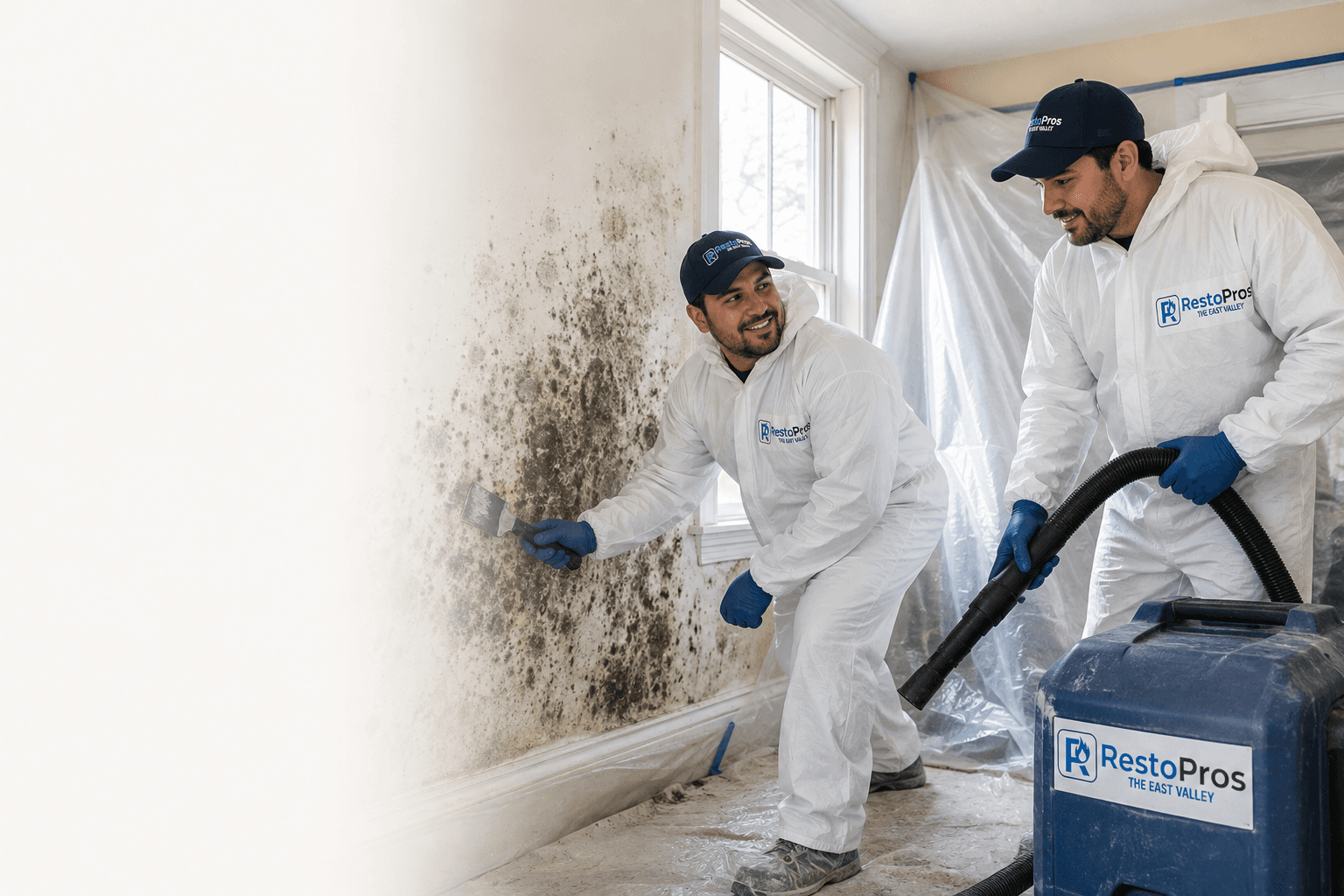
You found something dark spreading behind the toilet or along a baseboard, and the bottle under the sink says it kills 99.9% of germs. So you spray it, wipe it, and the spot disappears. Three weeks later it's back, slightly bigger, and now there's a smell. This is the single most common mold story we hear, and it happens because bleach does something genuinely useful on one type of surface and something almost counterproductive on another.
Here's the honest, complete answer — the surfaces where bleach genuinely works, the surfaces where it sets you back, the reason why, and what to use instead.
Key Takeaways
- On hard, non-porous surfaces — glazed tile, glass, sealed countertops, tubs — bleach kills surface mold effectively.
- On porous materials — drywall, wood, grout, insulation, particleboard — it typically doesn't reach the root structure, and the water it carries can feed regrowth.
- Bleach also removes the color, which makes a colony look gone while it's still alive underneath — the reason so many 'cleaned' spots return.
- The real fix is always the same two steps: remove the affected material or clean it appropriately, and eliminate the moisture feeding it.
The Short Answer
Yes on hard non-porous surfaces. Mostly no on porous ones. Sodium hypochlorite is a genuinely effective biocide — the issue isn't whether it can kill mold, it's whether it can reach it.
Why Bleach Fails on Drywall and Wood
Mold has roots, and bleach stays on top
Mold isn't a stain sitting on a surface. It's an organism with a root-like structure (hyphae) growing down into whatever it's eating — and on drywall, it's eating the paper facing and sometimes the gypsum behind it. Sodium hypochlorite is an ionic compound that doesn't travel well into porous material; it largely stays at the surface. So you kill the visible growth and leave the roots in the material, intact and ready to regrow.
Household bleach is mostly water — and water is mold food
Standard household bleach is roughly 5–8% sodium hypochlorite. The rest is water. When you apply it to porous material, the chlorine component largely evaporates from the surface while the water soaks in — which is why a bleach treatment can leave the material wetter than it started. You've removed the color, killed the surface layer, and delivered moisture directly to the roots. That's the mechanism behind the 'it came back bigger' pattern.
You've also destroyed your own evidence
Bleach's most reliable effect on mold is cosmetic: it strips the pigment. The colony goes from obvious black-green to nearly invisible while remaining alive. That's actively harmful, because now you can't see the growth spreading, you can't judge the true extent, and a future inspection — or a buyer's inspector — is working with a bleached, misleading surface.
Where Bleach Genuinely Works
- Glazed ceramic tile and glass shower doors — nothing penetrates, so surface treatment is the whole job.
- Bathtubs, sinks, and sealed solid-surface countertops.
- Sealed, non-porous plastic and metal fixtures.
- Note the exception hiding in your bathroom: tile is non-porous but grout is not. Grout is cement-based and absorbent, which is exactly why the black lines in your shower keep returning after every bleach session.
For these surfaces, a diluted solution (roughly one cup of bleach per gallon of water) applied to a pre-cleaned surface, left briefly, then rinsed and dried, is a perfectly reasonable approach. Ventilate, wear gloves and eye protection, and never mix bleach with ammonia or acidic cleaners — that combination produces toxic gases and is genuinely dangerous.
What the EPA Actually Recommends
This surprises people: the EPA's mold cleanup guidance does not recommend routinely using biocides like bleach for mold remediation. Their guidance centers on removing the mold and fixing the moisture problem — with detergent and water sufficient for hard-surface cleaning, and porous materials that absorbed water generally being discarded rather than treated. The logic is simple: dead mold is still allergenic, so the goal is removal, not sterilization in place. Killing mold and leaving it there doesn't solve the problem.
What to Use Instead
For small hard-surface growth
Detergent and warm water, scrubbed and dried thoroughly, handles most of it. If you want something with more staying power, undiluted white vinegar is mildly acidic, penetrates porous surfaces better than bleach, and doesn't carry the same fume and mixing hazards — apply, leave an hour, scrub, dry. Hydrogen peroxide (3%) is another reasonable option on colorfast surfaces. None of these are magic; the scrubbing and the drying are doing much of the work.
For anything porous or larger
Contaminated drywall, insulation, carpet pad, and particleboard get removed rather than treated. That sounds drastic until you consider that these materials are cheap, and the alternative is a colony living inside your wall indefinitely. Professional remediation uses EPA-registered antimicrobials on the surfaces that remain — but only after removal, and always under containment.
And in every case: find the water
Mold is a symptom. Moisture is the diagnosis. Until the source is fixed, any cleaning — bleach, vinegar, or professional remediation — is temporary by definition. In Arizona homes the usual culprits are an AC condensate line, a slab leak, a monsoon roof penetration, or water damage that was extracted but never dried to standard. Our guide to tracing a musty smell to its source walks through finding it room by room.
The DIY Line: When It's Fine, When It Isn't
EPA's practical rule of thumb: mold covering less than about 10 square feet on accessible, hard surfaces is reasonable to handle yourself — with gloves, eye protection, an N95, and ventilation. Beyond that, or in any of the situations below, the risk isn't the scrubbing, it's the spreading: disturbing a colony without containment aerosolizes spores throughout the house.
- Growth larger than roughly 10 square feet, or spread across multiple areas.
- Anything inside walls, under flooring, in insulation, or on HVAC components.
- Mold following a known water event — a burst pipe, slab leak, or roof leak.
- Recurring growth in the same spot, which means the moisture source was never fixed.
- Anyone in the household who is immunocompromised, elderly, an infant, or has asthma or significant allergies.
- Contaminated water involvement — sewage or flood water is a different hazard class entirely.
Why Bleaching Mold Backfires Harder in Arizona
There's a local wrinkle worth knowing. Because our outdoor air is so dry, Arizona homeowners tend to assume any mold they find must be a small, surface-level fluke — so the bleach-and-forget approach feels proportionate. But desert humidity has no bearing on the inside of a wall cavity. When mold appears on a Mesa or Gilbert baseboard, it's usually the visible edge of a moisture problem inside the structure: a slab leak wicking up through the floor assembly, an AC drain line backing up above the ceiling, or an old leak that was never properly dried. Wiping the visible part with bleach treats the one part of the problem that wasn't actually the problem.
Frequently Asked Questions
Does bleach kill black mold specifically?
The same rules apply regardless of species — on non-porous surfaces it kills surface growth, on porous materials it usually doesn't reach the roots. Species identification also matters less than people expect: EPA guidance is that all significant indoor mold growth should be removed and the moisture fixed, whatever type it is.
Is vinegar actually better than bleach for mold?
On porous surfaces, generally yes — it penetrates better and doesn't carry the same fume or dangerous-mixing risks. On glazed tile and glass, bleach is at least as effective. Neither one fixes mold living inside drywall or insulation; that material needs to come out.
I already bleached it and it came back. What now?
That's the diagnostic result, not a failure on your part — regrowth in the same place means there's a moisture source still feeding it and root structure still in the material. Stop treating the surface and find the water. A moisture inspection with meters and thermal imaging will locate it; ours is free.
Can I paint over mold with mold-killing primer?
No. Paint and primer seal the surface while the colony continues in the material and the moisture problem persists behind it. Stain-blocking primers have a legitimate role, but only after proper removal and drying — as the last step, never as the fix.
Is dead mold still a problem?
Yes, which is the core reason 'killing' mold isn't the goal. Dead spores and fragments remain allergenic and can still trigger reactions in sensitive people. Removal is the objective; disinfection of remaining surfaces is a supporting step.
How do I know if it's mold in the first place?
Mold typically shows a growth pattern following a water path, smears or returns when wiped, and carries a musty odor. Dust and soot wipe away cleanly and don't smell. Our guide to identifying black mold covers the visual differences in detail — and if you're unsure, send us a photo when you call.
Mold That Keeps Coming Back? Let's Find What's Feeding It
If bleach hasn't held, the answer isn't a stronger chemical — it's finding the moisture. RestoPros of the East Valley provides free mold and moisture inspections with meters and thermal imaging, then IICRC-standard mold remediation with containment, safe removal, and verification across Mesa, Gilbert, Chandler, and the rest of the East Valley. Not sure what you're looking at? Start with what black mold looks like, or call (520) 482-3900.