
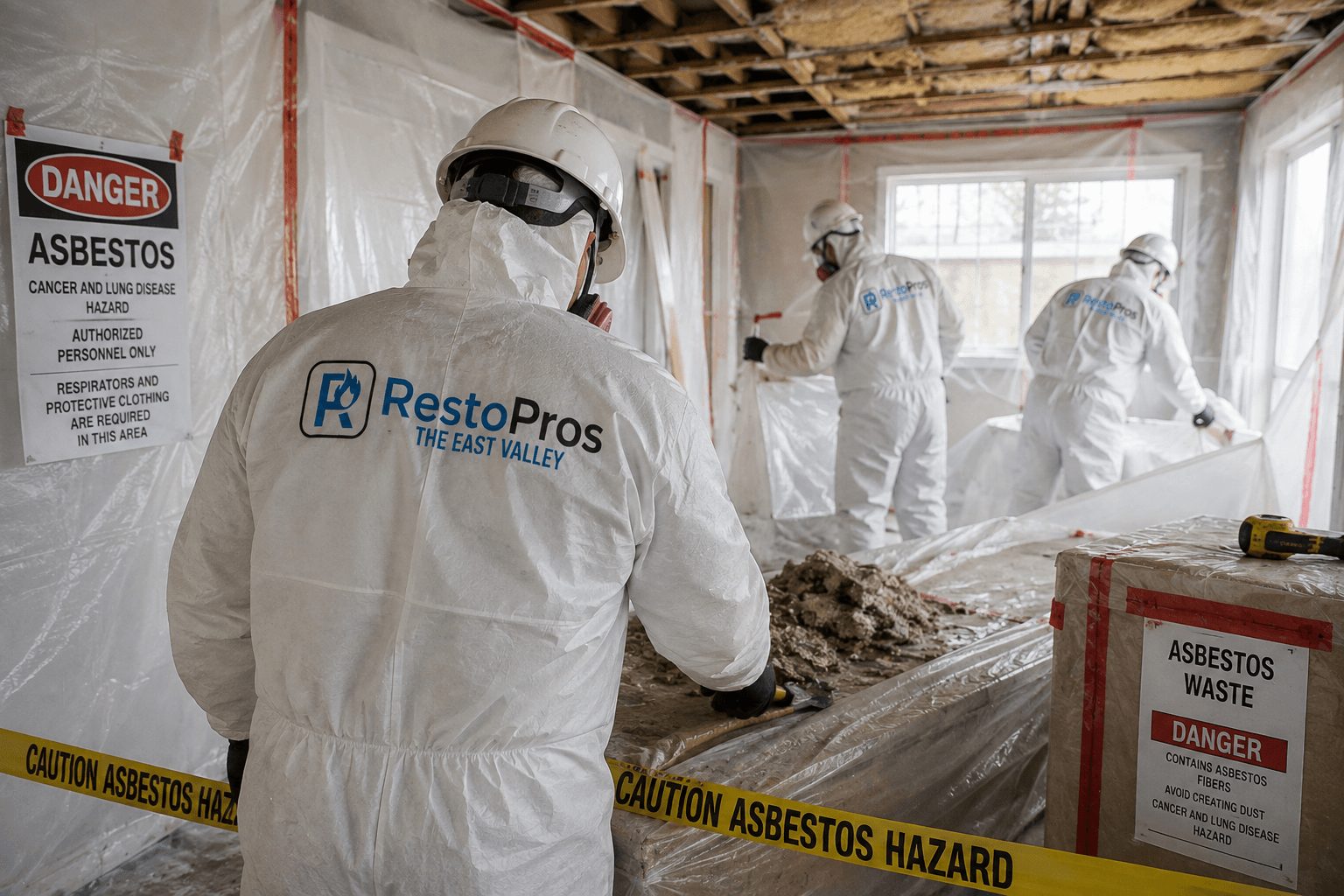
The question usually arrives about a week before demo day. Someone is taking out a popcorn ceiling, or pulling up two layers of old vinyl tile, or opening a wall in a 1974 ranch house in Mesa, and a contractor mentions asbestos. From there it splits into two bad outcomes: the homeowner panics and pays for testing nobody needed, or shrugs it off and sends a sledgehammer through material that should have been sampled first.
The honest answer is that it depends on three things — who owns the building, how many dwelling units it has, and whether it has ever been used for anything other than someone living in it. Get those three right and the requirement is usually clear. This is general information about how the rules work in the East Valley, not legal advice, and the agency with jurisdiction over your address is the final word.
Key Takeaways
- Owner-occupied single-family homes are generally outside the federal asbestos NESHAP notification rule, and that is the exemption most East Valley homeowners are relying on.
- The exemption has three common holes: five or more dwelling units, any past commercial or institutional use of the building, and demolition tied to redevelopment rather than to the owner living there.
- Regulated jobs in Mesa, Chandler, Gilbert and Tempe require notification to Maricopa County Air Quality at least 10 business days before work starts.
- Apache Junction and part of Queen Creek sit in Pinal County, which runs its own program with its own notification and fee — a detail that catches contractors out regularly.
- Being exempt from notification does not make the material safe, does not waive disposal rules, and does not protect you from the liability of disturbing it badly.
What the Rule Actually Regulates
The governing standard is the federal asbestos NESHAP at 40 CFR 61 Subpart M, enforced locally. In Mesa, Chandler, Gilbert and Tempe that enforcement sits with the Maricopa County Air Quality Department under Rule 370. For a regulated renovation or demolition, the rule expects two things in order: a survey of the materials that will be disturbed, with bulk samples analyzed by a laboratory accredited under the National Voluntary Laboratory Accreditation Program, and then a notification filed with the county before work begins.
The notification window is at least 10 business days ahead of the start of work, which is the part that wrecks schedules. Two calendar weeks is not a formality you can compress by paying more; it is a filing deadline. A contractor who tells you on Friday that demo starts Monday and testing can happen alongside is either working an exempt job or not working a compliant one.
One more timing detail worth knowing if you are buying a building that has already been surveyed: a survey is generally treated as good for five years. Past that, or if new materials went in after the survey date, the materials need looking at again by a qualified inspector rather than relying on the old report.
The Single-Family Exemption, and Where It Comes From
Most people reading this own a house they live in, and for them the rule generally does not apply. Rule 370 carves out demolition and renovation on a single owner-occupied, solely residential parcel containing four or fewer detached dwelling units. Maricopa County states it plainly in its demolition and renovation guidance: single-family residences are outside the requirement, while residential buildings with five or more dwelling units, and apartment or condominium complexes with more than one building, are inside it.
That is a real exemption and you are entitled to rely on it. What it means precisely is that you are not required to file a notification with the county and not required to have a survey on file before you start. It does not mean the material in your ceiling is different from the material in the duplex next door.
The Three Holes People Fall Through
The first is unit count. Four or fewer detached units is the line. A fourplex may sit on the right side of it; a small apartment building does not, and a condominium complex with more than one building does not, regardless of how residential it feels. If you own a rental property rather than live in it, read the wording carefully rather than assuming residential means exempt.
The second is history of use. The exemption is for buildings used solely as residences. A structure that is used, or ever has been used, for commercial, institutional or industrial purposes falls back under the rule. In older parts of Mesa and Tempe this is not a hypothetical — converted storefronts, former offices, church annexes and live-work buildings all exist, and the county looks at what the building has been, not only what it is now.
The third is who is really doing the demolition and why. The exemption is built around an owner who occupies the home. A house bought by a builder and knocked down as part of a redevelopment is a demolition project, not a homeowner renovation, and treating it as exempt because it used to be somebody's house is where investors and flippers get into trouble.
Apache Junction and Queen Creek: A Different Agency
Maricopa County Air Quality covers Mesa, Chandler, Gilbert and Tempe. Apache Junction sits in Pinal County, and Queen Creek straddles the county line, which means part of it does too. Pinal County runs its own delegated air quality program with its own asbestos NESHAP requirements, including its own notification filed at least 10 working days ahead and a per-notification fee. Elsewhere in the state, the program is run by ADEQ.
The practical failure mode is a contractor who works mostly in the Valley, files everything with Maricopa County out of habit, and files nothing at all for a job in Apache Junction. Confirm which agency has your address before anyone files anything, because filing with the wrong one is the same as not filing.
What Actually Contains Asbestos in an East Valley Home
Pre-1980 is the usual rule of thumb, and it is a decent one, but it is a rule of thumb rather than a cutoff — asbestos was never comprehensively banned from US construction products, and stock kept being installed after it stopped being manufactured. Our guide to asbestos in older Arizona homes covers the history. These are the materials that most often come back positive on a remodel:
- Textured and popcorn ceiling coatings, the single most common finding in Valley homes of this era.
- Nine-by-nine inch vinyl floor tile and the black cutback mastic underneath it, including under later flooring.
- Sheet vinyl backing, which is often more of a problem than the tile because it tears rather than lifts.
- Drywall joint compound and textured wall finishes.
- Duct wrap, HVAC tape and insulation around older air handlers and water heaters.
- Cement board, transite pipe and some exterior siding and soffit panels.
- Roofing felt, mastics, and window and door glazing compounds.
Two patterns matter more than the list. Flooring is frequently layered, so the material you can see is not the material you will disturb. And intact, undisturbed asbestos-containing material sitting where nobody touches it is generally lower risk than the same material after a demo crew has broken it up — disturbance is what creates exposure, which is why the timing of this question, before the work rather than after, is the whole point.
What a Survey Costs
In the Phoenix area, a residential inspection with a handful of bulk samples commonly runs a few hundred dollars, with more comprehensive surveys on larger or more complex buildings running into four figures. Laboratory analysis of each sample is a modest add per sample. Against a remodel budget it is small, and against the cost of an abatement you did not plan for it is very small — our asbestos removal cost guide for Arizona walks through what removal runs material by material.
What you should receive is a written report identifying each sampled material, its location, the quantity present, the lab result with the analytical method used, and a clear statement of what is and is not asbestos-containing. A verbal all-clear is not a survey, and it is worth nothing to a buyer, a permit office or an insurer later.
The Conflict of Interest Worth Knowing About
A company that inspects and also sells abatement has an obvious incentive when reading a borderline result. That does not make it disqualifying, and plenty of firms handle it properly, but on a large job independent testing is cheap insurance. This is the same structural problem we describe in mold inspection versus mold testing, and the same defense applies: ask who reads the sample, which accredited lab is used, and whether you get the lab report itself rather than a summary of it.
When You Can Reasonably Skip It
If you own and live in the house, it has only ever been a residence, it was built after the mid-1980s, and you are doing work that does not disturb original ceiling texture, flooring layers, or mechanical insulation, the case for paying for a survey is weak. Painting, replacing fixtures, cabinet swaps and most cosmetic work do not disturb the materials in question.
Test when the work is destructive and the house is old enough to matter: ceiling texture removal, floor tile or sheet vinyl removal, wall openings in pre-1980 construction, duct replacement, or any full demolition. And test before the schedule is locked, because a positive result adds an abatement step and, on a regulated job, that 10-business-day filing window in front of it.
Frequently Asked Questions
Is an asbestos inspection required by law before remodeling in Arizona?
For regulated renovations and demolitions, yes — a survey of the materials to be disturbed is expected, along with notification to the agency with jurisdiction at least 10 business days before work begins. Owner-occupied single-family homes and solely residential parcels with four or fewer detached dwelling units are generally exempt from that requirement, though the exemption falls away if the building has five or more units or has ever been used commercially or institutionally.
Who has jurisdiction over my address?
Maricopa County Air Quality Department covers Mesa, Chandler, Gilbert and Tempe. Apache Junction is in Pinal County, and Queen Creek spans the county line, so part of it is Pinal as well. Pinal County runs its own program with its own notification and fee. Elsewhere in Arizona the program is administered by ADEQ. Confirm before filing, because filing with the wrong agency counts as not filing.
How much does an asbestos inspection cost in the Phoenix area?
A residential inspection with a handful of bulk samples commonly runs a few hundred dollars, with larger or more complex surveys running higher and each laboratory sample adding a modest amount. Price varies with home size, number of samples and whether you need a full AHERA-style written report.
Can I take my own samples and send them to a lab?
Labs will accept homeowner-submitted samples, but collecting a bulk sample means disturbing the exact material in question, usually without containment, negative pressure or respiratory protection. You also get no chain of custody and no professional assessment of quantity and condition, which is most of what a survey is actually for. On a regulated job it does not satisfy the requirement at all.
What happens if asbestos is found?
Not necessarily removal. Material in good condition that your project will not disturb can often be left in place and managed. If the work will disturb it, the options are abatement by a licensed contractor beforehand, or redesigning the scope to avoid it. On a regulated project, abatement triggers the notification requirement and the waiting period.
Does my homeowners insurance pay for asbestos removal?
Generally not for planned remodeling, since that is an improvement rather than a sudden loss. Where it can come into play is when asbestos-containing material is damaged by a covered event such as a burst pipe, a fire or storm damage, and removal becomes part of making that loss right. Coverage varies, so it is a policy-specific question.
Find Out Before the Demo Crew Does
The cheapest version of this problem is the one you find before the schedule is set. Our asbestos cleanup and abatement team handles assessment, containment, regulated removal and disposal, and the reconstruction afterwards, and we will tell you plainly when your project does not need us.
We cover asbestos cleanup in Mesa, Tempe, Chandler and Gilbert, across Arizona's East Valley. Inspections are free, estimates are written line by line, and we will point you to the right county agency for your address. Call (520) 482-3900.