
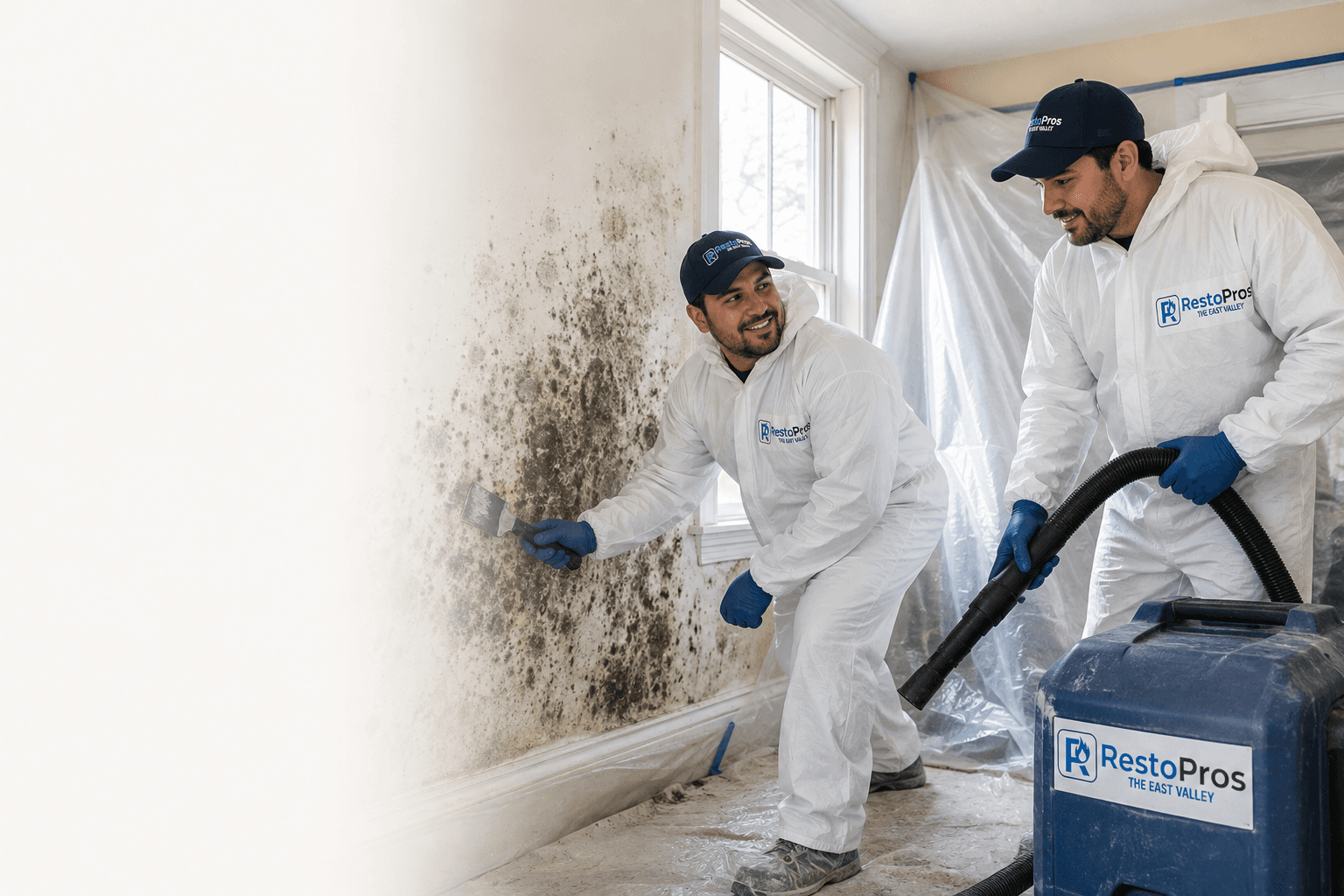
Most people call about mold testing when what they actually need is a mold inspection. The two words get used interchangeably, they cost very different amounts, and only one of them changes what happens next.
An inspection is a physical investigation of the building: where the moisture is, where it came from, and how far the growth extends behind finishes. Testing is laboratory sampling that identifies and counts what is in the air or on a surface. An inspection produces a plan. A test produces a number, and numbers without a source are hard to act on.
Key Takeaways
- The EPA's position is direct: in most cases, if visible mold growth is present, sampling is unnecessary.
- There are no federal standards or threshold limit values for airborne mold, so a lab result cannot tell you whether your home passes or fails anything.
- An inspection finds the water source. Without that, remediation is temporary no matter what the lab says.
- Testing earns its cost in five specific situations, most of them involving a second party: a buyer, a carrier, a lawyer or a doctor.
- Arizona does not license mold remediators as a separate trade, so the meaningful credentials are AZ ROC licensing and IICRC certification.
The Difference in One Paragraph
A mold inspection is diagnostic. A technician reads moisture in building materials with pin and non-invasive meters, uses thermal imaging to find temperature differentials behind finishes, traces the plumbing or roof or condensate path that put water there, and scopes how much material is affected. A mold test is analytical. Air or surface samples go to a lab and come back with genera and spore counts, sometimes compared against an outdoor control sample.
Put plainly: the inspection tells you what to do, the test tells you what it is called. Homeowners who buy the test first usually end up buying the inspection anyway.
What a Mold Inspection Actually Involves
- Moisture mapping of affected and adjacent materials, including readings from unaffected areas as a reference baseline.
- Thermal imaging to locate cool, wet areas behind drywall, under flooring and around AC components.
- Source tracing: supply lines, drain lines, slab penetrations, shower pans, roof and flashing, window and door seals, AC condensate drains and pans.
- Scope definition: how much material has to come out, what containment level is needed, and whether HVAC is involved.
- A written scope you can compare against other bids, and photographs.
If you do not yet know what is feeding the growth, that is the whole job. In Arizona homes the two most common hidden sources are under the slab and inside the air handler, which is why our guides to slab leak detection and mold in air ducts and AC vents cover the two failure points we find most often.
What Mold Testing Measures, and What It Cannot Tell You
Air sampling captures spores over a set period and reports counts by genus, usually alongside an outdoor control so the indoor result has something to be compared to. Surface sampling, by swab or tape lift, confirms whether a stain is mold and roughly what kind. Both are legitimate tools used well.
The limits are the part that rarely gets explained. The EPA states that standards or threshold limit values for airborne concentrations of mold or mold spores have not been set, and that there are no EPA regulations or standards for airborne mold contaminants. That means no lab can tell you your home is above or below a legal limit, because no limit exists. Results are also a snapshot: spore counts move with the time of day, whether the AC was running, and whether anyone had recently disturbed the growth.
Testing also cannot locate anything. A high count tells you spores are present in the sampled air, not which wall they came out of. The EPA is equally direct on that front: in most cases, if visible mold growth is present, sampling is unnecessary.
The Five Times Testing Is Worth Paying For
1. Symptoms or a musty smell with nothing visible
When the house smells wrong and an inspection finds no obvious growth, air sampling can support the case that something is hidden, usually inside a wall cavity or the duct system. Start with the nose though, because it is often enough on its own. Our guide to what a musty smell is actually telling you walks through the likely sources before you spend anything.
2. Post-remediation clearance
This is the strongest use of a test. After remediation, independent clearance sampling documents that the work achieved its goal. On larger jobs, jobs involving HVAC, and any job you may need to explain to a future buyer, clearance testing is worth the modest additional cost.
3. A real estate transaction
Buyers, sellers and lenders often want documentation rather than a contractor's opinion. An Arizona seller disclosing a past water event is in a much stronger position with an inspection report, a remediation scope and a clearance result than with a receipt.
4. An insurance or legal dispute
When a carrier is questioning causation or a landlord and tenant disagree about responsibility, third-party documentation carries weight that an internal report does not. If a dispute looks likely, test before remediation begins, not after.
5. A health-sensitive occupant
If someone in the home is immunocompromised, asthmatic, or under a physician's care for a suspected environmental exposure, a doctor may specifically want sampling data. That is a legitimate reason, and the request should come from the physician rather than from a contractor.
When Testing Is Wasted Money
- You can already see the mold. You know it is there. Identifying the genus rarely changes the remediation, because the process is the same for almost all of it.
- You want to know whether it is toxic black mold. Removal protocol does not change based on the answer, and the label alarms people more than it informs them.
- You are hoping a clean result means you can skip the repair. A low spore count in a hallway does not dry the wall cavity.
- You test but never fix the moisture. Mold is a symptom of water. Sampling the symptom while the water continues is the most expensive way to learn nothing.
The same logic applies to the bottle of bleach under the sink, which is the other thing homeowners reach for before addressing the source. We covered why that fails in does bleach kill mold.
The Conflict of Interest Worth Knowing About
A company that sells you the test and then sells you the remediation based on its own result has an incentive problem, and it gets worse when that same company writes its own clearance. The industry convention exists for a reason: whoever performs the remediation should not be the party certifying that it worked.
Our practice is to inspect free, tell you plainly when sampling would not change the plan, and bring in an independent hygienist when clearance testing is genuinely called for. If a company leads with a paid test before anyone has looked for the water, ask what the test will change about the scope. The answer is informative.
What Arizona Regulation Does and Does Not Cover
Arizona has no statewide mold contractor licensing statute of the kind Florida and Texas maintain, and no state-issued mold assessor credential. It does not follow that anyone can legitimately do the work. The construction involved in remediation, the demolition and the rebuild, falls under Arizona Registrar of Contractors licensing, and the accepted technical standard for the remediation itself is the IICRC S520.
So the credentials to ask for here are an active AZ ROC license and IICRC-certified technicians, plus a written scope. RestoPros of the East Valley holds AZ ROC #365594.
Why Mold Hides Better in Arizona
Low ambient humidity works against you in one specific way: surfaces dry fast, so the visible evidence of a leak disappears while the material inside the wall stays wet. Homeowners see a stain fade and assume the problem resolved itself. The moisture meter says otherwise.
The 2026 monsoon was one of the driest on record for the Phoenix area, so the growth we are finding this year traces overwhelmingly to indoor water rather than storms: condensate drains that clogged during a long cooling season, water heaters worn by a hot summer, and slab leaks. As AC runtime drops through October, leaks that evaporation was quietly masking start to show. If you are not sure what you are looking at yet, what black mold actually looks like is a better first stop than a lab.
Frequently Asked Questions
Do I need a mold test if I can already see mold?
Usually not. The EPA states that in most cases, if visible mold growth is present, sampling is unnecessary. You already know mold is there, and remediation protocol is largely the same regardless of species. Spend the money on an inspection that finds the moisture source instead.
What is the difference between a mold inspection and a mold test?
An inspection is a physical investigation using moisture meters, thermal imaging and source tracing to find where water is entering and how far growth extends. A test is laboratory sampling of air or surfaces that identifies and counts spores. The inspection tells you what work is needed. The test tells you what is present.
Is there a legal limit for mold in a house?
No. The EPA states that standards or threshold limit values for airborne concentrations of mold or mold spores have not been set, and there are no EPA regulations or standards for airborne mold contaminants. A lab report cannot say your home passed or failed, because there is nothing to pass or fail against.
Should the same company test and remediate?
For the remediation itself, one company is efficient. For clearance testing after the work, use an independent party. A contractor certifying its own work has an obvious conflict, and an independent clearance result is what holds up with a buyer, a carrier or a court.
Does Arizona require a license for mold remediation?
Arizona does not issue a separate mold remediation license the way some states do. The construction work involved requires Arizona Registrar of Contractors licensing, and the recognized technical standard for the remediation is the IICRC S520. Ask for both the ROC number and IICRC certification.
How much does a mold inspection cost in Arizona?
Diagnostic inspections are commonly offered free by remediation companies, including ours. Independent third-party assessments with laboratory sampling typically run a few hundred dollars depending on the number of samples. Clearance testing after remediation is usually priced per sample.
Get the Inspection First, Free
Our IICRC-certified team inspects free across Mesa, Gilbert, Chandler and the rest of the East Valley: moisture mapping, thermal imaging, source identification and a written scope before anything is demolished. If the scope turns into work, our mold remediation service runs containment under negative air pressure and finishes with verification. For what the work itself costs, see our Arizona mold remediation cost breakdown. AZ ROC #365594. Call (520) 482-3900.