
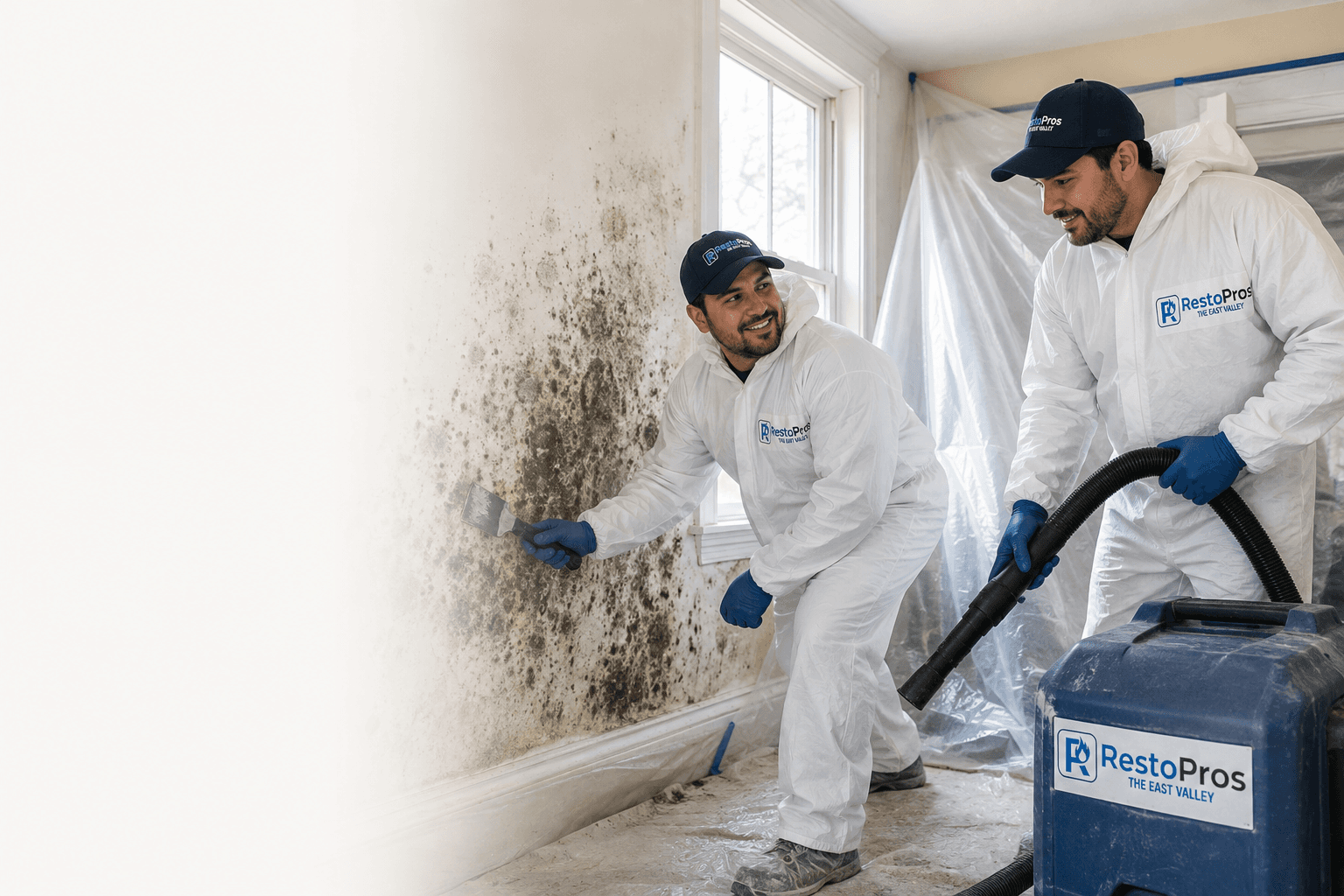
Mold pricing confuses homeowners for a good reason: the same dark patch on a bathroom wall can be a $300 cleanup or the visible corner of a $10,000 problem, and you can't tell which from the paint side. What sets the price isn't the visible mold — it's what's behind it, what caused it, and how much containment the removal requires. Here's the honest breakdown we walk East Valley homeowners through every week.
Key Takeaways
- Five factors drive cost: affected area, location and access, the moisture source, containment level, and post-remediation verification.
- Small surface jobs run hundreds; typical contained remediations in one area run into the low thousands; multi-room or HVAC-involved jobs go higher.
- Insurance covers mold only when it results from a covered water event — and most Arizona policies cap mold coverage ($5,000–$10,000 caps are common).
- A remediation quote that doesn't include fixing the moisture source isn't a fix — it's a subscription.
The Five Factors That Set Mold Remediation Cost
1. How much area is actually affected
Not the visible patch — the real footprint, which a moisture meter and sometimes a borescope reveal. Mold on two square feet of drywall surface is a different job from mold running the length of a wall cavity fed by a slab leak. This is why credible companies inspect before quoting, and why phone quotes are fiction.
2. Where it is and how hard it is to reach
A patch on open drywall is easy access. Mold inside a wall cavity, under installed cabinets, beneath wood flooring, in a tight East Valley attic in July, or in a crawlspace multiplies labor. Demolition and rebuild scope follows access: getting to the mold is often more work than treating it.
3. What's feeding it
Mold is a moisture symptom. A one-time leak that's already fixed is the cheap case. An active slab leak, a failed shower pan, or an AC condensate problem must be corrected as part of the project — otherwise the mold returns on schedule. If you're not sure what's feeding yours, our guide to slab leak detection in Arizona covers the most common hidden source we find under East Valley homes.
4. Containment and protection level
Proper remediation seals the work area behind plastic containment under negative air pressure with HEPA filtration, so removal doesn't seed spores through the rest of the house. Bigger areas and HVAC involvement mean more containment engineering. This line item is exactly what the suspiciously cheap bids skip — and it's the difference between removing mold and redistributing it.
5. Verification
Good jobs end with proof: moisture readings at dry standard, visual clearance, and — on larger or sensitive jobs — independent third-party clearance testing. It adds modest cost and is worth every dollar when you sell the house and the buyer's inspector asks about that remediation.
Realistic Price Tiers (Arizona)
- Small surface remediation — limited growth on accessible, non-porous or semi-porous surfaces, moisture source already resolved: typically a few hundred dollars.
- Standard contained remediation — one area (bathroom wall, closet, kitchen cabinet run) with containment, material removal, treatment, and drying: typically $1,500–$4,000 in our market.
- Complex jobs — multiple rooms, flooring systems, attic or HVAC involvement, or mold following a long-unnoticed leak: $5,000 well into five figures, driven mostly by demolition and rebuild scope.
Treat these as orientation, not a quote — the honest number comes from an inspection, which we do free, with the scope in writing.
How Insurance Handles Mold in Arizona
The rule that decides most claims: insurance covers mold when it results from a sudden, covered water event — the burst pipe you found last week — and excludes mold from long-term moisture, humidity, or deferred maintenance. On top of that, most Arizona policies carry a mold sublimit, commonly $5,000–$10,000, which caps what the carrier pays for remediation specifically even on covered claims. Two practical consequences: report water events fast (dwell time converts covered water claims into excluded mold claims), and get remediation scoped accurately so the sublimit is spent on the right work. We document cause and scope to insurance standards and bill carriers directly on covered losses.
Why the Cheap Mold Bid Grows Back
The pattern is reliable: a low bid that sprays and wipes visible growth, skips containment, doesn't open the wall, and never addresses the moisture. The smell returns in six weeks, the patch in twelve — except now spores have been broadcast through the house and the fix costs more than doing it right would have. When comparing quotes, ask three questions: What's your containment plan? What moisture source did you identify and who's fixing it? What verification do I get at the end? The bids that can't answer aren't cheaper — they're incomplete.
Frequently Asked Questions
Does homeowners insurance cover mold remediation in Arizona?
When the mold resulted from a covered, sudden water event — usually yes, up to your policy's mold sublimit (commonly $5,000–$10,000). Mold from gradual leaks, humidity, or maintenance issues is typically excluded. Fast reporting and good documentation protect your claim.
Can I remediate mold myself?
EPA's rule of thumb: small areas (under roughly 10 square feet) on accessible surfaces are reasonable DIY with detergent, gloves, and an N95 — after fixing the moisture. Anything inside walls, on HVAC components, larger than that, or recurring belongs with professionals, because the risk isn't the scrubbing — it's the spreading.
Does mold remediation include repairs?
Ask — it varies by company. Remediation ends with clean, dry, verified surfaces; putting back drywall, paint, and flooring is reconstruction. RestoPros does both under one roof, so the number you approve includes the finished room, not a bare stud wall.
How long does mold remediation take?
Small contained jobs: 1–3 days. Typical single-area remediations: 3–5 days including drying and verification. Multi-room or post-slab-leak projects: one to several weeks, mostly for the rebuild phase. Your written scope includes the timeline.
Get a Real Mold Scope, Free
Our IICRC-certified mold removal and remediation team inspects free across Mesa, Gilbert, and the entire East Valley — moisture mapping, written scope, honest tiering, and direct insurance billing where coverage applies. Call (520) 482-3900.