
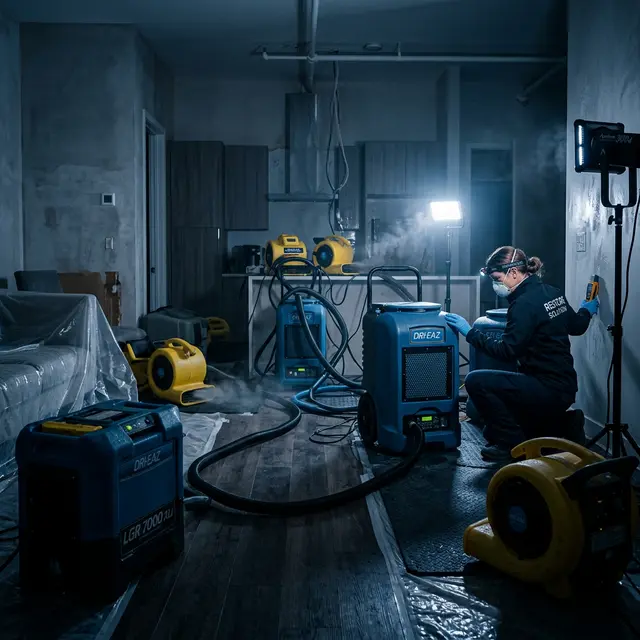
Almost nobody researches restoration companies in advance. You find out you need one at 11 p.m., standing on wet carpet, and you call whoever answers. That urgency is real — waiting genuinely makes the damage worse — but it also means you're making a several-thousand-dollar decision, signing paperwork tied to your insurance claim, in the worst possible frame of mind.
The good news is that the decision isn't complicated once you know what to look at. Most of what matters can be verified in about ten minutes, and the handful of things that cause real regret afterward are all visible up front if you know to look. Here's the whole picture.
Key Takeaways
- Verify three things before anyone starts work: an active state contractor license, current liability insurance, and IICRC certification.
- Insist on a written, line-item scope before work begins — not a signature on a blank authorization.
- Ask how they'll prove your home is dry. If the answer isn't daily moisture readings, keep calling.
- The most expensive mistakes aren't about price — they're about paperwork signed in the first hour.
The Six Things That Actually Matter
1. Licensed, bonded, and insured — verified, not claimed
Every company says this on its website. In Arizona you can check it yourself in about two minutes through the Arizona Registrar of Contractors license search. Look up the license number, confirm it's active, and confirm the classification actually covers the work. Then ask for a certificate of liability insurance — a real company sends one without hesitating. If someone gets defensive about either request, that's your answer.
2. IICRC certification
The IICRC is the body that sets the technical standards for water, fire, and mold restoration — including the S500 standard that governs how a structure gets dried. Certification means technicians were trained to a documented method rather than whatever the crew lead picked up on the job. It also matters at claim time, because adjusters recognize the standard and expect work to conform to it. Ask whether the technicians who will be in your house are certified, not just whether the company is.
3. A written, line-item scope of work
This is the single biggest predictor of whether you'll be happy at the end. Before work starts, you should have a document listing what will be removed, what will be dried, what will be rebuilt, and what it costs. "We'll bill your insurance, don't worry about it" is not a scope of work. Without one, you have no way to tell later whether you were charged for equipment that ran in an empty room for a week.
4. How they prove the house is dry
Ask this one directly: "How will I know it's actually dry?" The right answer involves moisture meters and daily logged readings against a dry standard for each material. The wrong answer is "we'll check it" or "when the fans come off." Incomplete drying is the most common way a water job becomes a mold job six weeks later — and at that point the original claim is closed and the new problem may be argued as maintenance.
5. Direct insurance billing and claim documentation
A company that works with carriers regularly will photograph everything, write estimates in the format adjusters expect, communicate with your adjuster directly, and bill the carrier for covered work so you're not fronting the whole cost. Companies that can't do this will hand you an invoice and leave you to fight for reimbursement on your own.
6. Genuinely local, with a real response time
Ask where crews dispatch from and what arrival time they'll commit to. In an emergency, a company two cities away with an answering service is materially different from one whose trucks are twenty minutes out. Also ask whether they handle the rebuild or only the drying — if they only mitigate, you'll be hiring a second contractor later, and coordinating that yourself is where projects stall.
The Paperwork That Causes the Most Regret
This is the part almost nobody warns homeowners about, and it matters more than price.
Never sign a blank or open-ended authorization
In the first hour someone will hand you a form on a tablet. Read it. A "work authorization" that doesn't specify the scope is effectively a blank check — it authorizes whatever the company later decides to do. Authorizing emergency mitigation (extraction, tarping, initial drying) is reasonable and often necessary. Authorizing unlimited unspecified work is not.
Understand what an Assignment of Benefits does
An Assignment of Benefits, or AOB, transfers your rights under your insurance policy to the contractor, letting them bill and negotiate with your insurer directly. It is a legitimate instrument and plenty of reputable companies use it. But it also hands over a lot of control — including, in some forms, the ability to pursue the claim in your name. You are entitled to read it, take a photo of it, ask what it means, and decline to sign it on the spot. A company that pressures you to sign anything immediately, in your driveway, at midnight, is telling you something about how it operates.
"We'll cover your deductible" is a red flag, not a favor
Offering to waive, absorb, or eat your deductible generally means inflating the estimate to the carrier to make up the difference. That's insurance fraud, and the policyholder — you — is a party to it. A company willing to do that with your claim is also willing to do other things you won't find out about until later.
Red Flags Worth Walking Away From
- Showed up uninvited after a storm. Post-monsoon door-knocking crews are a recurring problem across the East Valley, and many aren't local, aren't licensed here, and won't be reachable when a repair fails next summer.
- Won't provide a license number, or the number doesn't check out on the state registry.
- Demands a large cash payment up front. Deposits happen; large cash-only demands don't.
- Refuses to put the scope in writing, or gives a firm price over the phone before seeing the damage. Nobody can price water damage sight-unseen — the category of water and how far it spread change everything.
- Pressures you to decide immediately. Real urgency is about starting extraction, not about signing a contract in the next five minutes.
- Can't tell you how they verify the structure is dry.
Five Questions to Ask on the Phone
- What's your Arizona ROC license number? (Then look it up.)
- Are the technicians who'll be at my house IICRC certified?
- Will I get a written, line-item scope before work starts?
- How will you document that my home is dry when you're finished?
- Do you handle the repairs too, or only the drying?
You'll learn most of what you need from how those questions are answered — not just from the answers themselves. Hesitation on any of the five is informative.
When You Don't Need to Hire Anyone
Worth saying plainly, since it's rarely said by companies in this industry: not every water event needs a restoration crew. A small spill of clean water on sealed tile, caught within an hour and dried the same day, is a mop and a fan. So is a minor appliance overflow that never reached drywall, baseboards, carpet pad, or cabinets. The threshold that changes things is porous materials — once water is absorbed into drywall, wood, insulation, or carpet pad, it stops being a cleanup and becomes a drying problem, because those materials release moisture slowly into a closed, air-conditioned house. Our guide to what water damage restoration actually costs walks through where that line falls.
Frequently Asked Questions
Do I have to use the company my insurance recommends?
No. Insurers maintain preferred vendor programs and may suggest one, but in general you choose who works on your home. A preferred vendor can be perfectly good — just apply the same checks you'd apply to anyone else, and remember that a company in a carrier's program has a relationship with the carrier as well as with you.
Should I get multiple estimates?
For emergency mitigation, usually not — the delay costs more than the comparison saves, and mitigation scope is fairly standard. For the reconstruction phase, yes, absolutely. That's the larger number and there's time to compare, since the rebuild doesn't start until the structure is dry.
How fast do I actually need to act?
Extraction should start within hours, not days. Water keeps migrating into materials the whole time it sits, and in Arizona's heat mold can establish inside wall cavities within 24 to 48 hours. Speed genuinely is the main cost lever — it's not a sales line.
What if I already signed something I'm unsure about?
Ask for a copy immediately — you're entitled to one — and read what you signed. If it's an open-ended authorization or an AOB you didn't understand, raise it with the company directly and, if the claim is significant, with your insurance agent. Getting clarity early is far easier than untangling it after the work is done.
Does hiring a restoration company raise my premium?
Filing a claim can affect your premium at renewal; hiring a contractor doesn't do so by itself. If the damage is small, it's worth comparing an honest written estimate against your deductible before deciding to file at all — which is a good reason to get that estimate in writing regardless.
What if the company finds mold once they open the wall?
That's common, and the scope should be revised in writing before the additional work proceeds. Mold remediation is a separate line item with its own containment requirements, and most Arizona policies cap mold coverage separately from water damage. You should see an updated scope, not a surprise on the final invoice.
Need Someone Tonight? Here's How We'd Answer Our Own Questions
RestoPros of the East Valley is licensed, bonded and insured in Arizona, our technicians are IICRC certified, every job starts with a free inspection and a written line-item scope, we log moisture readings daily until materials hit dry standard, and we bill your insurance carrier directly on covered losses. We handle both the water damage restoration and the rebuild, so you're not hiring twice. Crews reach Mesa, Gilbert, Chandler, and Tempe in about 60 to 90 minutes. Call (520) 482-3900 — and ask us all five questions.