
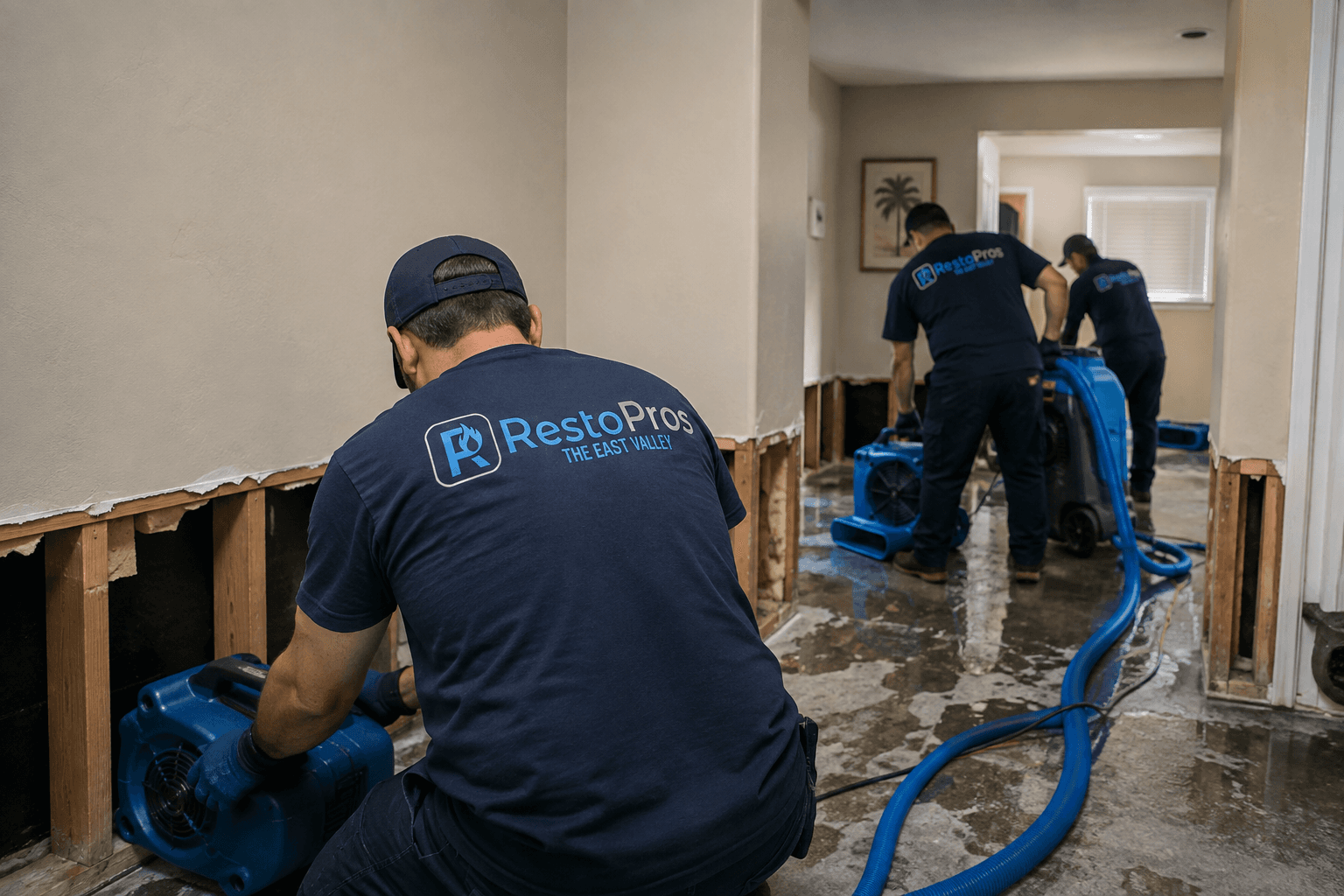
When a pipe lets go in a rental, two questions arrive at the same time: who fixes it, and who pays for it. In Arizona the answers are usually separate. The landlord is responsible for repairing the building no matter who caused the leak, and then the cost follows fault, through one of two insurance policies or out of a security deposit.
That split is where most disputes start. Below is how the Arizona Residential Landlord and Tenant Act divides a water loss, what the notice deadlines are, and what both sides should do in the first day. This is general information about Arizona statute, not legal advice.
Key Takeaways
- The landlord must keep plumbing in good working order and the unit fit and habitable under A.R.S. 33-1324, regardless of who caused the leak.
- A tenant's written notice starts the clock: five days for a breach affecting health and safety, ten days for other material breaches (A.R.S. 33-1361).
- Repair-and-deduct is capped at $300 or half a month's rent, whichever is greater, needs ten days of written notice, and requires a licensed contractor (A.R.S. 33-1363).
- The landlord's dwelling policy covers the structure. Only renters insurance covers the tenant's belongings and temporary housing.
- Delay is the expensive variable. Water that sits turns a covered sudden-loss claim into an excluded mold claim, and the argument over that gap is where deposits get lost.
The Short Answer: Structure Versus Contents
Draw the line at the walls. Drywall, framing, subfloor, cabinets, plumbing, the water heater and the AC system are the landlord's property and the landlord's repair obligation. Furniture, electronics, clothing, rugs and anything else the tenant moved in are the tenant's property, and they are not covered by the landlord's policy.
Responsibility to repair and responsibility to pay are different questions. The landlord repairs the building either way. If the tenant caused the loss, for example by overflowing a tub or leaving a hose running, the landlord can pursue those repair costs against the tenant or the security deposit.
What Arizona Law Actually Requires
The landlord's repair duty (A.R.S. 33-1324)
The statute requires a landlord to make all repairs necessary to put and keep the premises in a fit and habitable condition, and to maintain in good and safe working order all electrical, plumbing, sanitary, heating, ventilating and air-conditioning facilities. Running water and reasonable amounts of hot water must be supplied at all times.
A burst supply line, a failed water heater, a leaking AC condensate system and a roof leak all land inside that duty. The landlord does not get to wait for an insurance decision before starting mitigation.
The five-day and ten-day notices (A.R.S. 33-1361)
If the landlord does not act, the tenant's leverage starts with written notice. For a material noncompliance that affects health and safety, the notice states that the rental agreement terminates no less than five days after receipt if the breach is not remedied in five days. For other material breaches the same mechanism runs on ten days.
Standing water, sewage and active mold growth generally sit in the health and safety category. Put it in writing, keep proof of delivery, and photograph the conditions the same day.
Repair-and-deduct is smaller than tenants expect (A.R.S. 33-1363)
Arizona's self-help remedy for minor defects lets a tenant give ten days of written notice, or act as promptly thereafter as conditions require in an emergency, then hire a licensed contractor and deduct the reasonable cost from rent with an itemized statement and a lien waiver. The deduction cannot exceed $300 or one-half of the monthly rent, whichever is greater.
That ceiling matters. A genuine water loss with extraction, structural drying and drywall replacement passes that figure quickly, so repair-and-deduct is rarely the right tool for anything beyond a small fix. Tenants who hire a restoration crew on their own card and expect full reimbursement are usually disappointed.
When water knocks out an essential service (A.R.S. 33-1364)
If the loss takes out running water, hot water, electrical service or cooling, this section applies after reasonable notice specifying the breach. The tenant may procure the missing service and deduct the actual reasonable cost, recover damages based on the reduced fair rental value, or procure reasonable substitute housing and be excused from rent for the period of noncompliance.
When the unit becomes unlivable (A.R.S. 33-1366)
Where damage substantially impairs enjoyment of the unit, the tenant may immediately vacate and give written notice within fourteen days of the intention to terminate, or vacate only the unusable portion and have rent liability reduced in proportion to the lost fair rental value. A sewage backup across a one-bathroom unit is the classic example.
When the Tenant Pays
Fault shifts the bill. Arizona tenants are expected to use plumbing and appliances reasonably and to report problems. Costs commonly land on the tenant when the loss came from an overflowed tub or sink, a disconnected washing machine hose the tenant installed, a pet or an aquarium, or a small drip that was noticed and never reported until it had rotted the subfloor.
That last one is the most common and the most avoidable. Late reporting converts a two-day dry-out into a wall cavity full of mold, and the difference in cost is what ends up disputed against the deposit.
Two Policies, Two Different Jobs
- Landlord dwelling policy: covers the building, built-in systems and usually lost rental income. It does not cover the tenant's property.
- Renters insurance: covers the tenant's belongings and, on most policies, additional living expenses if the unit is unlivable. It is inexpensive, and it is the only thing that replaces a tenant's furniture.
- Liability coverage on either policy: may respond when the policyholder caused damage to the other party's property.
- Mold sublimits: many Arizona policies cap mold remediation separately, commonly in the $5,000 to $10,000 range, on both sides of the lease.
Coverage also turns on how the loss happened rather than how bad it is. Our guide to what homeowners insurance covers for water damage in Arizona explains the sudden-versus-gradual rule that decides most of these claims, and it applies to dwelling policies too.
The First 24 Hours in a Rental
What the tenant does
- Shut off the water at the fixture, or at the main if the source is unclear, and kill power to any wet area at the breaker.
- Notify the landlord or property manager in writing, not only by phone, and note the time.
- Photograph and video everything before moving anything, including standing water, wet contents and the source.
- Move belongings out of the water and lift furniture legs off wet flooring.
- Open a renters insurance claim without waiting for the landlord's claim decision.
What the landlord or property manager does
- Get a restoration crew on site the same day. Mitigation delay is the largest single cost driver, and carriers scrutinize it.
- Have the source diagnosed and repaired, not just the water removed.
- Require moisture mapping and daily drying logs, because that documentation supports the claim and any later dispute.
- Decide early whether the unit is habitable, and document that decision in writing.
Our first 24 hours checklist for water damage covers the sequence in more detail, and it works the same in a rental as in an owner-occupied home.
What This Looks Like Across the East Valley
The rental stock here shapes the losses. Tempe's student and ASU-area rentals include a lot of pre-1980 housing with original supply lines, on a turnover cycle that puts new tenants into old plumbing every August. Mesa and Apache Junction carry seasonal and snowbird rentals that sit empty for months, which is exactly how a small drip becomes a floor replacement.
Gilbert and Chandler investor rentals skew toward 1990s and 2000s builds, where the recurring culprit is not a storm but the air conditioner. The 2026 monsoon was one of the driest on record for the Phoenix area, so this year's rental water losses have been overwhelmingly plumbing and condensate driven rather than weather driven. Our breakdown of how AC systems cause water damage in Chandler homes covers the clogged condensate drain behind most of them.
For Property Managers: What Makes a Water Loss Cheap or Expensive
Across a portfolio, the variables that move the number are consistent. Response time beats everything, because materials that dry in place cost a fraction of materials that get removed. Source repair before drying prevents the second visit. Documentation decides the claim, so moisture maps, psychrometric logs and photographs are worth more than an adjuster's goodwill.
The fourth variable is scope discipline. A crew that dries only what is wet, verified against unaffected reference readings, returns units to rent-ready faster than a crew that demolishes on instinct. Vacancy days are usually the largest hidden cost in a rental water loss.
Frequently Asked Questions
Who pays for water damage in a rental in Arizona?
The landlord is responsible for repairing the building under A.R.S. 33-1324 regardless of cause, and the landlord's dwelling policy typically covers structural damage. The tenant's belongings are covered only by renters insurance. If the tenant caused the loss through negligence, the landlord can pursue those repair costs from the tenant or the security deposit.
How long does a landlord have to fix water damage in Arizona?
Arizona does not set a fixed repair deadline, but A.R.S. 33-1361 lets a tenant give written notice that the lease terminates in five days if a health-and-safety breach is not remedied, or ten days for other material breaches. Standing water, sewage and mold growth generally fall in the five-day category.
Can a tenant withhold rent for water damage in Arizona?
Not by simply not paying. Arizona provides specific remedies instead: repair-and-deduct up to $300 or half a month's rent under A.R.S. 33-1363, cost deduction or substitute housing when an essential service is lost under A.R.S. 33-1364, and termination or proportional rent reduction under A.R.S. 33-1366 when the unit is substantially unusable. Withholding rent outside those provisions risks an eviction action.
Does renters insurance cover water damage?
Renters insurance generally covers the tenant's belongings damaged by a sudden, accidental water event, and usually pays additional living expenses if the unit becomes unlivable. It does not repair the building, and like dwelling policies it typically excludes gradual leaks and often caps mold remediation separately.
Who is responsible for mold in an Arizona rental?
Arizona has no mold-specific statute, so it runs through the habitability duty. Mold caused by a building defect or an unrepaired leak is the landlord's responsibility. Mold caused by tenant behavior, such as never running the bathroom exhaust fan or failing to report a leak, can shift cost to the tenant. Written reporting is usually what settles the question.
Does the landlord have to pay for a hotel during repairs?
Not automatically. Under A.R.S. 33-1364 a tenant who is left without an essential service may procure substitute housing and be excused from rent for that period, and A.R.S. 33-1366 allows termination or proportional rent reduction when the unit is substantially impaired. Hotel costs themselves are more commonly paid by the tenant's renters insurance as additional living expenses.
Same-Day Mitigation for East Valley Rentals
RestoPros of the East Valley handles rental and multi-unit water losses across Mesa, Tempe and the rest of the East Valley, with IICRC-certified water damage restoration, moisture mapping, daily drying logs built for adjusters, and mold remediation when the water sat too long. We bill carriers directly on covered losses. AZ ROC #365594. Call (520) 482-3900.