
A stain on the ceiling is one of the few home problems that is almost never cosmetic. Drywall doesn't discolor on its own — that ring is mineral residue left behind as water passed through, which means water got into the assembly above your head and something up there is wet right now or was recently. The stain is the receipt, not the event.
The good news is that a ceiling stain is unusually informative. Its shape, location, and behavior narrow down the cause considerably before anyone climbs into the attic. Here's how to read yours, what's most likely causing it in an Arizona home, when it's an actual safety issue, and what an honest repair includes.
Key Takeaways
- Ceiling stains mean active or recent water above the drywall — painting over one without finding the source guarantees it returns.
- In East Valley homes the #1 cause is a clogged AC condensate line, followed by monsoon roof intrusion and upstairs plumbing.
- Sagging, bulging, or a heavy wet patch is a collapse risk — clear the area underneath and don't poke it while standing beneath it.
- Proper repair means finding the source, drying the cavity above (including insulation), then replacing drywall — in that order.
How to Read the Stain
Location tells you the likely source
A stain in a hallway or closet ceiling, or directly below where the air handler sits, points hard at AC condensate. A stain near an exterior wall, in a corner, or around a roof penetration like a vent or skylight points at the roof. A stain directly beneath an upstairs bathroom, laundry room, or water heater closet points at plumbing. A stain that spans a long straight line often follows a joist or a pipe run.
Shape and edges tell you how long
A single ring with a well-defined edge usually means one discrete event that has since stopped — water reached a boundary, stopped spreading, and dried. Multiple concentric rings, like a tree cross-section, indicate repeated wetting and drying cycles: a recurring leak over weeks or months. A soft, spreading edge with no defined boundary usually means it's actively wet right now.
Timing tells you the trigger
Appears or worsens after rain? Roof. Appears during the hottest weeks with no rain at all? Almost certainly AC condensate — this is the classic East Valley July and August presentation. Appears after someone showers or runs laundry upstairs? Plumbing. Constant regardless of weather or usage? Likely a supply line rather than a drain, since supply lines are under pressure around the clock.
The Arizona Causes, Ranked
- Clogged AC condensate line — the runaway leader here. Your air conditioner pulls gallons of water out of the air on a hot day and drains it through a narrow PVC line that reliably clogs with algae and dust. When it backs up, the pan overflows into the ceiling below. Sagging ceilings in Mesa and Gilbert hallways every August are overwhelmingly this.
- Monsoon roof intrusion — a microburst lifts a tile or damages flashing, and subsequent storms send water into the attic. It travels along framing and shows up somewhere that may be nowhere near the entry point.
- Upstairs plumbing — supply lines, angle stops, toilet connectors, tub overflows, and second-floor water heaters. In two-story Gilbert and Chandler homes this is a top-two cause.
- Roof penetration seals — vents, skylights, swamp cooler mounts, and solar mounting points. Arizona sun destroys sealant and flashing over time, and every penetration is a candidate.
- Water heaters in ceiling-adjacent closets or upstairs — a slow weep before the eventual rupture.
- Ductwork condensation — poorly insulated ducts running through a 150° attic can sweat enough to wet the surrounding drywall, which also tends to grow mold at the register.
When It's an Emergency
Most ceiling stains are urgent-but-not-dangerous. These are the exceptions, and they warrant immediate action:
- Sagging, bulging, or a visibly heavy wet area — saturated drywall holds a startling amount of weight and can come down all at once. Move people, pets, and furniture out from underneath. If you choose to relieve it by puncturing a small hole to drain into a bucket, do it from the side with a pole, never directly beneath it.
- Active dripping — put a container down, but understand you're managing symptoms; the water is still entering the assembly.
- Water anywhere near light fixtures, ceiling fans, or electrical boxes — cut power to that circuit at the breaker before touching anything.
- A ceiling that's warm to the touch or discolored around a fixture — treat as an electrical hazard and call for help.
Why Painting Over It Never Works
The instinct is understandable: the stain is ugly, stain-blocking primer exists, and the ceiling looks fixed in an afternoon. Two problems. First, if the source is still active, the stain returns — usually within weeks, sometimes larger. Second and more seriously, the drywall was wet, and above it insulation almost certainly got wet too. Insulation holds water for a long time and dries very slowly in an enclosed, air-conditioned attic space. Sealing the room-side surface with paint traps that moisture in a dark cavity at Arizona attic temperatures, which is close to an ideal mold incubator. The paint hides the evidence while the real problem accelerates.
What Proper Ceiling Water Damage Repair Involves
- Find and stop the source first — nothing else matters until this is done, whether it's a plumber clearing a condensate line, a roofer replacing flashing, or us tracing a leak with thermal imaging.
- Map the real moisture footprint. The wet area above is nearly always larger than the visible stain, and moisture meters and thermal imaging show the actual boundary rather than a guess.
- Remove saturated insulation. Wet blown-in or batt insulation loses its R-value, holds water, and won't reliably dry in place. This is standard, not upselling.
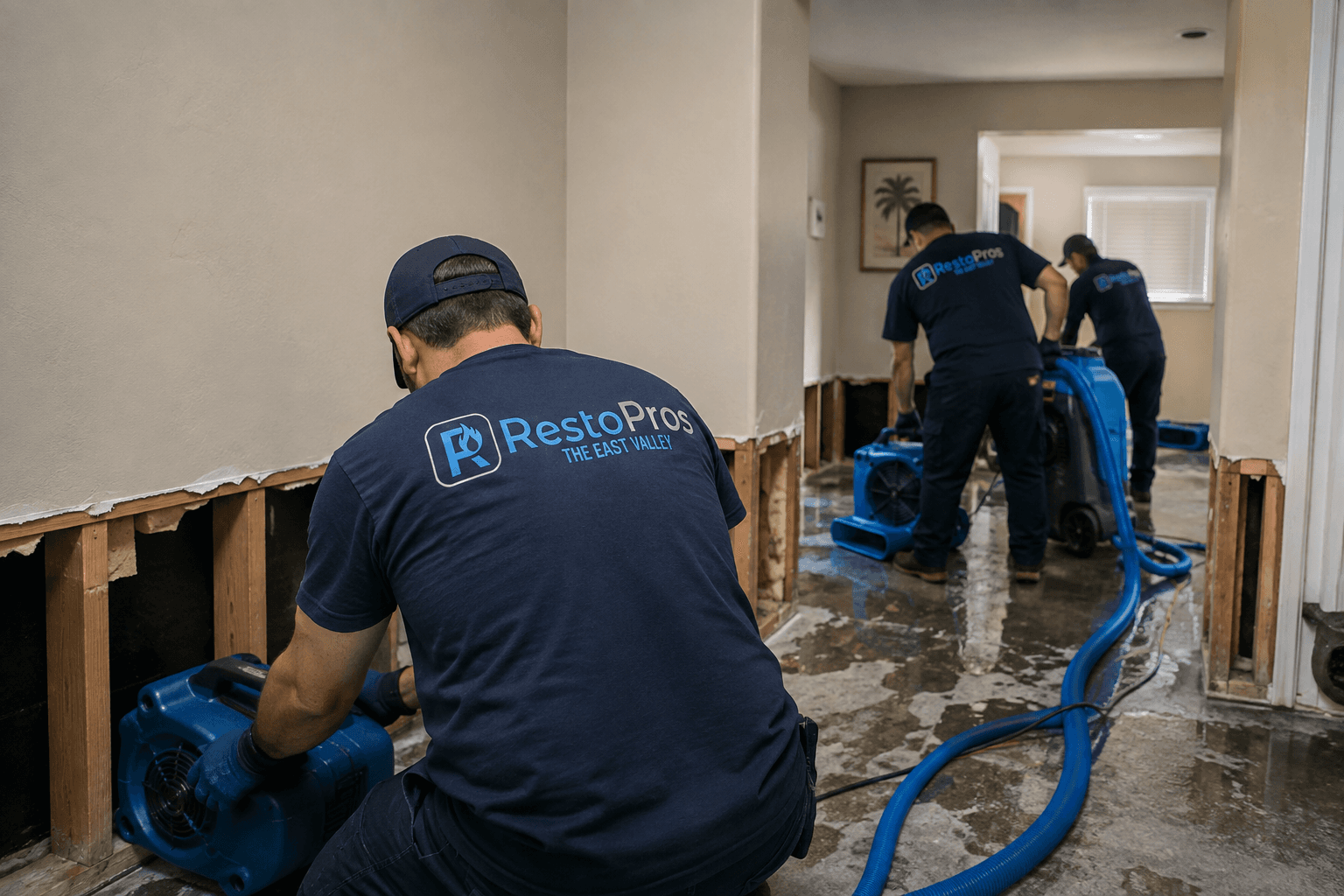
- Dry the cavity and framing with air movers and dehumidifiers, verified by daily moisture readings — not by how it looks.
- Treat with antimicrobial where moisture sat long enough to warrant it.
- Replace the affected drywall, then texture-match. Arizona's knockdown and orange-peel textures are the part that separates a repair you can see from one you can't.
- Prime with a stain-blocking primer and repaint — as the final step, on dry material.
Cost and Insurance
Cost tracks the size of the wet area and what's above it, not the size of the stain. A small, caught-early condensate leak affecting a few square feet of drywall and a patch of insulation is a modest repair. A leak that ran through two monsoon seasons, saturated a wide span of insulation, and started mold in the joist bays is a substantially larger project involving containment and remediation on top of the drywall work.
On coverage, the same Arizona rule applies as with any water loss: sudden and accidental is generally covered, gradual is generally not. A burst supply line above the ceiling is a textbook covered claim. An AC condensate line that has been backing up for two summers is likely to be treated as deferred maintenance. Storm damage to the roof is usually covered, while the roof repair itself may or may not be. Our guide to what Arizona homeowners insurance covers breaks down the distinctions, and we document cause and moisture readings to insurance standards on every job.
Frequently Asked Questions
How do I know if a ceiling stain is old or active?
Press gently at the edge with a gloved fingertip — soft, spongy, or cool-damp drywall means active moisture, while firm and dry means the event has passed. A second test: photograph the stain with something for scale, then check it in a week. If the boundary moved, it's active. And a single crisp-edged ring is usually historic, while a soft spreading edge is usually current.
Why does my ceiling only leak in summer with no rain?
That's the AC condensate signature, and it's the most common ceiling leak in the East Valley. Your air conditioner condenses gallons of water on hot days, and when the drain line clogs, that water overflows into the ceiling below. It has nothing to do with rain — which is exactly why it confuses people.
Can I just cut out the wet drywall myself?
You can, but sequence matters more than the cutting: stop the source first, cut power to nearby fixtures, wear an N95 and eye protection, and be aware that pre-1990 homes may have asbestos in the drywall compound or texture, which should be tested before disturbing. The bigger risk is what you don't remove — wet insulation and framing above need drying and verification, or you'll be repairing the same ceiling twice.
How long does a ceiling repair take?
Once the source is fixed, drying the cavity typically runs 2 to 4 days with equipment and daily readings, then drywall, texture matching, and paint add several more days including cure time between coats. Most straightforward ceiling repairs finish inside a week; larger areas or mold involvement extend it.
Will mold grow above my ceiling?
If the moisture sat more than 24 to 48 hours, it's a real possibility — and attic-side insulation is one of the most favorable environments for it in an Arizona home. It's the main reason we inspect above the ceiling rather than treating a stain as a surface problem. If growth is present, remediation gets folded into the same project.
Do you handle the roof or plumbing repair too?
We coordinate with your roofer or plumber on the source repair and handle everything the water touched — moisture mapping, insulation removal, structural drying, mold prevention or remediation, drywall, texture matching, and paint — so the whole event closes as one project. Call (520) 482-3900 for a free inspection.
Stain on Your Ceiling? Find Out What's Above It — Free
The only way to know whether you have a small repair or a saturated attic assembly is to measure. RestoPros of the East Valley provides free moisture inspections with meters and thermal imaging, then complete water damage restoration across Mesa, Gilbert, Chandler, and Tempe. If you suspect your AC is the culprit, our guide to how AC systems cause water damage covers the prevention side. Call (520) 482-3900, 24/7.