
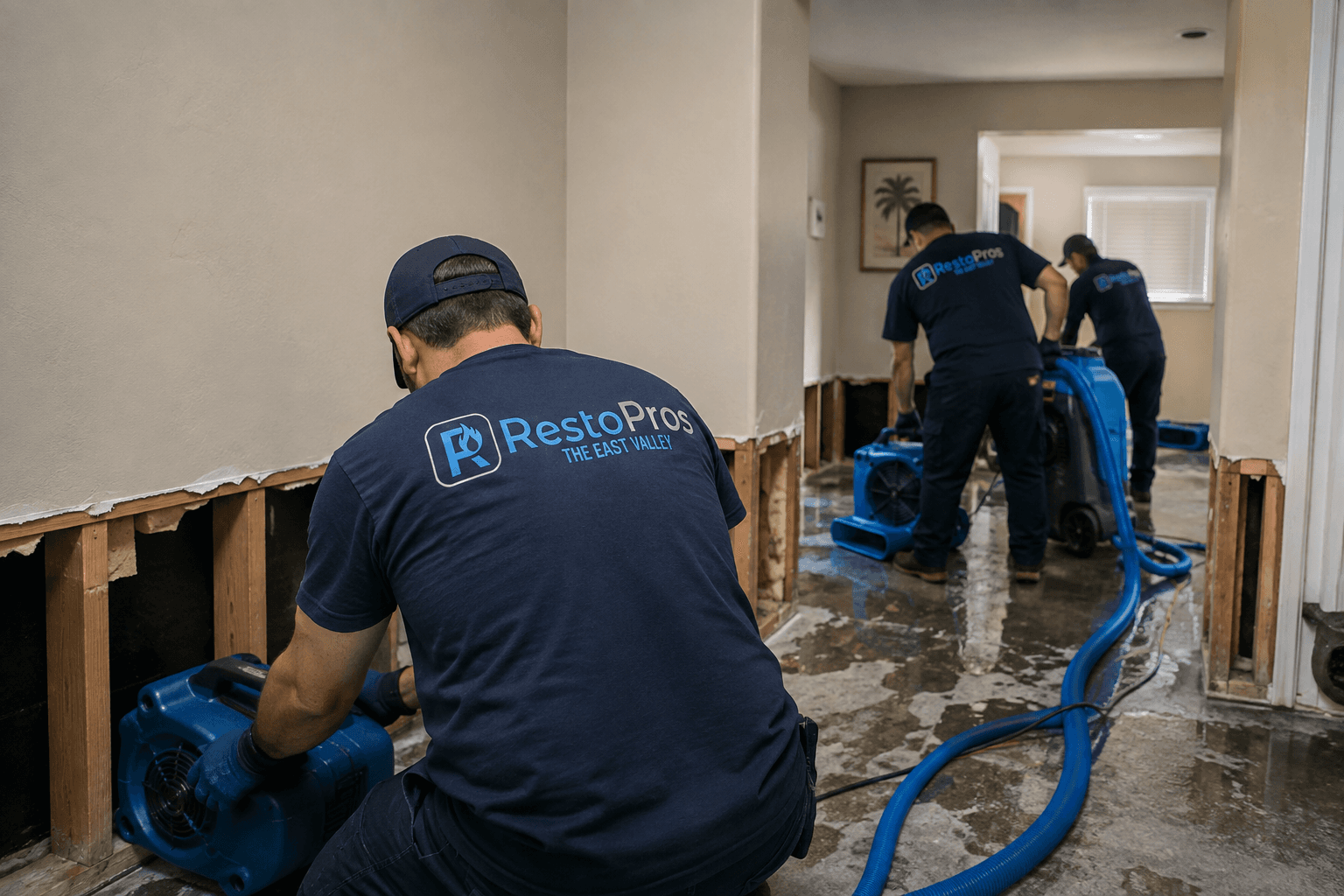
Within a day of a water loss, you'll start seeing three words used in ways that sound interchangeable: mitigation, restoration, and remediation. Your adjuster uses them. Your estimate is divided by them. They are not synonyms, and the difference isn't industry jargon — it determines the order work happens in, how long you're living with equipment running, and in many cases whether you get one insurance payment or two.
Here's what each one actually covers, in plain terms.
Key Takeaways
- Mitigation is emergency work: stop the water, remove it, dry the structure. It happens first and fast.
- Restoration is rebuilding: drywall, flooring, paint, cabinets — putting the house back.
- Remediation is the mold-specific work that happens between them when growth is found.
- Insurers frequently treat mitigation and restoration as separate approvals with separate payments, which is why the money can arrive in two pieces.
Mitigation: Stopping the Loss From Growing
Mitigation means limiting the damage. It's the emergency phase, it starts the day you call, and its entire purpose is to prevent a bad situation from becoming a worse one. On a typical job it includes stopping or isolating the water source, extracting standing water, removing materials that can't be saved, setting containment where needed, and running commercial air movers and dehumidifiers until the structure reaches a verified dry standard.
The defining feature of mitigation is that it's time-critical. Water migrates into drywall, framing, and flooring continuously while it sits, and inside a closed, air-conditioned Arizona house, mold can establish in wall cavities within 24 to 48 hours. Mitigation done in hour one is dramatically cheaper than the same job started on day four — not because anyone charges differently, but because far less material has been ruined.
Something worth knowing: most policies place a duty on you to mitigate. Taking reasonable steps to prevent further damage isn't just sensible, it's usually a condition of coverage. Waiting for an adjuster to physically arrive before starting drying is a common and expensive mistake.
Restoration: Putting the House Back
Restoration is the rebuild. It's what happens after the structure is dry, and it covers replacing the drywall that came out, matching the ceiling texture, reinstalling or replacing flooring, painting, rehanging baseboards and trim, and reinstalling cabinetry. On a large loss it can extend to framing and structural repairs.
It is not time-critical in the same way. Restoration can't responsibly start until moisture readings confirm the affected materials are dry, and starting early is actively harmful — closing a wall over damp framing is precisely how you end up doing the whole job twice. If a contractor offers to begin rebuilding before drying is verified, that's a reason to slow down, not to feel reassured.
On most jobs, restoration is also the bigger number. Mitigation is labor and equipment for a few days; restoration is materials, finish work, and trades.
Remediation: The Third Word
Remediation is the mold-specific phase, and it sits between the other two. If growth is found — either because the water sat long enough or because the leak had been running unnoticed — remediation adds containment under negative air pressure with HEPA filtration, removal and disposal of contaminated porous materials, antimicrobial treatment of what remains, and verification before anything is closed back up. Our guide to what mold remediation costs in Arizona covers that phase in detail, including the coverage caps that apply to it specifically.
Why the Split Matters for Your Insurance Claim
This is the practical reason to understand the terms at all. Insurers commonly handle the two phases as separate scopes with separate approvals — and often separate payments. Mitigation is typically approved quickly, because it's emergency work with a duty-to-mitigate obligation behind it. Restoration usually goes through a fuller review, because it's the larger number and involves choices about materials and finishes.
Three things follow from that, and they're the ones that catch people out:
- The first check often covers only mitigation. Homeowners sometimes assume the initial payment is the whole settlement and are alarmed when it doesn't come close to covering the rebuild. It isn't meant to.
- Depreciation is usually held back on the restoration side. Many policies pay actual cash value first and release the remaining recoverable depreciation after the work is completed and documented — so part of the money arrives at the end, not the beginning.
- Mold has its own limit. Even on a covered loss, most Arizona policies cap mold remediation separately from water damage, commonly in the $5,000 to $10,000 range. If remediation enters the picture, it draws against that cap rather than the main water limit.
Whether any of it is covered comes back to the same principle that governs most Arizona water claims: sudden and accidental damage is generally covered, gradual damage generally isn't. Our guide to what homeowners insurance covers in Arizona goes through the exclusions, including the flood distinction that catches so many monsoon losses.
What the Timeline Actually Looks Like
- Hours 0–4 — Mitigation begins: source stopped, water extracted, moisture mapped, unsalvageable material removed.
- Days 1–5 — Drying: air movers and dehumidifiers run with daily logged readings until each material reaches dry standard. Typical, but wet ceiling assemblies and slab-adjacent flooring take longer.
- If mold is present — Remediation: containment, removal, treatment, and verification before the rebuild can start.
- After dry standard is confirmed — Restoration: drywall, texture, paint, flooring, trim. Days for a small area, weeks for multiple rooms, longer if materials or insurance approvals lag.
One Company or Two?
Some companies only mitigate. They extract, dry, and leave — and you hire a general contractor for the rebuild. Others do both. Neither model is wrong, but you should know which you've hired before work starts, because the handoff is where projects stall: a second contractor arrives weeks later, re-scopes from scratch, and the insurance paperwork has to be reconciled across two companies. If you'd rather not manage that, ask the question during the first call.
Frequently Asked Questions
Is water mitigation the same as water restoration?
No. Mitigation is the emergency phase that stops the damage and dries the structure. Restoration is the rebuild that puts the house back afterward. Mitigation happens in hours; restoration starts only once moisture readings confirm the structure is dry.
Which one does insurance pay for?
Typically both on a covered loss, but often as separate approvals and separate payments. Mitigation is usually approved fast because of the duty to mitigate; restoration goes through fuller review and frequently has depreciation held back until the work is finished and documented.
Can I skip mitigation and just rebuild?
No — and it's the most costly shortcut in this business. Rebuilding over materials that never reached dry standard traps moisture inside the assembly, which produces mold in a sealed cavity and means tearing out the new work to fix it. Drying has to be verified before anything closes up.
How long does equipment have to run in my house?
Usually three to five days, with readings taken daily. It varies with how much water there was, which materials absorbed it, and how the structure is built — ceiling assemblies and flooring over slab dry more slowly. Equipment comes out when materials read dry, not on a fixed schedule.
Do I need a separate mold inspection?
Not automatically. If the water was clean and drying started quickly, mold prevention is built into the mitigation phase through antimicrobial treatment and verified drying. If water sat more than a day or two, or you smell something musty afterward, an inspection is worth it — ours is free.
Why did I only get part of the money?
Usually one of two reasons: the first payment covered mitigation only and restoration is approved separately, or your policy pays actual cash value up front and releases recoverable depreciation once the repairs are completed and documented. Your adjuster can tell you which applies, and a properly documented final scope is what releases the remainder.
Both Phases, One Team
RestoPros of the East Valley handles mitigation and restoration together — extraction and verified drying, mold remediation where it's needed, and the rebuild — so nothing falls between two contractors and your insurance file stays consistent from the first photo to the final walkthrough. We serve Mesa, Gilbert, Chandler, and Tempe 24/7 with free inspections and direct insurance billing. If you're still deciding who to call, read how to choose a restoration company first. Call (520) 482-3900.