
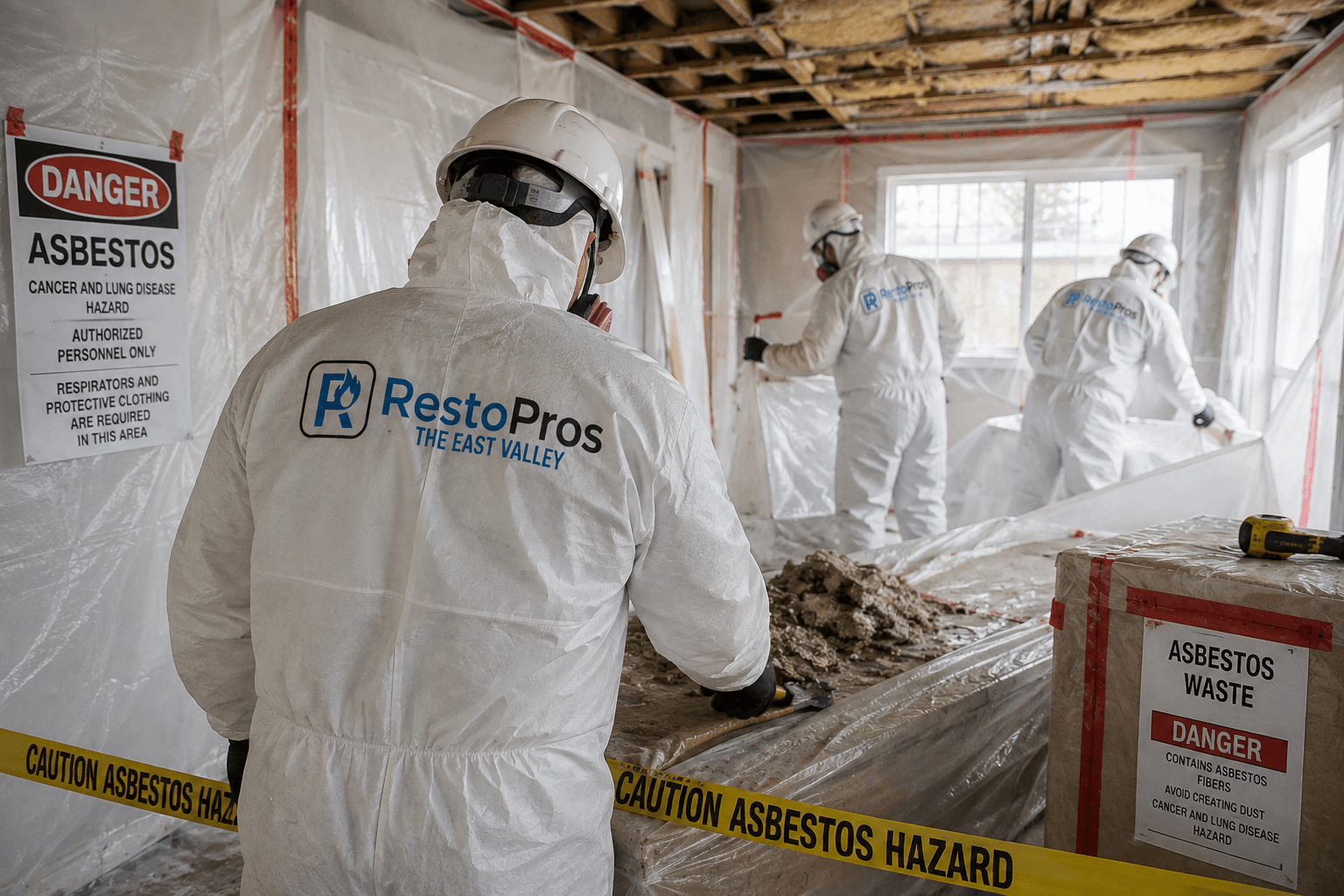
Most East Valley homes are stucco or block, so asbestos siding is not the first thing people expect to find here. It still turns up, usually on older houses in Mesa and Tempe, on detached garages and workshops, on room additions, and on gable ends above a block wall. Owners tend to find out one of three ways: a home inspector flags it during a sale, a contractor refuses to drill into it, or a monsoon storm cracks a few panels and somebody asks what they are made of.
This guide explains how to recognize asbestos cement siding, when leaving it alone is the right call, what your repair and cover-up options are, and what proper removal looks like. It is general information, not legal advice.
Key Takeaways
- Asbestos cement siding is a hard, brittle panel or shingle. Intact and painted, it is generally low risk because the fibers are locked in cement.
- The hazard comes from breaking, cutting, drilling, sanding or pressure washing it, all of which can release fibers.
- Appearance and age can make siding suspect, but only a lab test confirms asbestos.
- You usually have four options: leave it, repair damaged pieces, cover it, or remove it. Removal is not automatically the right one.
- Owner-occupied single-family homes are generally exempt from Maricopa County notification, but safe handling and legal disposal still apply.
What Asbestos Siding Is
Asbestos cement siding is Portland cement reinforced with asbestos fibers, pressed into shingles or flat sheets. Builders used it widely through the middle of the twentieth century because it does not burn, does not rot, holds paint well, and shrugs off insects. The same product family includes the flat panels and pipe often called transite. Production for housing tapered off in the 1970s and 1980s, and modern fiber cement siding, which looks similar, uses cellulose fibers instead.
Because the fibers are bound in cement, the material is classed as non-friable, meaning it cannot be crumbled by hand pressure when it is in good condition. That is the main reason it is treated differently from soft materials like popcorn ceiling texture or pipe insulation.
How to Recognize Asbestos Siding
You cannot confirm asbestos by eye, but several features together make siding a strong suspect:
- Age: the house, garage or addition dates from before about 1980.
- Shingle size and shape: rectangular shingles commonly around 12 by 24 inches, often with a wavy or scalloped bottom edge.
- Surface: a pressed wood-grain pattern or a dimpled texture, under what may be many coats of paint.
- Nail pattern: two or three visible nail holes along the bottom of each shingle.
- Feel and sound: dense, cold and rigid, with a sharp ceramic sound when tapped rather than the dull thud of wood or the hollow sound of vinyl.
- Damage pattern: clean cracks and snapped-off corners instead of rot, warping or dents.
- Newer siding over the top: vinyl or metal siding on an older house is sometimes installed directly over the original cement shingles.
Modern fiber cement can look almost identical, and some older cement siding never contained asbestos. If a project depends on the answer, have a sample analyzed by an accredited laboratory. The standard method is polarized light microscopy, and results typically come back in a few business days. Sampling means breaking off a small piece, so it is better done by an inspector who can wet the spot, take the piece cleanly and seal the edge afterward.
Is Asbestos Siding Dangerous?
In good condition, generally not. Siding that is intact, painted and left alone does not shed fibers in any meaningful amount, and it sits outside the house rather than in the air you breathe indoors. The risk rises when the cement matrix is broken. These are the activities that cause trouble:
- Cutting it with a circular saw or grinder, which produces fine dust.
- Drilling through it for cables, hose bibs, lights or house numbers.
- Sanding or wire brushing it to prepare for paint.
- Pressure washing, which erodes the surface and spreads slurry across the yard.
- Prying panels off so that they snap, or throwing them into a dumpster where they shatter.
Weather matters too. Decades of Arizona sun wear away paint, and a surface that has gone chalky and pitted is in worse shape than one under sound paint. For the wider picture of where asbestos hides in a house of this age, see our guide to asbestos in older Arizona homes.
Your Four Options
1. Leave It and Maintain It
For siding in good condition, this is often the best choice. Keep it painted, since paint seals the surface. Wash it gently with a garden hose and a soft brush instead of a pressure washer. Avoid drilling new holes, and keep sprinklers and string trimmers from wearing at the bottom course. Note the material in your house records so future contractors know what they are working on.
2. Repair Individual Pieces
A few cracked shingles do not require stripping a whole wall. Damaged pieces can be removed whole by pulling or cutting the nails, and replaced with non-asbestos fiber cement shingles made in matching sizes and textures. Small cracks can sometimes be sealed and painted. The removed pieces are still asbestos waste and need to be handled and disposed of that way.
3. Cover It
New siding can be installed over the old, which avoids the cost of removal. The catch is that every fastener driven through cement shingles can crack them, so installers who do this properly use methods that limit penetration and breakage. Covering also leaves the material in place, which you should disclose when selling and which any later project will have to deal with.
4. Remove It
Removal makes sense when the siding is badly deteriorated, when a remodel or addition requires opening the wall, when storm damage is widespread, or when you want the question closed before a sale. It is the most expensive option, and it should be planned together with whatever is going back on the wall.
How Asbestos Siding Removal Is Done
Because the material is cement bound, removal is mostly about taking each piece off whole and keeping it wet. A typical job runs like this:
- The work area is marked off, windows and doors on that side are closed and sealed, and plastic sheeting is laid on the ground to catch debris.
- Panels are misted with water, often with a wetting agent added, and kept damp throughout.
- Workers in respirators and disposable suits pull or clip the nails so each shingle comes off in one piece, working from the top course down.
- Pieces are lowered, never dropped, then wrapped or bagged in heavy plastic, sealed and labeled.
- The ground sheeting is folded in on itself and bagged, and the area is cleaned with HEPA vacuums and wet wiping.
- Waste goes to a landfill approved to accept asbestos, with paperwork showing where it went.
No power saws, no pry bars snapping panels in half, and no open dumpster full of broken shingles. If a crew is working that way, the material is being turned from a low-risk product into a dusty one. Cost depends on wall area, height, access and how brittle the panels have become. Published figures vary widely, and our asbestos removal cost guide for Arizona explains what drives the spread.
What the Rules Say in the East Valley
In Mesa, Chandler, Gilbert and Tempe, asbestos renovation and demolition rules are administered by the Maricopa County Air Quality Department. Apache Junction and part of Queen Creek fall under Pinal County's program. An owner-occupied single-family home is generally exempt from the survey and notification requirement. Residential buildings with more than four dwelling units are covered, and so is any building with a commercial or institutional history. Our post on asbestos inspections before remodeling goes through the exemption and where it stops.
Disposal is the part homeowners most often get stuck on. The City of Mesa's household hazardous materials program does not accept asbestos, and broken siding cannot go in the regular trash. It has to be wetted, sealed in leak-tight, labeled packaging and taken to a facility that accepts it.
Storm Damage, Insurance and Asbestos Siding
Cement siding is strong against sun and fire but brittle against impact. Monsoon wind can throw branches, patio furniture and roof tiles into a wall, and a fallen limb can shatter a run of shingles in one hit. When that happens, treat the broken pieces as suspect: keep people and pets away from the debris, do not sweep or rake it dry, and do not run a mower over fragments in the grass. Our storm damage restoration team can stabilize the wall and collect the debris safely while testing is arranged.
Sudden damage from wind or a falling tree is the kind of loss homeowners policies commonly cover, and the cost of handling asbestos material damaged in that loss can become part of the claim. Wear, age and planned upgrades generally are not covered. Coverage varies by policy, so photograph the damage before anything is moved and ask your adjuster how matching and code-related costs are treated.
Buying or Selling a House With Asbestos Siding
Asbestos siding does not make a house unsellable, and it is not automatically a reason to walk away from a purchase. Buyers should look at condition: cracked or missing shingles, bare or chalking surfaces, and amateur repairs. Sellers who know the siding contains asbestos should disclose it. A test report and a record of proper repairs tend to settle the conversation faster than guesswork on either side.
Frequently Asked Questions
How can I tell if my siding is asbestos?
Look for rigid cement shingles, often about 12 by 24 inches with a wavy bottom edge, a wood-grain or dimpled surface, and visible nail holes, on a building from before about 1980. Those signs make it suspect. Only laboratory analysis of a sample confirms whether it contains asbestos.
Is it safe to live in a house with asbestos siding?
Generally yes. Intact, painted asbestos cement siding is low risk because the fibers are bound in cement and the material is outside the home. The risk comes from breaking, cutting, drilling, sanding or pressure washing it.
Can I paint asbestos siding?
Yes, and keeping it painted helps seal the surface. Clean it gently with a hose and soft brush, do not sand or scrape it dry, and do not pressure wash it. If the surface is badly weathered, ask a professional about preparation before painting.
Can I remove asbestos siding myself in Arizona?
An owner-occupied single-family home is generally exempt from county notification, so it is usually allowed. The practical issues are doing it without breaking the panels, protecting yourself and your neighbors from dust, and disposal, since household hazardous waste programs such as Mesa's do not take asbestos. Rentals with more than four units and buildings with commercial history fall under the rules.
Can new siding go over asbestos siding?
It can, and it avoids removal cost. Fasteners driven through cement shingles can crack them, so the method matters, and the asbestos material remains in the wall for any future work. Disclose it when you sell.
Does homeowners insurance cover asbestos siding removal?
Not for age, wear or a planned upgrade. If a covered event such as wind or a fallen tree damages the siding, the cost of safely handling the damaged asbestos material can become part of that claim. Check your policy and ask your adjuster.
Get It Checked Before You Cut, Drill or Demolish
If you think you have asbestos siding and a repair, a remodel or storm damage is forcing a decision, start with a test. Our asbestos cleanup team coordinates sampling with an accredited inspector, removes damaged or unwanted siding by hand under wet methods, handles disposal, and can take care of the exterior repair and rebuild afterward.
We handle asbestos siding removal in Mesa, Tempe, Chandler and Gilbert, across Arizona's East Valley. Inspections are free and estimates are written line by line. Call (520) 482-3900.