
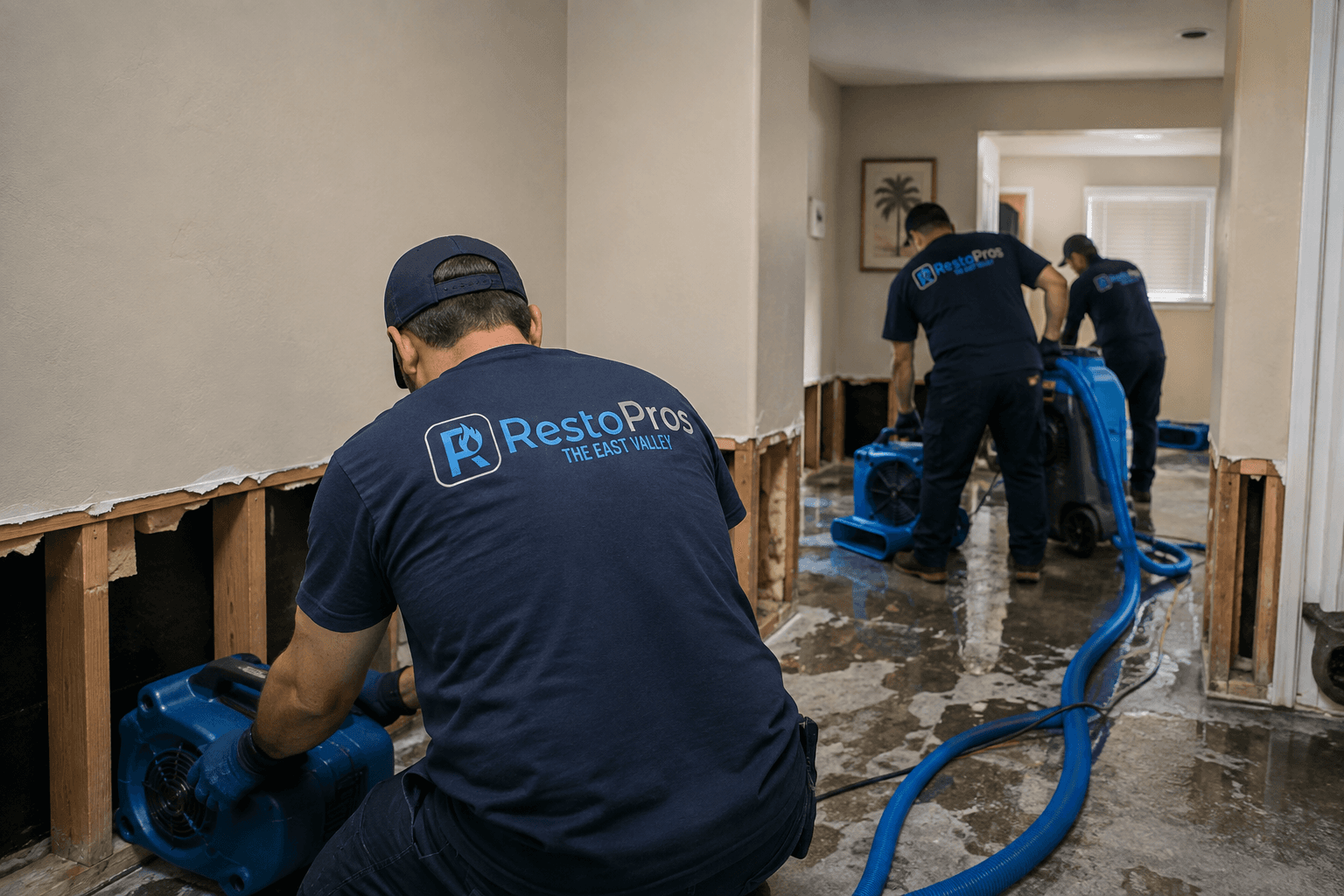
A water heater doesn't just hold 40 or 50 gallons — it's connected to a supply line that will keep feeding it as it leaks. That's why a tank failing at 2 p.m. while you're at work can put hundreds of gallons into your garage, hallway, and adjacent bedrooms by dinner. If you're standing in front of a leaking tank right now, do the steps in the first section immediately. The explanation can wait.
First: The 30-Minute Shutdown Sequence
- Cut the power. Electric heater: flip its breaker (usually a double 30-amp labeled 'water heater'). Gas heater: turn the control dial to OFF, or close the gas valve on the supply pipe — quarter-turn so the handle sits crosswise to the pipe. Heating an empty or draining tank destroys elements and can be dangerous.
- Close the cold-water shutoff. It's the valve on the pipe entering the top of the tank. If it's stuck or broken (common on older Valley homes), close the main house shutoff instead — typically near the hose bib out front or at the meter box.
- Contain what you can. Towels and buckets buy time; a wet/dry vacuum helps for small volumes. Move stored items — cardboard boxes wick water upward remarkably fast.
- Photograph everything before cleanup: the tank, the water line on walls and boxes, the affected rooms. Your insurance claim will thank you.
- If water reached drywall, baseboards, or flooring beyond the immediate drain pan area, call a restoration company while things are still wet — drying decisions made on day one are cheaper than demolition decisions on day five.
What a Bottom Leak Actually Means
Not every puddle under a water heater is a dying tank. Three sources account for nearly all of them, and they have very different outcomes:
1. The drain valve (fixable)
The spigot near the bottom of the tank can weep from its outlet or around its threads. If tightening gently or capping the outlet with a garden-hose cap stops it, you've solved it for a few dollars.
2. The T&P relief line (a symptom, not the disease)
The temperature-and-pressure relief valve on the top or side discharges through a pipe that runs down the tank's exterior and ends near the floor — so a T&P discharge often looks like a bottom leak. A T&P valve that keeps releasing means excess pressure or temperature, which needs a plumber's attention, but the tank itself may be fine.
3. The tank itself (terminal)
If water is seeping from under the outer jacket or pooling from the tank body with the drain valve dry, the internal tank has corroded through. There is no repair for a breached tank — replacement is the only path, and the leak will only widen. Treat a weeping tank as a countdown clock.
Why Water Heaters Die Young in the East Valley
Arizona's water is among the hardest in the country, and Mesa, Gilbert, and Chandler homes feel it directly. Dissolved minerals drop out of solution as sediment inside the tank, where the layer traps heat against the steel, accelerates corrosion, and eats the sacrificial anode rod years early. A tank that might last 10–12 years elsewhere commonly fails at 6–10 here — and because most East Valley heaters live in the garage or an interior hallway closet, a failure floods either your storage and drywall or the middle of your house.
Annual flushing and an anode check every few years genuinely extend tank life in hard-water country. If your tank is past year eight and you're noticing rumbling sounds, rusty hot water, or moisture around the base, replacement on your schedule beats failure on the tank's schedule.
When the Puddle Becomes a Restoration Problem
Here's the threshold that matters: water that stayed on sealed concrete and got mopped up within hours is a plumbing event. Water that reached drywall, baseboards, wood flooring, carpet pad, or cabinet toe-kicks is a drying event — because those materials absorb water and release it slowly into an enclosed, air-conditioned space, which is exactly the recipe for mold within 24–48 hours in an Arizona summer.
Garage flood into an adjacent bedroom wall is the classic Gilbert and Chandler version of this — the wall looks dry from the paint side while the inside of the cavity is soaked. Our water damage restoration team maps the moisture with meters and thermal imaging, dries the structure with commercial equipment, and documents readings daily — so you know it's actually dry, not just dry-looking.
Will Insurance Cover It?
Usually, yes — a sudden tank failure is a textbook 'sudden and accidental discharge,' and the resulting water damage to your home is covered under most Arizona homeowner's policies. Two caveats: the water heater itself is typically not covered (that's a maintenance item), and if an adjuster finds evidence the tank had been leaking slowly for months while ignored, the claim gets harder. Fast action and good photos protect both your home and your claim. We document the loss to insurance standards and bill carriers directly.
Frequently Asked Questions
Can I keep using a water heater that's leaking from the bottom?
If the leak is from the tank body, no — shut it down. The breach only widens, and running heat on a failing tank risks a much bigger release. If the leak traces to the drain valve or the T&P discharge line, the tank can often stay in service while that specific part is addressed.
How much water damage can one water heater cause?
The tank holds 40–50 gallons, but the real number depends on the supply line: until someone closes a valve, the house keeps feeding the leak. Failures that run unattended for a workday routinely put several hundred gallons into surrounding rooms.
How long do water heaters last in Arizona?
Six to ten years is typical in the East Valley's hard water, versus 10–12 in softer-water regions. Annual flushing, a working anode rod, and a water softener all push the number upward.
The water only reached the drywall a little — do I really need professional drying?
Wet drywall and baseboards wick water far above the visible line and dry too slowly on their own in a closed house. If porous materials got wet, a moisture inspection is worth it — ours is free, and it takes the guesswork out. Call (520) 482-3900.
Tank Let Go? Get East Valley Help Fast
RestoPros of the East Valley provides 24/7 emergency water damage restoration — water removal, structural drying, and repairs — across Gilbert, Mesa, Chandler, and the entire East Valley — typically on site within 60–90 minutes, with direct insurance billing. And if the water's already been sitting a while, read our guide to the first 24 hours after water damage while help is on the way.