
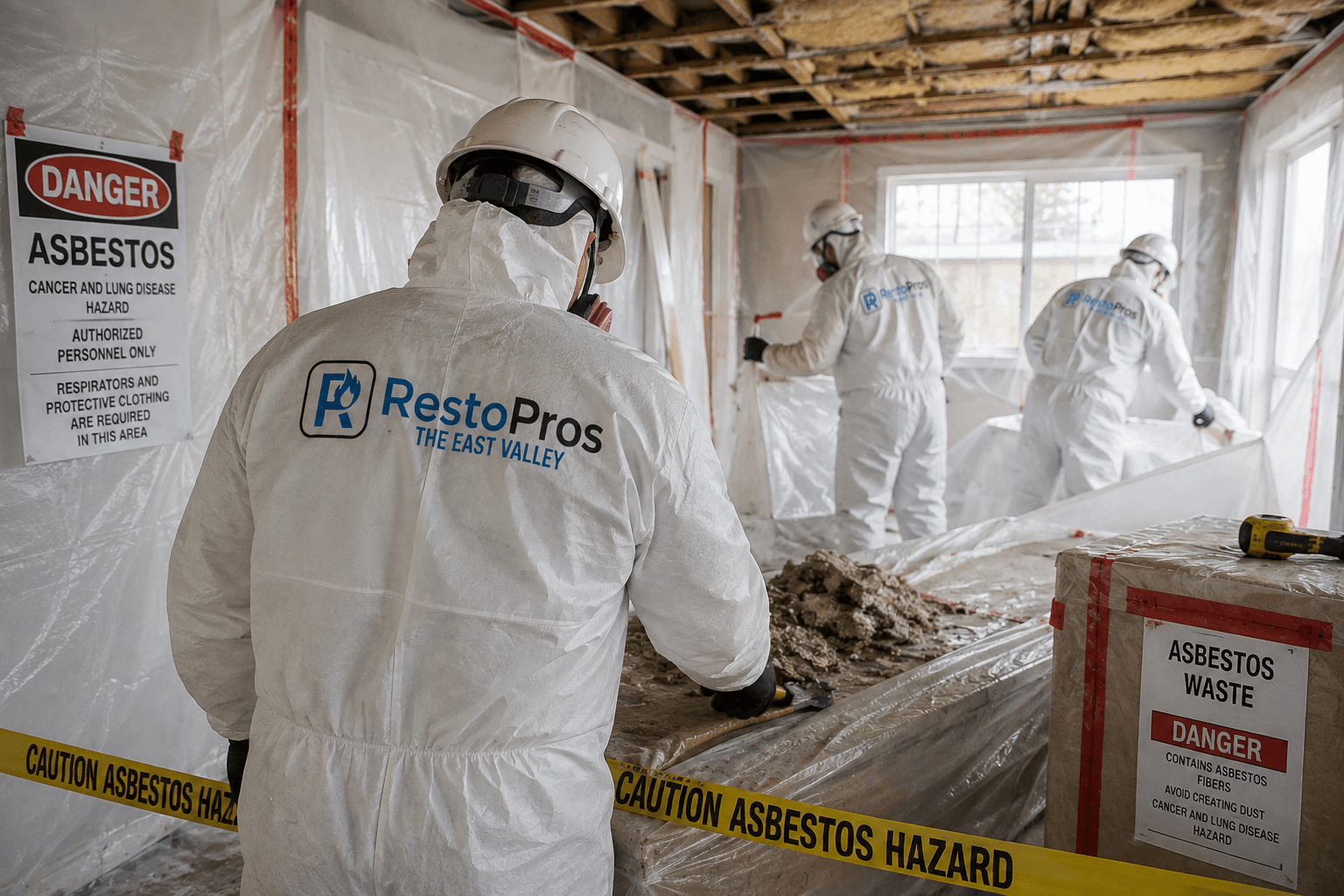
Popcorn ceilings are one of the first things people want gone after buying an older house in Mesa or Tempe. The tools are cheap, the videos make it look easy, and a pump sprayer and a wide scraper can clear a bedroom in an afternoon. The one step those videos tend to skip is the one that decides whether the job is ordinary remodeling or a whole-house contamination problem: finding out whether the texture contains asbestos before the scraper touches it.
This guide covers how to tell, what testing involves and costs in the East Valley, what the rules actually require of a homeowner, and the realistic options when a result comes back positive. It is general information, not legal advice.
Key Takeaways
- You cannot tell by looking. Asbestos and non-asbestos popcorn texture look identical, so a lab test is the only answer.
- Homes built or re-textured before the mid-1980s are the main concern, but age only raises or lowers the odds. It does not settle the question.
- Testing is cheap next to the job itself: a lab analysis per sample is modest, and a professional inspection commonly runs a few hundred dollars.
- Owner-occupied single-family homes are generally exempt from Maricopa County notification, but that does not make dry scraping safe and does not solve disposal.
- A positive result is not an automatic removal. Intact texture you leave alone or seal is a legitimate option.
Why Popcorn Ceilings Are the Usual Suspect
Spray-on acoustic texture was popular from the 1950s through the 1980s because it hid drywall flaws, softened echo, and went on fast. Some formulations included asbestos as a binder and filler. Federal rules in the 1970s restricted spray-applied asbestos surfacing materials, but those rules did not recall product already made or already on the wall, and existing stock kept being used. That is why texture applied in the early 1980s still turns up positive on Valley lab reports.
The East Valley's housing stock makes this a practical issue rather than a theoretical one. Large parts of Mesa and Tempe were built between the 1950s and early 1980s, and many of those homes still have original ceilings in bedrooms and hallways even after kitchens and floors were updated. Gilbert and Chandler are mostly newer, but older pockets and early subdivisions exist in both.
For the broader picture of which materials in an older home are worth worrying about, see asbestos in older Arizona homes. Ceiling texture is usually the first item on that list, and the most frequently disturbed one.
Signs That Raise the Odds (But Don't Answer the Question)
- The house was built, or the ceiling was textured, before about 1985.
- The texture is coarse, cottage-cheese style rather than a fine knockdown or orange-peel finish.
- The texture has never been painted and crumbles when you brush it, which also makes it more likely to shed fibers if it does contain asbestos.
- You have original paperwork or a previous inspection report that mentions acoustic or surfacing material.
- Patches in different textures, which can mean different products applied at different times, each needing its own sample.
None of these is proof either way. A 1990s house can have a later patch done with old stock, and plenty of 1970s ceilings test negative. The lab result is what counts.
How Popcorn Ceiling Asbestos Testing Works
A bulk sample is a small piece of the texture, taken down to the drywall, sealed in a bag, and sent to a laboratory. The standard method is polarized light microscopy, which identifies whether asbestos fibers are present and what type they are. Under the federal rules, a material counts as asbestos-containing when it is more than 1% asbestos. When a result lands near that line, labs can run a more precise count to confirm.
One sample is rarely enough. The federal protocol written for school buildings, which inspectors widely use as a guide, calls for at least three samples from a surfacing material area under 1,000 square feet, and more for larger areas. In a house, that usually means sampling each distinct texture or patch, plus extra samples from large continuous ceilings. Results typically come back in two to five business days, with rush turnaround available if a project is waiting.
What you should end up with is a written report listing each sample, where it was taken, the lab result, and the method used. That document matters later, for a contractor, a buyer, or an insurance adjuster, in a way that a verbal all-clear never will.
Can You Take the Sample Yourself?
Mail-in test kits and labs that accept homeowner samples exist, and for a single-family home you are not legally barred from using them. The trade-off is that taking a sample means disturbing exactly the material you are worried about. If you do it, mist the spot lightly with water first, wear a disposable respirator rated for fine particles, lay plastic under the spot, take a small piece into a sealable bag, and patch the hole with paint or spackle. A professional inspector does the same thing with better protection, picks the right number and locations of samples, and produces a report other people will accept.
What a Test Costs Compared With the Job
Lab analysis per sample is a modest cost, and a professional inspection with several samples commonly runs a few hundred dollars in the Phoenix area. Compare that with removal itself: published ranges for popcorn ceiling asbestos abatement run from roughly $3 to $20 per square foot depending on ceiling height, whether the texture is painted, and how much containment the layout needs. Our asbestos removal cost guide for Arizona breaks those numbers down. The test is the cheapest line item in the whole project, and it is the one that tells you which kind of project you have.
What the Rules Say for East Valley Homeowners
In Mesa, Chandler, Gilbert and Tempe, asbestos renovation and demolition rules are administered by the Maricopa County Air Quality Department. An owner-occupied single-family home is generally exempt from the survey and notification requirement, which is why most homeowners are told they can scrape their own ceiling. Apache Junction and part of Queen Creek fall under Pinal County's program instead.
The exemption is narrower than people assume. Residential buildings with more than four dwelling units are covered, and so is a building with any past commercial or institutional use. Landlords and investors working on larger rental properties, which is common in Tempe near ASU, should read the rule closely rather than treating residential as exempt. Our post on asbestos inspections before remodeling goes through who is and isn't covered.
Even where you are exempt from notification, two problems remain. The first is your own household's exposure, which no exemption changes. The second is disposal. Asbestos waste has to be wetted, sealed in leak-tight, labeled containers, and taken to a facility that accepts it. The City of Mesa's household hazardous materials program does not take asbestos, so bags of scraped texture cannot simply go out with the trash or to a drop-off day.
Why Dry Scraping Is the Real Problem
Popcorn texture is soft and loosely bound, which is exactly why it scrapes off easily. Scraped dry, it breaks into fine dust that drifts well beyond the room, settles into carpet, upholstery and closets, and gets pulled into the return air of the HVAC system. Once that happens, the cleanup is no longer one ceiling. It can mean HEPA cleaning every room the air reached and cleaning or replacing ductwork.
Wetting the texture first helps, and it is part of every proper removal, but water alone is not containment. Professional removal of a positive ceiling adds the parts a weekend job leaves out: sealing the room with plastic, shutting down and covering the HVAC, negative air with HEPA filtration so dust moves into the filter rather than into the house, workers in fitted respirators, bagging waste as it comes down, HEPA cleaning before the plastic comes down, and clearance before the room is reopened.
Your Options If the Result Is Positive
There are three realistic paths, and the right one depends on the ceiling's condition and your plans for the room.
- Leave it alone. Intact texture that is not crumbling, water stained, or about to be disturbed is low risk. Many homeowners keep it in rooms they are not remodeling.
- Encapsulate it. Sealing the texture with a bonding paint or coating locks fibers in place, and covering it with new drywall hides it entirely. Both cost less than removal, though the material is still there for any future project to deal with.
- Remove it under containment. This is the right call before a remodel that will cut into the ceiling, when the texture is damaged, or when you want the question closed for good, including before a sale.
If the result is negative, removal is ordinary remodeling. Wet the texture, protect the floor and the HVAC returns, and keep the report so you can show it to a future buyer or contractor.
When Water Damage Makes the Decision for You
In the East Valley, the call we get about popcorn ceilings often is not about a remodel at all. A roof leak during monsoon season, an AC drain line overflow in the attic, or a supply line failure upstairs soaks the texture, and it sags, delaminates, or falls in chunks. Wet texture that is falling apart is no longer intact material you can leave in place, and drywall that needs to come out for drying has asbestos texture attached to it. The causes and repair costs of ceiling water damage are covered in a separate guide, but on an older ceiling the rule is the same: sample before cutting. We ask the lab for its fastest turnaround on an active water loss and keep drying running while the result comes back.
If the loss is covered by your homeowners policy, the cost of handling asbestos-containing material damaged by that loss can become part of the claim. Planned removal for a remodel generally is not covered, since it is an improvement rather than a sudden loss.
Frequently Asked Questions
How do I know if my popcorn ceiling has asbestos?
Only a lab test can tell you. A small bulk sample of the texture is analyzed by polarized light microscopy, and a material with more than 1% asbestos counts as asbestos-containing. The age of the house or the texture raises or lowers the odds, but it never answers the question on its own.
What year did popcorn ceilings stop containing asbestos?
There is no clean cutoff. Federal restrictions on spray-applied asbestos surfacing materials came in the 1970s, but existing stock kept being applied afterward, so ceilings textured into the early to mid 1980s can still test positive. Treat anything from before about 1985 as suspect until it is tested, and test any later patch of unknown origin too.
How much does it cost to test a popcorn ceiling for asbestos in Arizona?
Lab analysis of a single sample is a modest cost, and a professional inspection with several samples commonly runs a few hundred dollars in the Phoenix area. Price depends on how many distinct textures and how much ceiling area need to be sampled.
Can I remove an asbestos popcorn ceiling myself in Arizona?
An owner-occupied single-family home is generally exempt from Maricopa County notification, so it is not usually a permit question. It is a safety and disposal question. Dry scraping asbestos texture can contaminate the whole house, and the waste has to be sealed, labeled and taken to a facility that accepts it, since household hazardous waste programs like Mesa's refuse asbestos. Rentals with more than four units and buildings with any commercial history fall under the rules.
Is it safe to live in a house with an asbestos popcorn ceiling?
Generally yes, as long as the texture is intact and nobody is scraping, sanding, drilling or cutting into it. The risk comes from disturbance. Keep an eye on water stains, sagging or crumbling, which change the picture, and test before any project that touches the ceiling.
Can I just paint over an asbestos popcorn ceiling?
Encapsulating it with a bonding paint or coating is a legitimate option for intact texture, and covering it with new drywall is another. Use a sprayer or a light touch, because rolling hard on loose texture can pull pieces off. The asbestos is still there afterward, so record it and tell anyone who works on the ceiling later.
Test It First, Then Decide
A few days and a modest lab fee are what stand between a simple weekend project and a whole-house cleanup. Our asbestos cleanup team coordinates sampling with an accredited inspector, explains the result in plain terms, and handles contained removal, disposal and the drywall and ceiling repair afterward if you need it.
We work on popcorn ceiling asbestos in Mesa, Tempe, Chandler and Gilbert, across Arizona's East Valley. Inspections are free and estimates are written line by line. Call (520) 482-3900.