
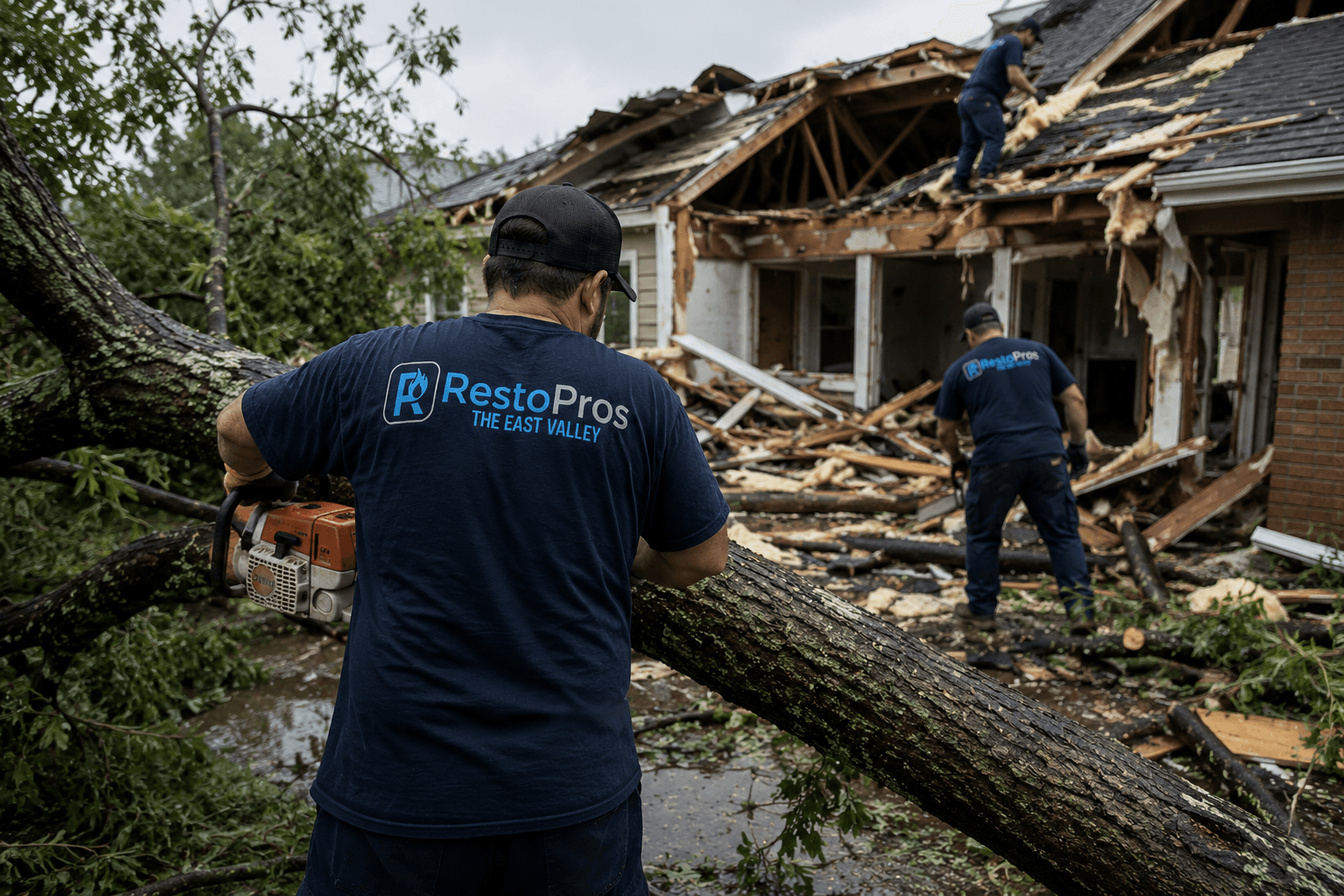
East Valley storms do most of their roof damage in a few minutes. A monsoon microburst lifts and cracks concrete tiles, a palm frond or tree limb punches through the deck, or hail chips a foam roof down to the substrate. When the rain stops, the damage is still open to the sky, and the next storm may be only a day away.
An emergency roof tarp is the step between the damage and the permanent repair. Done properly, it keeps water out of the attic, ceilings and walls while the claim is filed and the roof is repaired. Done badly, it blows off in the next gust or adds new holes to the roof. This guide explains when you need one, how it should be installed, and what to expect.
Key Takeaways
- Tarp any roof opening, missing or broken tiles over exposed underlayment, or damage you can see from inside the attic, as soon as it is safe.
- Do not climb onto a wet, damaged or steep roof yourself. Tile roofs break under foot, and falls are the real risk.
- A proper tarp extends well past the damage, runs over the ridge when possible, and is fastened through wood battens rather than nailed straight through.
- Arizona sun breaks down plastic tarps quickly, so treat a tarp as a temporary fix measured in weeks, not months.
- Most homeowners policies expect you to prevent further damage, and the cost of emergency tarping is commonly included in a covered storm claim.
When Does a Roof Need an Emergency Tarp?
Not every storm-damaged roof needs a tarp, but these signs mean water has a way in:
- A hole or crack through the roof deck from a branch, debris or a fallen tree.
- Missing, slipped or broken tiles that expose the underlayment, especially if the underlayment is torn.
- Missing shingles or exposed nail lines on a shingle roof.
- Punctures, gouges or exposed foam on a spray foam flat roof.
- Lifted or damaged flashing around vents, chimneys, skylights or rooftop AC units.
- Daylight visible from the attic, or wet insulation and decking in the attic.
- A new ceiling stain, drip or bulge after the storm.
If water is already coming through a ceiling, the inside of the house is now part of the job too. Our guide to ceiling water damage covers what happens next, and a sagging ceiling should be treated as a hazard: keep people out from under it.
Why Arizona Roofs Need Different Handling
Most guides to roof tarping assume asphalt shingles. East Valley homes are mostly concrete or clay tile and low-slope foam roofs, and each one changes the job.
Tile Roofs
Concrete and clay tiles crack under foot, so walking a tile roof the wrong way can break more tiles than the storm did. The tiles themselves often are not the waterproofing layer. The underlayment beneath them is. That means a few slipped tiles over intact underlayment may not leak right away, while one broken tile over torn underlayment will. Tarping a tile roof usually means setting the tarp over the tiles with weighted or battened edges, rather than nailing through them, and working from walk boards or the batten lines to avoid new breakage.
Spray Foam Flat Roofs
Foam roofs are common on older Mesa and Tempe homes and on additions. Hail and debris can puncture the protective coating and the foam beneath it, and ponding water finds those holes. A small puncture can sometimes be sealed temporarily. Larger damage is covered with a tarp that is weighted or fastened at the edges, since nailing through foam creates new leak paths.
Shingle Roofs
Shingle roofs are the most straightforward to tarp. The tarp runs over the ridge and is secured with wood battens screwed through the tarp edges into the roof, so wind cannot get underneath.
How a Roof Tarp Should Be Installed
Whether you hire it out or are checking someone else's work, a proper emergency tarp has these features:
- A heavy-duty, UV-resistant tarp large enough to extend several feet past the damage on every side.
- Coverage over the ridge where possible, so water running down the roof goes over the tarp instead of under it.
- Edges rolled around wood battens, and the battens fastened to the roof, so wind load is spread across a board instead of a few grommets.
- As few new fasteners as possible, with each one placed where it will be covered by the repair later.
- On tile and foam roofs, weighted or batten-secured edges instead of nails through tiles or foam.
- No loose flaps. A tarp that can catch wind will lift, tear or peel off in the next storm.
- Photos of the damage before the tarp goes on, and of the finished tarp.
If the roof is steep, wet, tiled or structurally damaged, leave this to a professional crew with fall protection. Many roof injuries happen to homeowners trying to cover damage themselves.
How Long Does a Roof Tarp Last in Arizona?
Not long. Ultraviolet light breaks down standard plastic tarps, and the East Valley gets a great deal of it. Cheap blue tarps can become brittle and start shredding within weeks in summer, and wind accelerates the wear. Heavier UV-resistant tarps last longer, but every tarp should be treated as temporary.
Check the tarp after every storm and every few days in high wind. Look for lifted edges, torn grommets, sagging that collects water, and battens that have pulled loose. If the permanent repair is going to take more than a few weeks, ask whether the tarp needs to be replaced or upgraded.
What Emergency Roof Tarping Costs
Price depends on the size and location of the damage, roof pitch and height, roof type, and whether it is an after-hours call during a storm. A small tarp on a single-story roof costs far less than covering a large section of a two-story tile roof at night. Our storm damage restoration cost guide for Arizona breaks down tarping, board-up and water extraction as separate scopes. Ask for the tarping charge in writing, and ask whether it is billed separately from any later repair.
Roof Tarping and Your Insurance Claim
Homeowners policies generally require you to take reasonable steps to protect the property from further damage after a loss. An emergency tarp is the textbook example. Water that gets in because a damaged roof was left open can be treated as a separate, avoidable loss, which is the last argument you want to have with an adjuster.
- Photograph and video the damage from the ground, from the attic, and from the roof if someone can safely do it, before the tarp goes on.
- Report the claim promptly, and tell the insurer you are arranging emergency protection.
- Keep the invoice and photos for the tarping. It is commonly reimbursed as part of a covered storm claim.
- Do not wait for the adjuster to see the roof before tarping. Photographs document the damage, and the policy expects you to prevent more of it.
- Keep any debris that caused the damage, such as a limb or a piece of a neighbor's roof, until the adjuster has seen it or photos are on file.
If water got in at ground level as well, the claim may involve two policies. Our guide on flood damage cleanup explains how wind-driven rain and rising water are treated differently.
Inside the House: What to Do While the Roof Is Tarped
A tarp stops new water. It does not dry the water that already got in. Wet attic insulation, roof decking, ceiling drywall and wall cavities can hold moisture for days, and mold can start growing on wet materials within 24 to 48 hours. Our guide to roof leak water damage covers what happens inside. In short: move belongings away from leaks, catch drips, turn off power to light fixtures in wet ceilings, and have moisture measured in the attic and ceilings rather than judging by touch.
Choosing Who Tarps Your Roof
After a big storm, door knockers and out-of-area crews often show up offering same-day tarps and roof replacements. Some are legitimate. Some are not. A few checks protect you:
- Check any contractor's license with the Arizona Registrar of Contractors before work starts.
- Get the scope and price of the tarping in writing.
- Do not sign anything that assigns your insurance benefits or commits you to a full roof replacement just to get a tarp.
- Ask for before-and-after photos of the roof.
- Be wary of large upfront payments in cash.
Frequently Asked Questions
How soon should a storm-damaged roof be tarped?
As soon as it is safe to get on the roof, ideally within hours of the storm and before the next rain. In monsoon season, storms often come in clusters, so a roof left open for even a day or two can let in much more water.
Can I tarp my own roof?
On a low, dry, single-story shingle roof, some homeowners do. On tile, foam, steep or wet roofs, it is safer to hire a crew. Tile breaks under foot, foam is easily punctured, and falls from roofs cause serious injuries every storm season.
How long can a tarp stay on a roof in Arizona?
Treat it as a fix measured in weeks. Arizona's UV breaks down standard plastic tarps quickly, and wind wears them further. Check the tarp after every storm and replace it if the permanent repair is delayed.
Does homeowners insurance pay for emergency roof tarping?
When the roof damage is from a covered event such as wind, hail or a falling tree, emergency tarping is commonly reimbursed as part of the claim, because policies expect you to prevent further damage. Keep the invoice and photos.
Should I wait for the insurance adjuster before tarping?
No. Photograph the damage thoroughly, then tarp it. Waiting can let more water in, and that additional damage may be disputed as avoidable.
Can a tarp go on a tile roof without breaking more tiles?
Yes, with the right method. Crews work from walk boards or along the batten lines, set the tarp over the tiles, and secure the edges with weights or battens instead of nailing through the tile.
Storm Damage to Your Roof? Call Now
RestoPros of the East Valley provides 24/7 emergency roof tarping, board-up and water extraction after storms, and dries out the attic, ceilings and walls so the damage stops where it is. Learn more about our storm damage restoration service.
We respond to storm damage in Gilbert, Chandler, Tempe and Mesa. Inspections are free and we work directly with your insurance company. Call (520) 482-3900.