
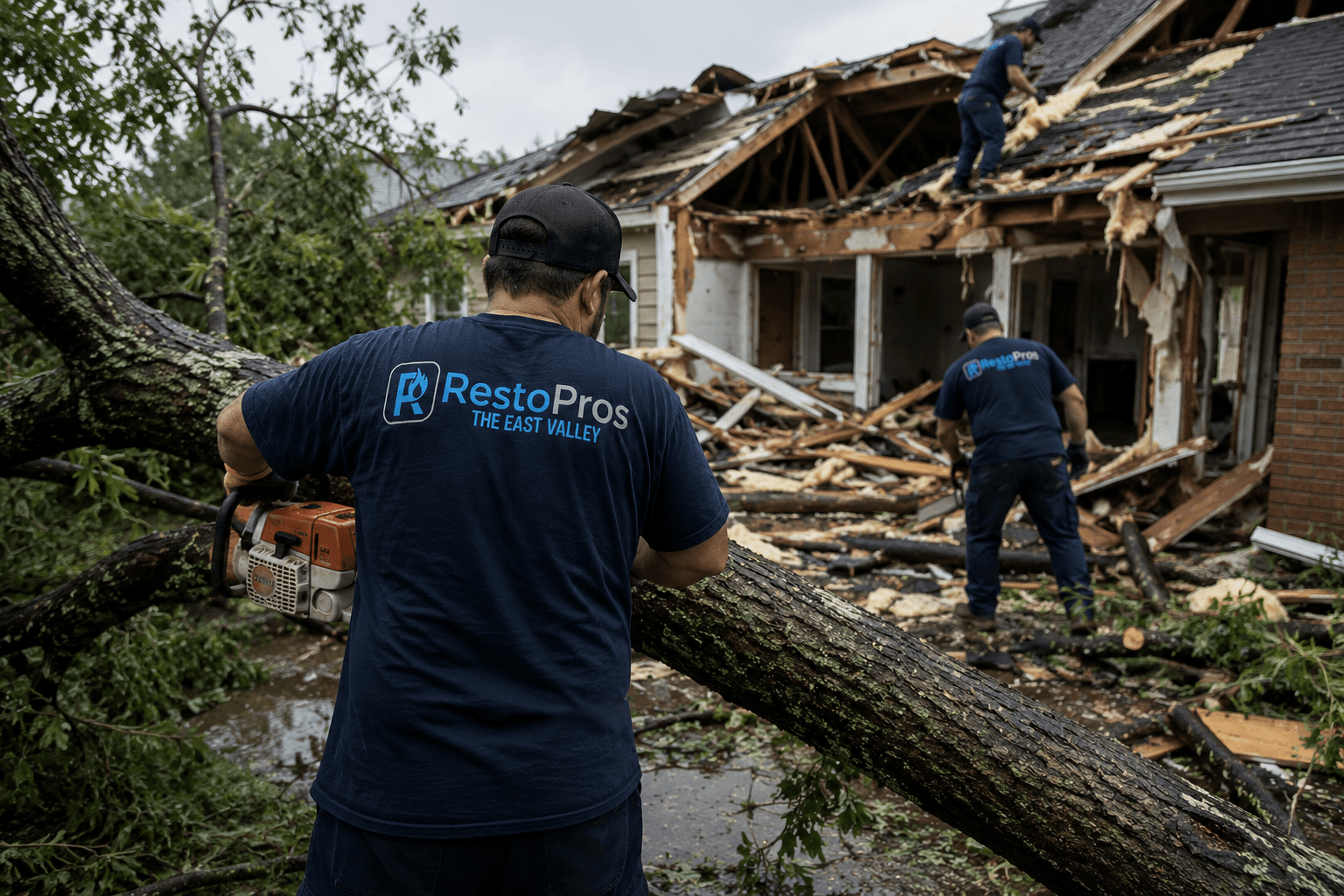
Search for storm damage restoration cost and almost everything that comes back was written about hurricanes. The ranges run from a few thousand dollars to six figures, the photos show water up the front door, and none of it describes what happens in Mesa at eleven at night in August when a microburst takes half the tiles off a roof and leaves the underlayment open to the next cell.
Arizona storms bill differently because they damage differently. There is rarely standing water through the whole house. Instead there is a wind event lasting ten minutes, an opening somewhere in the roof or envelope, water that enters through that opening, and dust driven into everything the wind reached. Those are four separate scopes with four separate prices, and knowing which ones apply to you is the difference between a useful budget and a guess.
Key Takeaways
- Storm damage is priced as separate scopes — emergency stabilization, water damage, structural repair, dust and contents — not as one square-foot number.
- Emergency tarping and board-up are the cheapest phase and the one that most affects the final total, because an open roof in monsoon season invites a second loss.
- Wind damage to a roof commonly runs a few hundred dollars to several thousand, but on Arizona tile and foam roofs the underlayment underneath is what actually decides the number.
- Dust is a genuine line item here that national cost guides never mention, and it lands in attic insulation and the HVAC system rather than on visible surfaces.
- Wind and hail are typically covered perils; flooding from a wash or street runoff is typically excluded and needs separate flood coverage.
Why National Storm Damage Averages Do Not Fit Arizona
The published averages are built mostly on hurricane and severe-weather claims in the Southeast and Midwest, where the dominant loss is prolonged water intrusion across a large footprint. A monsoon microburst produces a short, violent wind event over a small area, which concentrates damage in the roof, the north or west elevation, carports, and anything the wind could pick up and throw.
The wind speeds involved are not trivial. East Valley microbursts have been measured with gusts in the 68 to 80 mph range, enough to strip roofing and flatten carports. During one August 2025 storm, carports at a Mesa RV resort were torn off onto parked vehicles and tens of thousands of customers lost power. A storm like that generates dozens of claims in one neighborhood and almost none two miles away, which is exactly why an average is the wrong tool.
Our overview of how Arizona monsoon season affects East Valley homes covers the seasonal pattern. This guide is about what the repair bill is made of once the storm has already hit.
Scope One: Emergency Stabilization
This is the crew that arrives the same night. It is tarping the roof, boarding openings, removing the limb or carport panel that is still moving, and extracting whatever water came in before it spreads. Published ranges put emergency roof tarping in the low hundreds to under a thousand dollars for a typical residential job, and board-up in the low hundreds per opening. Removing a tree off a structure is the outlier, running from several hundred dollars to several thousand depending on size, access, and whether a crane is needed.
This is the smallest of the scopes and the one with the most leverage over everything after it. Arizona's monsoon runs from mid-June through the end of September, and storms arrive in clusters. A roof left open after Monday's cell is a much larger claim after Thursday's. If you take one thing from a cost guide, take this: pay for the tarp immediately, and do not wait for an adjuster to authorize it. Emergency mitigation to prevent further damage is a standard part of what policies expect you to do.
Scope Two: The Water That Followed the Wind
Once there is an opening, the storm becomes a water damage job and it is priced like one. National indexes put water damage restoration around $1,300 to $5,400 for a typical residential loss, roughly $3 to $7.50 per affected square foot, covering extraction, air movers, dehumidification, and moisture monitoring until the structure reads dry.
Storm water complicates the category question. Rain entering through a damaged roof is usually clean water, but rain that has run across a roof, through insulation, and down into a wall cavity picks up contaminants on the way, and anything that entered at ground level from a flooded street or wash is category three. That distinction drives how much material has to come out rather than be dried in place. Our guide to clean, gray and black water explains why, and our East Valley water damage cost breakdown gives the local numbers in detail.
Scope Three: Roof and Envelope Repair
Repairing wind damage to a roof commonly runs from a couple of hundred dollars for a handful of shingles up to several thousand for widespread damage, and Arizona roof construction shifts where that lands. On a concrete tile roof the tiles are the rain shield, but the underlayment is the waterproofing, and underlayment has a shorter service life than the tile above it. Wind that breaks or lifts tiles exposes underlayment that may already be at the end of its life, which is how a twenty-tile repair turns into an underlayment conversation.
Low-slope and flat foam roofs behave differently again. Wind rarely peels intact foam, but it drives debris into the coating, and a punctured coating lets water track laterally a long way from the entry point. That is why the wet spot on a ceiling is often nowhere near the actual hole, and why a roofer who patches only what is visible from inside is guessing.
Everything downstream of the roof is priced separately: drywall and ceiling repair, insulation replacement, paint, and any framing that stayed wet long enough to matter. Our post on roof leaks and the water damage they cause in Mesa walks through how far water travels from a small opening before anyone sees a stain.
Scope Four: Dust, the Arizona Line Item
No national storm cost guide has a line for dust, and in the Valley it is often the scope homeowners are angriest about three weeks later. A haboob pushes fine silt through roof vents, weep holes, door sweeps, and any opening the wind just created. It settles in attic insulation, inside wall cavities, and through the return side of the HVAC system. Our breakdown of what dust storms actually do to East Valley homes covers the mechanism in full.
The cost consequence is simple: cleaning visible surfaces is cheap, and cleaning the places the dust actually went is not. Duct cleaning, filter replacement, and in bad cases removal and replacement of contaminated blown-in insulation are real line items. A storm estimate that covers only what you can see from the living room will be followed by a second conversation in October when the air conditioning still smells like dirt.
The Delayed Scope: Mold
Mold is not part of a storm estimate, which is precisely why it surprises people. A house that took water during a monsoon storm and was not dried properly can show growth within days, and monsoon weeks bring the one thing Arizona usually lacks, humidity, at the same time as the water. Our post on post-monsoon mold in Mesa, Chandler and Gilbert covers the timeline, and mold remediation costs in Arizona covers what it adds if it happens.
Coverage is the sharper issue. Many policies limit or exclude mold, and several will decline it outright if they conclude it resulted from delayed mitigation rather than from the storm itself. Documented, prompt drying is not just good practice, it is what keeps this scope inside the claim.
How Arizona Insurance Treats a Monsoon Claim
Wind and hail are named perils on most standard homeowners policies, so a microburst that damages the roof is usually a covered loss, subject to your deductible. Wind-driven rain is generally covered when the wind created the opening first, which is the common monsoon pattern. What is typically excluded is flooding, meaning water that arrives across the ground from a wash, a street, or saturated ground, and that requires separate flood coverage rather than a homeowners endorsement.
Two practical points. First, some Arizona policies carry a separate wind or hail deductible expressed as a percentage of the dwelling limit rather than a flat dollar figure, so check which one applies before you assume the claim is worth filing. Second, document before anyone cleans. Our guides to filing a restoration insurance claim in Arizona and what homeowners insurance covers for water damage cover the documentation that decides these files. This is general information, not coverage advice, and your policy language governs.
What Moves Your Number Up or Down
- How long the roof stayed open, which is the single biggest controllable factor.
- Roof type: tile with aged underlayment costs far more to make right than tile with recent underlayment.
- Whether water reached insulation and wall cavities, or stopped at the ceiling surface.
- Whether a tree or carport hit the structure, which adds demolition and framing to a cleanup job.
- How much dust entered, and whether the HVAC ran during or after the storm and distributed it.
- Whether one company handles mitigation and the rebuild, or you coordinate two contractors and the gap between them.
Questions That Make Two Storm Estimates Comparable
- Does this number include emergency tarping and board-up, or is that billed separately?
- Is structural drying included, and how will you verify the structure is dry rather than surface-dry?
- Does the scope include the roof repair itself, or does it stop at the interior?
- Is duct cleaning and attic insulation included if dust entered?
- Who documents the loss for my carrier, and will I get photos and moisture readings?
- Does this carry through the rebuild, or does it end at cleaned and dry?
Frequently Asked Questions
How much does storm damage restoration cost in Arizona?
There is no single figure, because a storm claim is several scopes billed separately. Emergency tarping and board-up typically land in the hundreds, water damage restoration commonly runs roughly $1,300 to $5,400, and roof and structural repair ranges from a few hundred dollars to well into five figures depending on what the wind actually did. Most East Valley monsoon claims cluster in the low-to-mid thousands, with the outliers driven by tree impact or an open roof that took a second storm.
Does homeowners insurance cover monsoon damage in Arizona?
Wind and hail are covered perils on most standard policies, so roof damage from a microburst and the rain that follows through the opening are usually covered, subject to your deductible. Flooding from a wash, street runoff or saturated ground is typically excluded and requires separate flood insurance. Check whether your policy applies a separate percentage-based wind or hail deductible, because it changes whether filing is worth it.
Should I tarp the roof before the adjuster sees it?
Yes. Policies generally expect you to take reasonable steps to prevent further damage, and an untarped roof during monsoon season almost guarantees more. Photograph and video the damage thoroughly first, keep the receipt for the emergency work, and the mitigation cost is normally part of the claim.
How long does storm damage restoration take?
Stabilization happens the same day. Structural drying typically runs three to five days, longer if water reached insulation or wall cavities. Roof and interior repairs depend on insurance approval, materials and city permitting, so a straightforward job is often two to four weeks end to end, while anything structural runs considerably longer.
Is dust damage from a haboob covered by insurance?
It depends on how the dust got in. Dust driven through an opening the storm created is generally treated as part of the covered loss. Dust that entered through normal gaps in an undamaged house is usually considered maintenance rather than a claim. Documenting the opening is what separates the two.
Do I need a separate roofer and restoration company?
Not necessarily, and there is a real cost to splitting them. When mitigation, interior repair and the rebuild sit with one company, nobody is arguing about whose scope the ceiling belongs to and there is no gap where the house sits open. Ask directly whether the estimate carries through reconstruction before you sign it.
Get a Storm Estimate Broken Into Its Actual Scopes
The number that matters is the one written against your house, itemized so you can see which scope each line belongs to. Our storm damage restoration team handles the whole sequence: emergency tarping and board-up, debris and tree removal, water extraction and structural drying, dust and HVAC cleanup, and the reconstruction afterwards, so nothing falls into the gap between two contractors.
We cover storm damage restoration in Mesa, Chandler and Gilbert, along with Tempe, Queen Creek and Apache Junction across Arizona's East Valley. Inspections are free, estimates are written line by line, and covered losses are billed directly to your carrier. Call (520) 482-3900.