
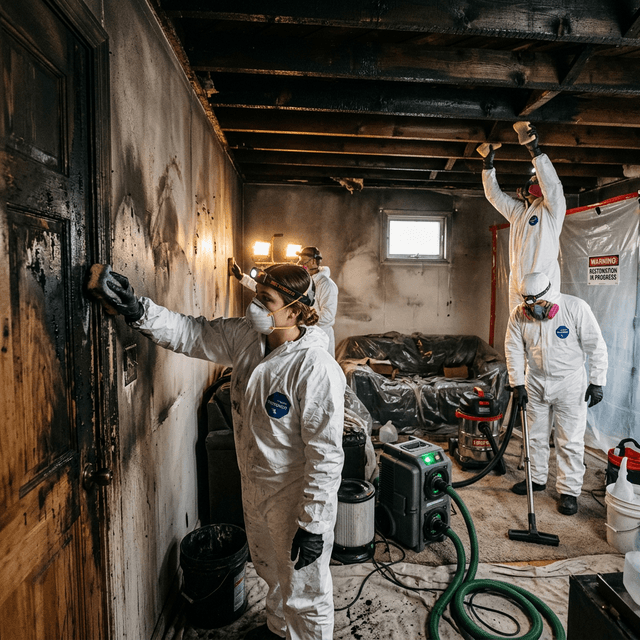
Look up the fire damage restoration cost and you will find one guide quoting a national average near $20,000 and another near $27,000, inside ranges that run from under $3,000 to past $50,000. Neither is wrong. The phrase covers a scorched stovetop wall cleaned in an afternoon and a house that has to be framed again, so the average lands somewhere neither homeowner will ever pay.
What actually helps is knowing that a fire produces four separate bills, not one. They are scoped at different times, paid at different times, and a quote that covers only the first two is not cheaper than a full one. Here is how the money breaks down, and the Arizona-specific line items that national cost guides leave out.
Key Takeaways
- A fire claim is four bills: emergency stabilization, smoke and odor work, contents, and reconstruction. The fourth usually dwarfs the other three.
- Published averages disagree by roughly $7,000 because severity, not square footage, sets the number.
- Smoke is priced separately from fire, and oily residue from a smoldering fire costs multiples of dry soot from a fast one.
- In the Valley, ductwork is a standard line item rather than an upsell, because the air handler distributes smoke through the whole house.
- Insurance usually pays mitigation and reconstruction in separate cheques, so the first payment looking small is normal, not a denial.
Why the Average Fire Damage Restoration Cost Misleads
A widely cited cost index updated in July 2026 puts fire and smoke restoration at a national average of about $20,470, within a range of roughly $2,900 to $38,325, and works out to something like $4.25 to $6.50 per square foot. Other guides ranking for the same search put the average nearer $27,000 with a ceiling past $51,000. When credible sources sit that far apart on the same question, the honest reading is that severity dominates everything else.
Square footage is the weakest predictor in the set. A contained kitchen fire in a 3,000 square foot house can cost less than a smoldering bedroom fire in a 1,400 square foot one, because what drives the number is how far the smoke travelled, what burned, how long firefighting water sat, and how much has to be rebuilt rather than cleaned.
Bill One: Stabilizing the House
This starts within hours and is the smallest of the four. It covers boarding openings, tarping the roof, and extracting the water the fire department left behind. That water matters more than homeowners expect: the same index prices water damage restoration at roughly $1,270 to $5,375, and emergency roof work in the $348 to $1,186 range.
Skipping or delaying this phase is how one claim becomes two. An opened roof between June and September in Arizona is an invitation to the next monsoon storm, and firefighting water sitting in a closed-up house in summer heat grows mold long before the rebuild is approved.
Bill Two: Smoke, Soot and Odor
Smoke is priced separately from fire, and it is where estimates diverge most. Soot removal commonly runs about $400 to $1,700, but the split inside that range is the real story: dry soot from a fast, hot fire runs roughly $400 to $700, while oily residue from a slow smouldering fire starts around $1,000 and climbs. Deodorization is its own line, with thermal fogging around $200 to $585 and ozone treatment around $235 to $465. Our breakdown of what professional smoke damage cleaning involves explains why the residue type changes the chemistry and the labour.
The common mistake is treating odor as the last five percent of the job. Odor is a symptom of residue still sitting somewhere nobody cleaned, usually inside the HVAC system, above the ceiling, or behind trim. If you are weighing what you can handle yourself first, getting smoke smell out of a house covers what genuinely works before you pay anyone.
Bill Three: Contents
Contents are quoted apart from the structure, and plenty of homeowners never realise that until the estimate arrives. The work is inventory, cleaning what can be saved, packing out what has to leave while the structure is worked on, and documenting what is a total loss for the claim. Furniture deodorizing alone runs from a couple of hundred dollars to about $1,000 on published indexes.
The decision that moves this number is cleaning versus replacing, and it is worth being unsentimental in both directions. Soft goods that absorbed oily smoke are usually a write-off. Hard goods, appliances and most furniture clean up well. A contractor who wants to write off everything is not saving you time, they are inflating a claim you will answer for.
Bill Four: Reconstruction
This is the one that dwarfs the rest, and the one that is impossible to price until demolition exposes what is behind the burned surfaces. Even individual components add up quickly: drywall repair around $250 to $605, insulation replacement around $2,130 to $6,700. Framing, wiring, cabinetry and finishes scale from there, which is why the post-fire reconstruction timeline runs in months rather than days on anything structural.
Two structural questions decide whether this bill is predictable. Does the same company handle both the cleanup and the rebuild, or are you hiring twice and coordinating the handoff yourself? And does the estimate account for bringing work up to current code, which is a separate coverage question on most policies?
The Arizona Line Items National Guides Miss
Ductwork comes first. Valley houses run the air handler most of the year, so a fire that starts in a kitchen has usually already distributed residue through every room with a supply vent. Duct cleaning runs roughly $275 to $490 on published indexes, and on a smoke job it is a standard line rather than an upsell. Cleaning painted walls while the system still holds residue guarantees the smell returns the first hot afternoon the AC kicks on.
Timing is the second. A fire in monsoon season leaves an opened roof exposed to storms, so tarping stops being a formality. Summer heat compounds it: a house without power, holding firefighting water, is a mold problem within days, and mold remediation is not part of a fire estimate.
Permits are the third. Reconstruction is permitted by your city, and Mesa, Chandler, Gilbert and Tempe each run their own building departments with their own queues. That is calendar time rather than a line item, but it shapes the schedule your insurer is reimbursing temporary housing against.
How Insurance Pays It, and Why the First Cheque Looks Small
Fire is a covered peril on standard homeowners policies, so the question is rarely whether you are covered, it is how the money arrives. Carriers typically approve and pay emergency mitigation separately from the rebuild, and hold back depreciation on the reconstruction until the work is actually done. The first payment landing well under your total is normal. Our explainer on how mitigation and restoration are billed as two phases walks through the sequence, and it works the same way after a fire.
Two things protect the number you end up with. Photograph everything before anyone cleans, because cleaning destroys the evidence of what the damage was. And keep receipts for temporary housing and essentials from day one, since additional living expenses are a separate part of the policy that homeowners routinely underclaim.
Questions That Make Two Fire Estimates Comparable
- Does this number include contents, or structure only?
- Is deodorization included, which method, and how will you verify the odor is gone rather than masked?
- Is HVAC and duct cleaning in the scope?
- Does this cover the rebuild, or does it stop at cleaned and dry?
- Who pulls the permits, you or me?
- What happens to the price if demolition exposes more damage, and will I see a revised written scope before that work starts?
Two estimates are only comparable once they cover the same four bills, because a fire damage restoration cost that stops at cleaned and dry is not the same product as one that carries through the rebuild. If you are still choosing between companies, the same logic that applies after water damage applies here: our guide to choosing a restoration company without regretting it covers the licensing, certification and paperwork checks worth ten minutes before you sign anything. Or call (520) 482-3900 and ask us these six questions directly.
Frequently Asked Questions
How much does fire damage restoration cost in Arizona?
Published national averages range from about $20,000 to $27,000, inside ranges spanning roughly $3,000 to $51,000, and Arizona sits inside those national ranges rather than apart from them. The spread is the useful part: minor smoke jobs land in the low thousands, while structural fires requiring reconstruction run well into five figures. Only an on-site inspection produces a number that means anything for your house.
Is smoke damage cheaper to fix than fire damage?
Usually, but not always. Cleaning and deodorization without structural damage commonly runs in the hundreds to low thousands. Oily residue from a smouldering fire that reached the HVAC system and soft goods throughout the house can cost more than a small, contained burn that never spread.
Does homeowners insurance cover fire damage restoration?
Fire is a covered peril on standard policies, so the structure, contents and additional living expenses are typically covered up to your limits and after your deductible. The friction is usually about scope and depreciation rather than coverage, which is why a detailed written scope and thorough photo documentation matter so much.
How long does fire damage restoration take?
Cleaning and deodorization on a contained fire often takes days to a couple of weeks. Anything requiring reconstruction runs in months, driven mostly by insurance approvals, permits and material lead times rather than by the building work itself.
Should I file a claim for a small kitchen fire?
Compare an honest written estimate against your deductible before deciding. A stovetop flare-up cleaned in an afternoon can land near a typical deductible, in which case a claim may not be worth filing. Get the estimate in writing regardless, because smoke that reached the ductwork is a bigger job than the wall suggests.
Does a house lose value after a fire?
Properly restored and documented, the long-term effect is usually small, and the documentation is what protects it. Keep the written scope, the clearance and verification records, and the permit history, because a future buyer's inspector will ask what was done and by whom.
Get a Fire Estimate Broken Into Its Four Parts
The fire damage restoration cost that matters is the one written against your house, itemised so you can see which of the four bills each number belongs to. Our fire and smoke damage restoration team handles all four: emergency board-up and tarping, soot and residue cleaning, air scrubbing and deodorization, contents pack-out, and the rebuild afterwards, so nothing falls into the gap between two contractors.
We cover fire damage restoration in Mesa, Tempe, Chandler and Gilbert, across Arizona's East Valley. Inspections are free, estimates are written line by line, and covered losses are billed directly to your carrier. Call (520) 482-3900.